Champs-Élysées, Paris
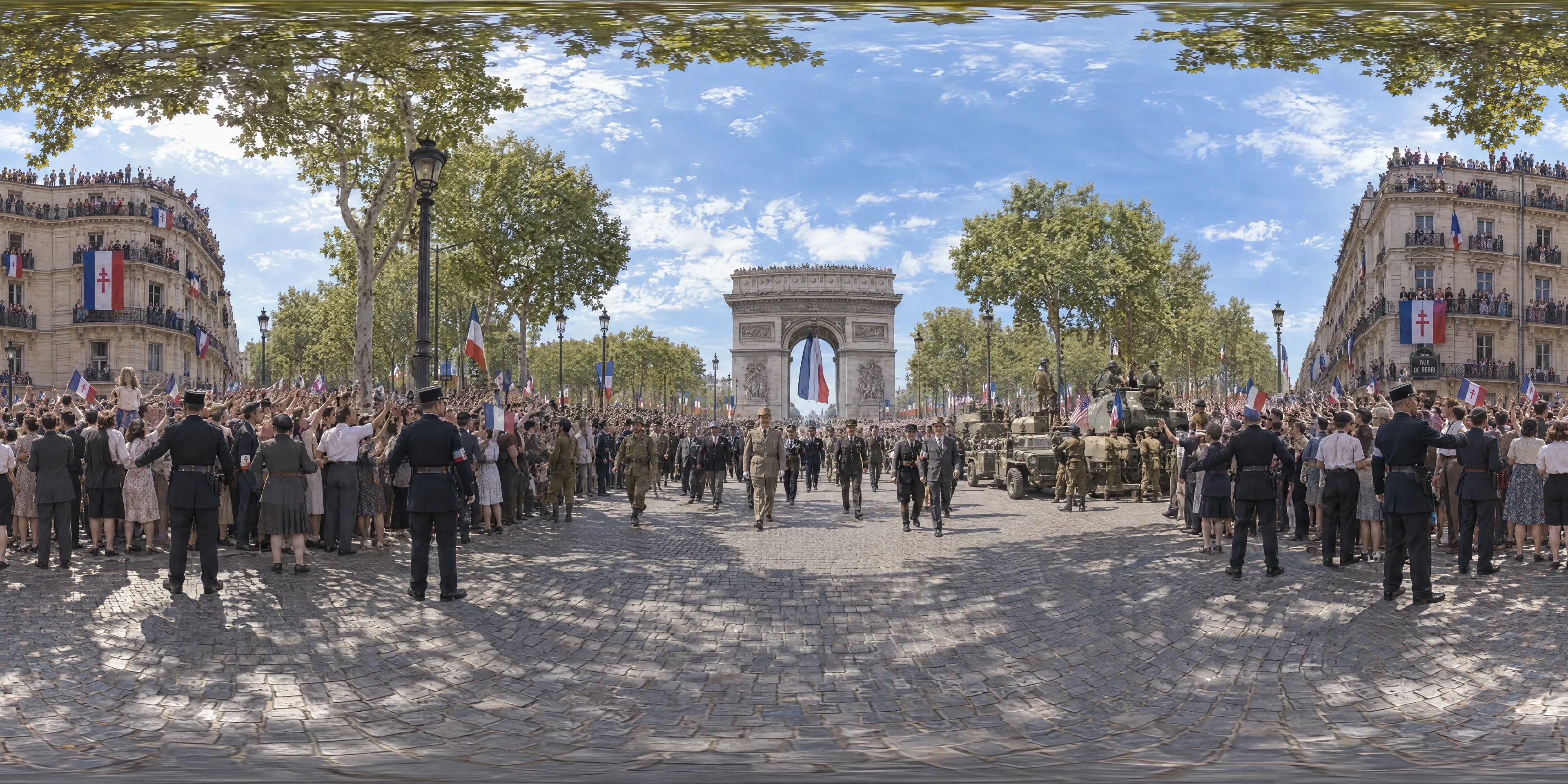
On the afternoon of 26 August 1944, the day after the German garrison surrendered, General de Gaulle rekindles the flame of the Unknown Soldier at the Arc de Triomphe and walks down the Champs-Élysées ahead of Leclerc and the Resistance leaders, through a crowd estimated at two million. The march seals his authority as head of liberated France.
- Year
- 1944
- Where
- Paris · FR
- Era
- modern_early
- Coordinates
- 48.871, 2.303
The moment
De Gaulle chose to walk
On the afternoon of Saturday 26 August 1944, the day after the German garrison surrendered, General Charles de Gaulle rekindled the flame of the Unknown Soldier beneath the Arc de Triomphe and set off down the Champs-Élysées on foot. He walked a few paces ahead of the others: Generals Leclerc, Koenig and Juin, Admiral d'Argenlieu, and the Resistance leaders Georges Bidault and Alexandre Parodi, with fighters of the French Forces of the Interior around them.
The Sherman tanks and half-tracks of Leclerc's 2nd Armoured Division lined the avenue. The crowd, estimated at two million, filled the pavements, the trees, the balconies and the roofs, waving tricolours and flags with the Cross of Lorraine. The cameraman Gaston Madru filmed the march.
Paris had risen before the tanks arrived
The city had begun its own liberation a week earlier. Railwaymen struck on 10 August, the police on the 15th, and a general strike followed on the 18th. On the morning of 19 August some 2,000 police officers of the Resistance seized the Prefecture of Police and raised the tricolour over it and over Notre-Dame. The next day insurgents took the Hôtel de Ville and removed its bust of Marshal Pétain.
The German garrison still numbered 16,000 to 20,000 men. At 9.22 pm on 24 August the first of Leclerc's troops reached the Hôtel de Ville: the 9th company of the Régiment de marche du Tchad, called La Nueve because most of its men were Spanish republicans, in half-tracks named after Civil War battles such as Teruel and Guadalajara. The great bell of Notre-Dame rang out. The next evening, at the Hôtel de Ville, de Gaulle hailed a Paris "liberated by itself, liberated by its people".
The celebration ended under fire
The day was not safe. Shots at the Place de la Concorde and outside Notre-Dame scattered the crowds, and inside the cathedral, without the organ, the congregation sang the Magnificat. Shortly before midnight German bombers struck the north and east of the city, killing between 189 and 200 people.
The fighting for Paris had cost lives on every side, and tallies differ. The historian Jean-François Muracciole estimates some 3,400 French and German dead and 5,500 wounded. Reprisals against suspected collaborators followed.
Why every French pupil knows this walk
The march down the Champs-Élysées is the image of France's return to freedom, the one every French pupil connects with the end of the Occupation. It also sealed de Gaulle's authority as head of liberated France.
For decades his story overshadowed others: the Communist-led fighters of Colonel Rol-Tanguy, the Allied armies, and the Spaniards of La Nueve. Paris has since made room for them. A garden in the city now bears the name of the fighters of La Nueve, and the Musée de la Libération de Paris opened at Denfert-Rochereau, above the underground command post from which Rol-Tanguy directed the insurrection.
Sources
Further reading
Tagged
- france
- paris
- liberation
- de-gaulle
- second-world-war
- 2e-db
- champs-elysees
- 20th-century
Published
See also

1939
Lower Wenceslas Square, Prague
On the morning of 15 March 1939, in a heavy fall of wet snow, German columns roll down Wenceslas Square as Hitler's troops occupy what remains of Czechoslovakia. Thousands of Praguers watch from the pavements, weeping, booing and singing the national anthem; that evening Hitler reaches Prague Castle, and the next day he proclaims the Protectorate of Bohemia and Moravia.

1918
Wenceslas Square, Prague
Late in the morning of 28 October 1918, as news spreads that Austria-Hungary has accepted President Wilson's terms, crowds pour onto Wenceslas Square and the priest Isidor Zahradník proclaims an independent Czechoslovak state at the St Wenceslas monument. That evening the National Committee passes the new republic's first law.

1939
Westerplatte, Gdańsk
At 4:45 on Friday 1 September 1939 the German training battleship Schleswig-Holstein, moored in the Gdańsk harbour channel, opens fire on the Polish Military Transit Depot at Westerplatte, the first shots of the Second World War in Europe. The 182 defenders, expected to hold for up to twelve hours, hold out for seven days.