Cibeles Fountain and the Salón del Prado, Madrid
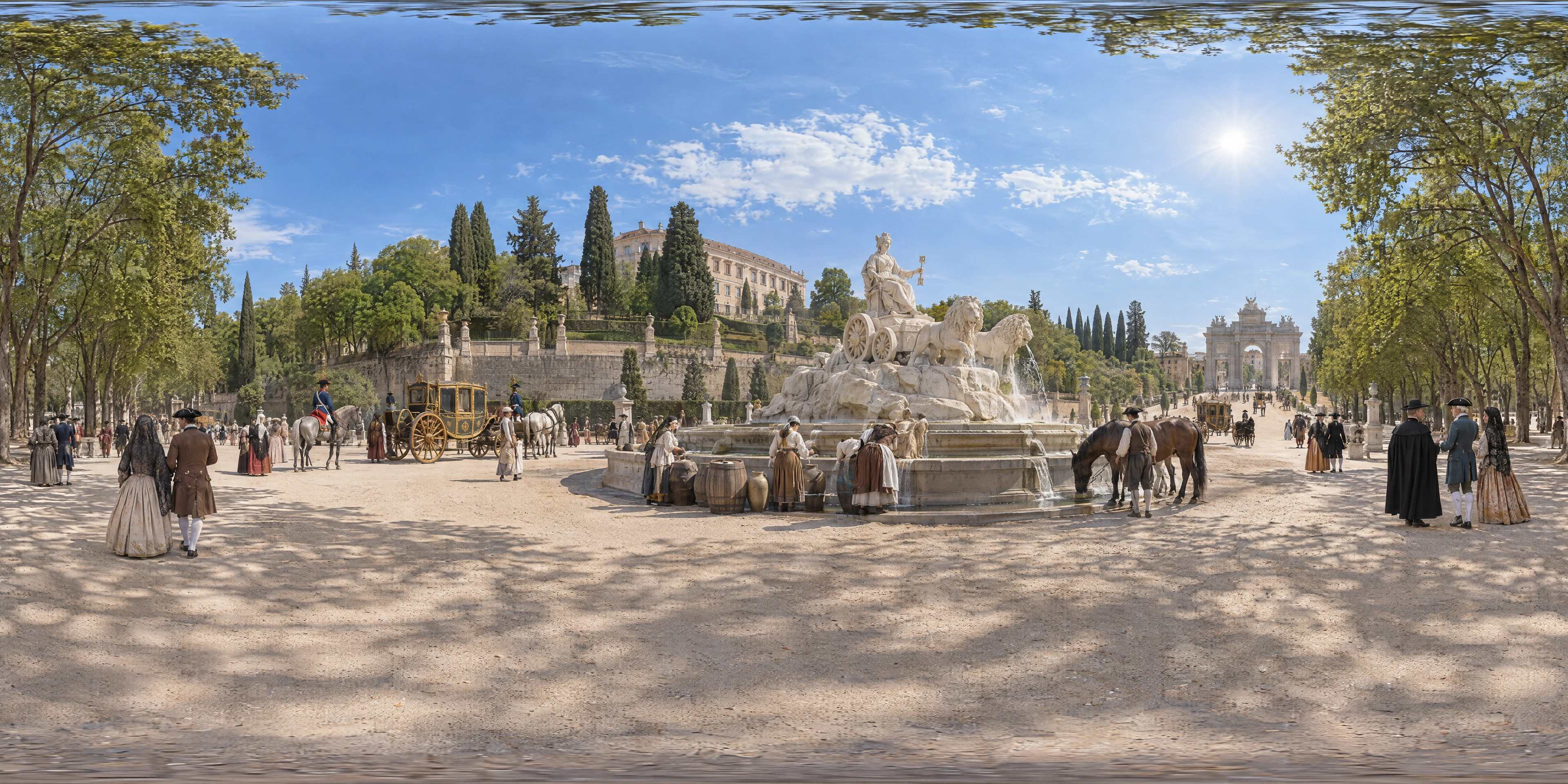
In the 1790s water finally flows from Ventura Rodríguez's Cibeles fountain, set up in 1782 at the head of the Salón del Prado, the tree-lined promenade Charles III laid out to beautify his capital. Water-carriers fill their jars at one spout, the public at the other, and carriages parade toward the Neptune fountain.
- Year
- 1790s
- Where
- Castile (Madrid) · ES
- Era
- Early modern
- Coordinates
- 40.419, -3.694
The moment
Ten years before the water came
The Cibeles fountain was set up in 1782 at the northern head of the Salón del Prado, beside the grounds of the Buenavista palace. It did not run until 1792.
Ventura Rodríguez designed it, and it was built between 1777 and 1782. Francisco Gutiérrez carved the goddess, and the Frenchman Roberto Michel the two lions. The figures are cut from a greyish-violet marble quarried at Montesclaros, in the province of Toledo, and the rest from stone brought from Redueña, north of Madrid.
Cybele sits crowned with city walls, holding a sceptre and a key. The lions have a story of their own: in the myth they are Hippomenes and Atalanta, turned into beasts for profaning her temple and condemned to pull her chariot.
One spout for the water-carriers, one for everyone else
The fountain was built to be used. It had two plain spouts. From one, the city's official water-carriers, most of them Asturians and Galicians, filled the barrels and jars they carried up to Madrid's houses. The other was for the public.
In the 1790s the goddess did not yet stand in the middle of a square. She stood at the side of the promenade and looked south, down the avenue of trees toward the Neptune fountain at its other end.
A king's promenade on the edge of town
The Salón del Prado was Charles III's showpiece, the tree-lined promenade he laid out on the eastern edge of the city to beautify his capital. Carriages paraded up and down it, and so did the city: majos in short jackets, majas in mantillas, gentlemen in French-cut coats, officers and clergy.
Up the slope of the Calle de Alcalá stood Sabatini's Puerta de Alcalá, finished in 1778 and still a working gate of the city. Madrileños still call Charles III the best mayor Madrid ever had.
Real Madrid's titles end at her feet
In February 1895 the fountain was moved into the middle of the square, raised on a platform and turned to face the Calle de Alcalá. Today the Bank of Spain, the Palacio de Linares and the vast Palacio de Comunicaciones surround it.
During the Civil War the Republican authorities buried the goddess under sandbags and a brick pyramid to protect her from the bombing.
Cibeles is now the emblem of the city and its party square. Fans have celebrated here at least since 1962, when Atlético de Madrid won the European Cup Winners' Cup, and from the late 1980s Real Madrid made the fountain its own; Atlético now goes to Neptune.
One legend has outlived every trophy. Madrileños like to say that if thieves ever broke into the Bank of Spain's gold vault, 35 metres below ground next door, the fountain's water would flood it.
Sources
Further reading
Tagged
- spain
- madrid
- enlightenment
- charles-iii
- salon-del-prado
- fountain
- goya
- everyday-life
Published
See also

1618
Prague Castle (Ludwig Wing)
On May 23, 1618, Bohemian Protestant nobles throw two imperial Catholic regents out of the upper window of the Ludwig Wing of Prague Castle, triggering the Thirty Years' War.

1650s
Tōkaidō road, Mt. Fuji
Around 1650 AD, a daimyō and his retinue of 2,000 retainers march along the Tōkaidō road past Mt. Fuji on the mandatory alternate-year residence journey to Edo: the Tokugawa shogunate's masterstroke of social control.

1640s
Taj Mahal under construction, Agra
Around 1640, the white marble dome of the Taj Mahal rises on its riverside platform at Agra: some twenty thousand workers and a thousand elephants raising Shah Jahan's tomb for his wife Mumtaz Mahal, partway through a project that will take more than twenty years.