Cologne Cathedral
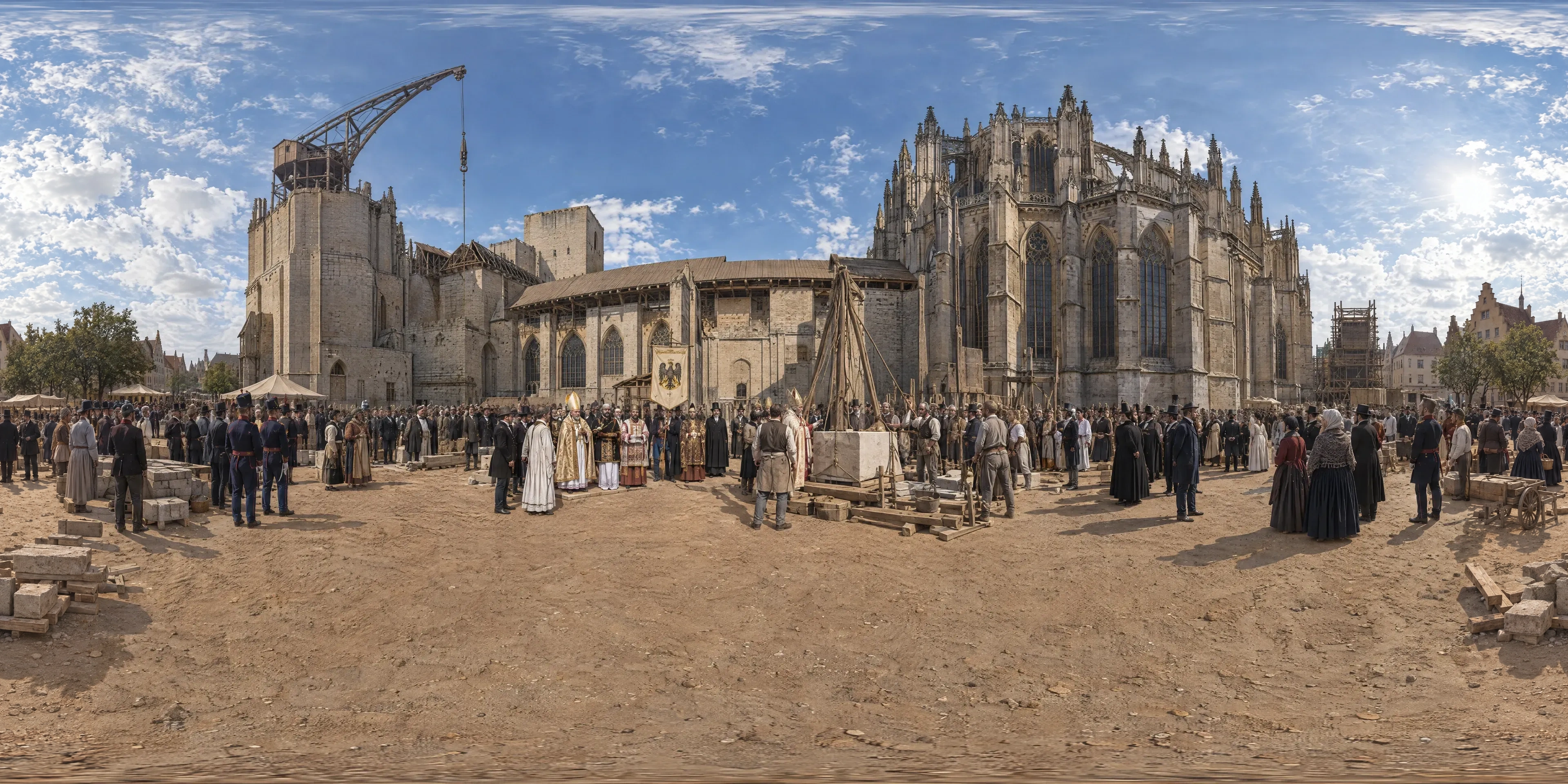
On 4 September 1842 King Frederick William IV of Prussia and the coadjutor Johannes von Geissel lay the foundation stone for completing Cologne Cathedral, a torso for almost three centuries with a medieval crane on its unfinished south tower. Funded by donors across Germany, the work becomes a national project and is finished in 1880.
- Year
- 1842
- Where
- Rhineland (Prussian Rhine Province) · DE
- Era
- Industrial
- Coordinates
- 50.941, 6.958
The moment
A torso with a crane on top
Cologne Cathedral was begun in 1248, and its choir was finished in 1322. Building then crept westward until 1473, when work on the south tower stopped at the level of the belfry. Around 1560 construction ceased altogether.
For almost three centuries the city lived with a torso. The Gothic choir, with its tall traceried windows, flying buttresses and pinnacles, stood at full height. The nave and transept reached only about half their planned height under makeshift roofs, and the north tower was a low stump.
On the stump of the south tower, about 59 metres up, stood a medieval wooden crane more than 25 metres tall. It stayed there for four hundred years and became part of the city's skyline.
A Protestant king, a Catholic stone
On 4 September 1842 the Prussian king Frederick William IV and the coadjutor Johannes von Geissel laid the foundation stone for completing the cathedral. The stone was to be hoisted up to the south tower and walled in there.
The coadjutor stood in for an archbishop sidelined by the state. Clemens August Droste zu Vischering had been arrested by Prussia in 1837, in a quarrel over mixed marriages, and Geissel, named coadjutor in 1841, had taken over the running of the archdiocese in March 1842. The cathedral gave the Protestant king and his Catholic Rhineland a cause they could share.
That year also saw the founding of the Central Cathedral Building Society, which raised money from donors across Germany.
The tallest building in the world, for four years
Completion took 38 years. The transept facades were finished in 1855, and on 15 October 1880 the cathedral was complete. Its twin spires, 157 metres high, made it the tallest building in the world until the Washington Monument overtook it in 1884.
The celebration had a sour note. The completion had become a symbol of Prussian-led national unity, and in 1880, in the middle of the Kulturkampf, the Catholic archbishop stayed away.
Why Germans treat it as their own
Cologne Cathedral is Germany's most visited landmark, drawing an average of six million people a year, and a UNESCO World Heritage Site since 1996. It came through the Second World War despite fourteen hits by aerial bombs.
Its completion was the great national project of the nineteenth century. Paid for by donors across the country, it was begun almost three decades before there was a German state, and it brought Germans of every class and both confessions behind a single building.
Sources
Further reading
Tagged
- germany
- cologne
- cathedral
- gothic
- prussia
- 19th-century
- national-monument
- unesco
Published
See also

1886
Neuschwanstein Castle
Before dawn on 10 June 1886 a government commission arrives at Neuschwanstein to take King Ludwig II, just declared unfit to rule, into custody; gendarmes loyal to the king bar the gate of his unfinished castle, and after half an hour in the rain the commissioners must turn back. Three days later Ludwig is dead in Lake Starnberg.

1869
Court Opera on the Ringstraße, Vienna
On the evening of 25 May 1869 Emperor Franz Joseph opens the new Court Opera, the first great public building on Vienna's Ringstraße, with Mozart's Don Giovanni sung in German. Neither of its architects lives to see the night: both died in 1868, after Viennese mockery of the 'sunken box'.

1897
Giant Ferris Wheel, Prater, Vienna
On 3 July 1897, a hot summer day, Vienna's Giant Ferris Wheel opens in the Prater, built by English engineers for the jubilee of Emperor Franz Joseph's 50 years on the throne. Its 30 cabins turn up to 64.75 m above the canals of the 'Venice in Vienna' pleasure park, making it one of the largest wheels in the world; a ride costs a gulden.