Neuschwanstein Castle
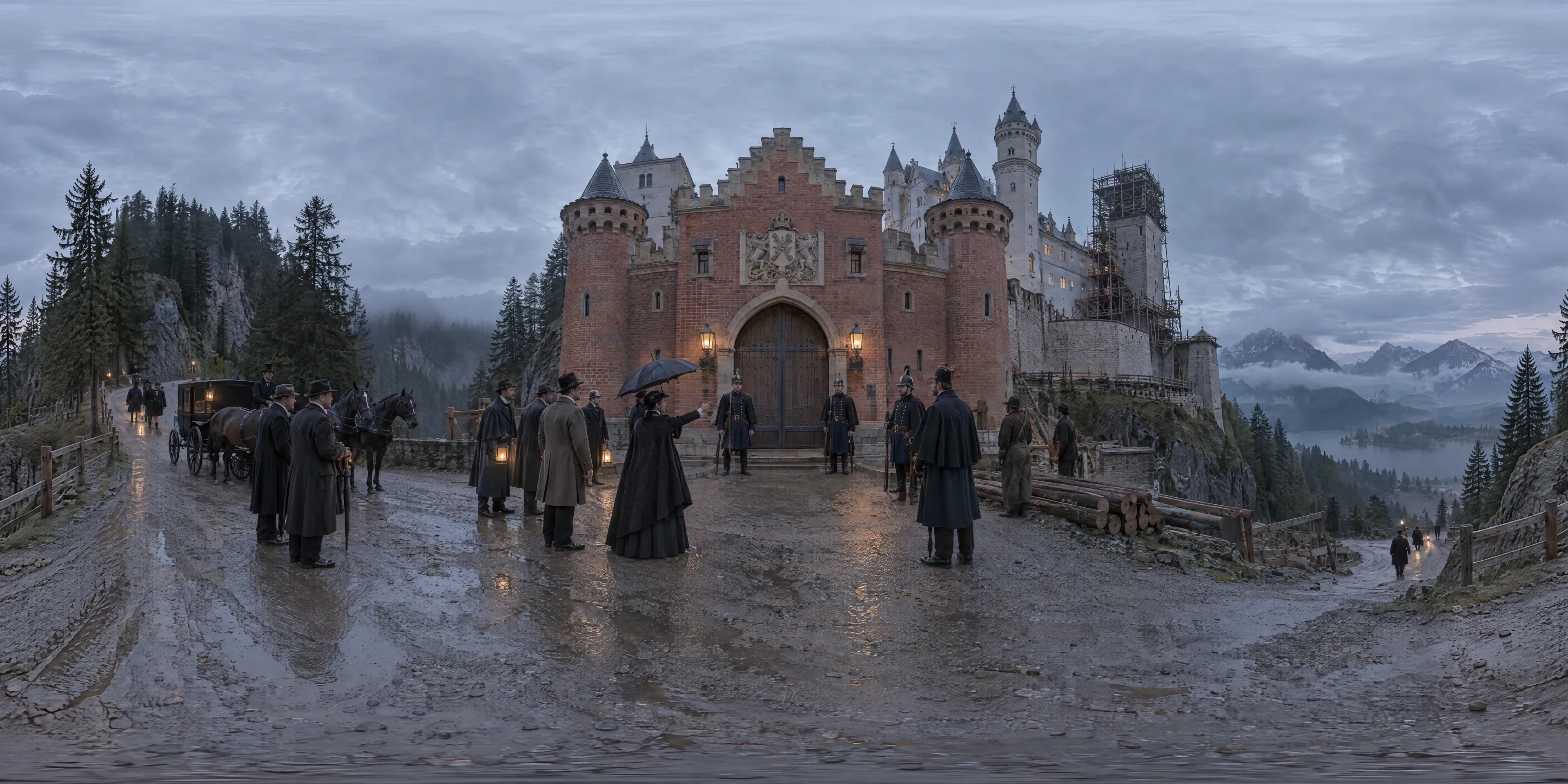
Before dawn on 10 June 1886 a government commission arrives at Neuschwanstein to take King Ludwig II, just declared unfit to rule, into custody; gendarmes loyal to the king bar the gate of his unfinished castle, and after half an hour in the rain the commissioners must turn back. Three days later Ludwig is dead in Lake Starnberg.
- Year
- 1886
- Where
- Bavaria (Allgäu) · DE
- Era
- Industrial
- Coordinates
- 47.558, 10.751
The moment
Stopped at the gate
In the rain, in the night before 10 June 1886, an eleven-man government commission arrived at Neuschwanstein to take King Ludwig II of Bavaria into custody. On 9 June four psychiatrists, among them Bernhard von Gudden, had declared him unfit to rule on the strength of witness statements, without examining him.
A coachman warned the king, who had local gendarmes occupy the castle gate. The commission, which included the foreign minister Friedrich Krafft von Crailsheim and Count Maximilian von Holnstein, was refused entry. Baroness Spera von Truchseß appeared, abused the commissioners and threatened them with her umbrella. After half an hour, at about half past four in the morning, they turned back.
Ludwig then had them arrested and locked in the gatehouse. They were released without his knowledge once the proclamation of the regency reached the telegraph office in Hohenschwangau. Prince Luitpold had taken over as regent that same day.
Three days to Lake Starnberg
A second commission, with Gudden, arrived around midnight on 11 June. At four in the morning on 12 June the king was taken to Berg Castle on Lake Starnberg.
On the evening of 13 June he went for a walk by the lake with Gudden. Both were found dead in the shallow water, no more than 25 paces from the shore. How they died has never been explained.
A castle half built
The castle the king defended was unfinished. The foundation stone had been laid on 5 September 1869. The gatehouse, of red brick with a stepped gable, was finished first, and Ludwig lived in its upper storey before moving into the unfinished palace in 1884.
By June 1886 the white limestone palace was roofed and complete outside, with a slender north stair tower about 65 metres high. The square tower was still in scaffolding, the bower had not been started, and the great keep existed only as foundations. In all, Ludwig spent just 172 days in the castle.
He built it as a stage for his imagination. Its models were Wagner's operas, above all Tannhäuser and Lohengrin, and the Wartburg near Eisenach.
Why the fairy-tale castle is Bavaria's
Neuschwanstein opened to the public within weeks of the king's death. It now receives almost 1.5 million visitors a year, more than 61 million since it opened. In July 2025 it was inscribed on the UNESCO World Heritage List together with Linderhof, Herrenchiemsee and the king's house on the Schachen.
For Bavarians the castle and the king cannot be separated. Ludwig, deposed on psychiatric grounds that are still debated and dead three days after that night at the gate, remains the most beloved and mysterious of their monarchs.
Sources
Further reading
Tagged
- germany
- bavaria
- neuschwanstein
- ludwig-ii
- castle
- 19th-century
- romanticism
- alps
Published
See also

1810
Theresienwiese, Munich
On 17 October 1810 a horse race on a meadow outside Munich crowns the celebrations for the wedding of Crown Prince Ludwig of Bavaria and Princess Therese of Saxe-Hildburghausen; 50,000 spectators watch from the hillside, and the field is named Theresienwiese after the bride. Repeated the next year, the race becomes the Oktoberfest.

1869
Court Opera on the Ringstraße, Vienna
On the evening of 25 May 1869 Emperor Franz Joseph opens the new Court Opera, the first great public building on Vienna's Ringstraße, with Mozart's Don Giovanni sung in German. Neither of its architects lives to see the night: both died in 1868, after Viennese mockery of the 'sunken box'.

1897
Giant Ferris Wheel, Prater, Vienna
On 3 July 1897, a hot summer day, Vienna's Giant Ferris Wheel opens in the Prater, built by English engineers for the jubilee of Emperor Franz Joseph's 50 years on the throne. Its 30 cabins turn up to 64.75 m above the canals of the 'Venice in Vienna' pleasure park, making it one of the largest wheels in the world; a ride costs a gulden.