Jan Palach Square, Prague
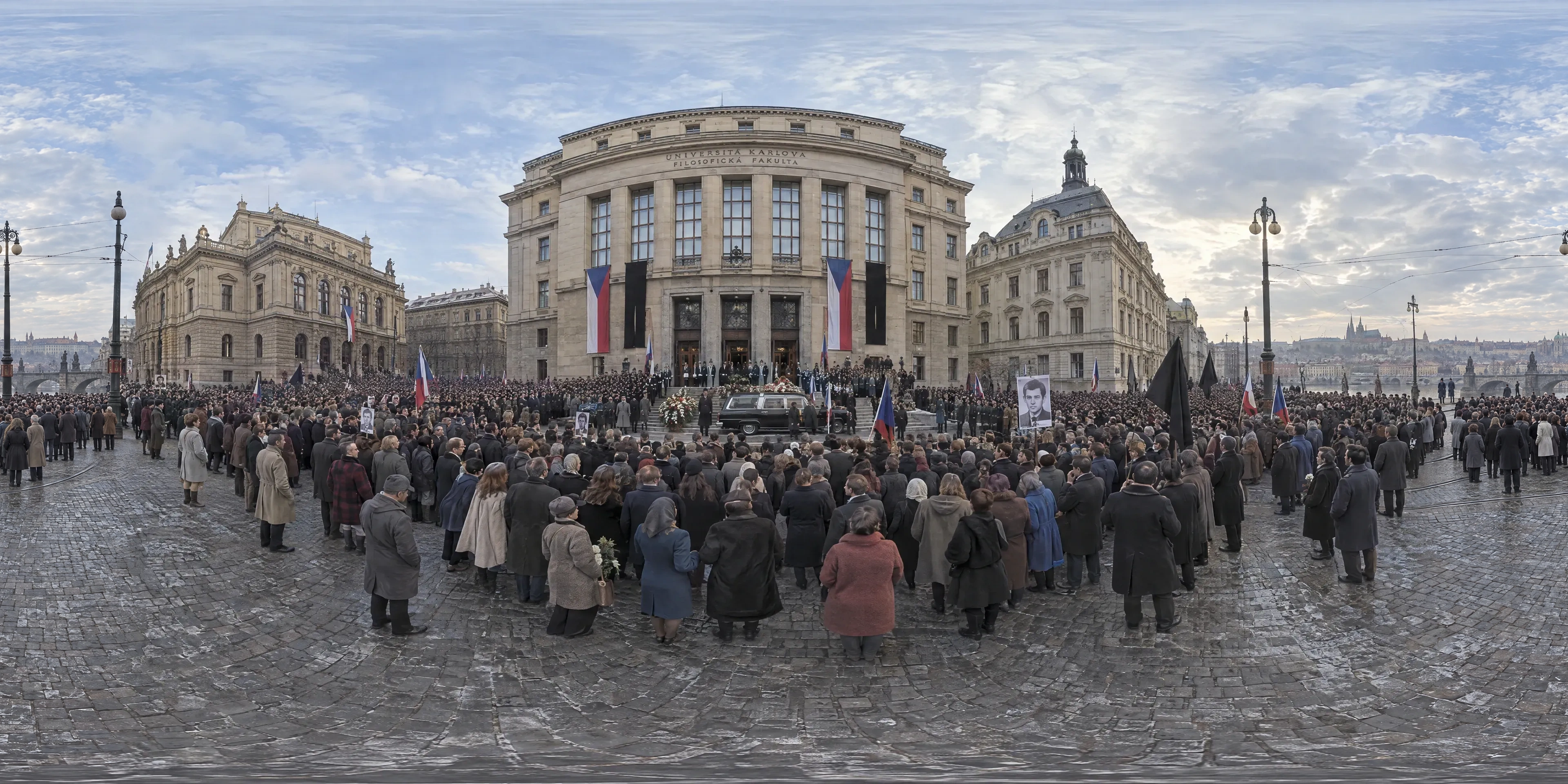
On 25 January 1969 some 200,000 people follow the coffin of Jan Palach in complete silence. The 20-year-old student had set himself on fire on Wenceslas Square on 16 January in protest against the resignation that followed the Soviet invasion; the procession halts before his Faculty of Arts, on a square students have already renamed after him.
- Year
- 1969
- Where
- Bohemia · CZ
- Era
- modern_postwar
- Coordinates
- 50.089, 14.415
The moment
A funeral in silence
On Saturday 25 January 1969 a vast crowd followed the coffin of Jan Palach through Prague. Estimates run from tens of thousands to 200,000 people, many of them students, and almost nobody spoke. The silence was the statement.
The procession went from the university's historic Carolinum through Celetná street and across the Old Town Square. It halted before the Faculty of Arts, where a student guard of honour stood with a flag, and the mourners filled the square outside with Czechoslovak flags, black flags and photographs of the dead student.
A twenty-year-old history student
Palach was born on 11 August 1948 in Všetaty, in Central Bohemia, and studied history and political economy at the Faculty of Arts of Charles University.
On 16 January 1969, on Wenceslas Square, he set himself on fire. His protest was aimed at the resignation that had spread through the country after the Soviet-led invasion of August 1968, and he left a letter with demands: the abolition of censorship, a ban on Zprávy, the occupiers' newsletter, and a general strike.
He died three days later, on 19 January.
A square renamed by students
The square before the faculty was officially called náměstí Krasnoarmějců, Red Army Soldiers' Square. On 20 January, students renamed it after Palach.
It sits at the Old Town end of the Mánes Bridge, between the neo-Renaissance Rudolfinum and the School of Applied Arts, with the interwar building of the Faculty of Arts, its home since 1929, on the east side. Across the river rise Prague Castle and St Vitus Cathedral.
The name the students gave it is the one it carries today.
The last free gathering
The funeral was the last great free gathering before two decades of normalisation. Even his grave worried the regime. In 1973 the secret police exhumed his remains, had them cremated and sent the ashes to his mother, and only on 25 October 1990 were they returned to his grave.
His memory outlived that. The demonstrations of Palach Week, held on the twentieth anniversary in January 1989, are seen as one of the catalysts of the revolution that ended communist rule that November.
Czechs mark 16 January as a significant day. The memory they keep is of a student's protest against an occupation and of the silent crowd that walked behind his coffin.
Sources
Further reading
Tagged
- czechia
- prague
- jan-palach
- normalisation
- funeral
- students
- 1969
- 20th-century
Published
See also

1945
Czech Radio Building, Vinohradská, Prague
On Saturday 5 May 1945 the Prague Uprising breaks out at the radio building on Vinohradská: at 12:15 the staff hoist the Czechoslovak and American flags, the station broadcasts desperate calls for help, and at six in the evening the SS inside surrender. That night about 100,000 Praguers raise some 1,600 barricades across the city.

1948
Kinsky Palace, Old Town Square, Prague
On Saturday 21 February 1948, the day after the non-communist ministers resign, Klement Gottwald speaks from the balcony of the Kinsky Palace to more than 100,000 people standing in hard frost. Four days later President Beneš gives way and the communists take power for 41 years; the photo from this balcony, with Vladimír Clementis later airbrushed out, went round the world.

1968
National Museum, Wenceslas Square, Prague
On the morning of 21 August 1968, hours after Warsaw Pact armies invaded to crush the Prague Spring, Soviet tanks coming from Vinohradská rake the facade of the National Museum with machine-gun fire. Praguers fill the upper square, surround the tanks to argue with their crews and cover the statue of St Wenceslas with flags and slogans.