Kinsky Palace, Old Town Square, Prague
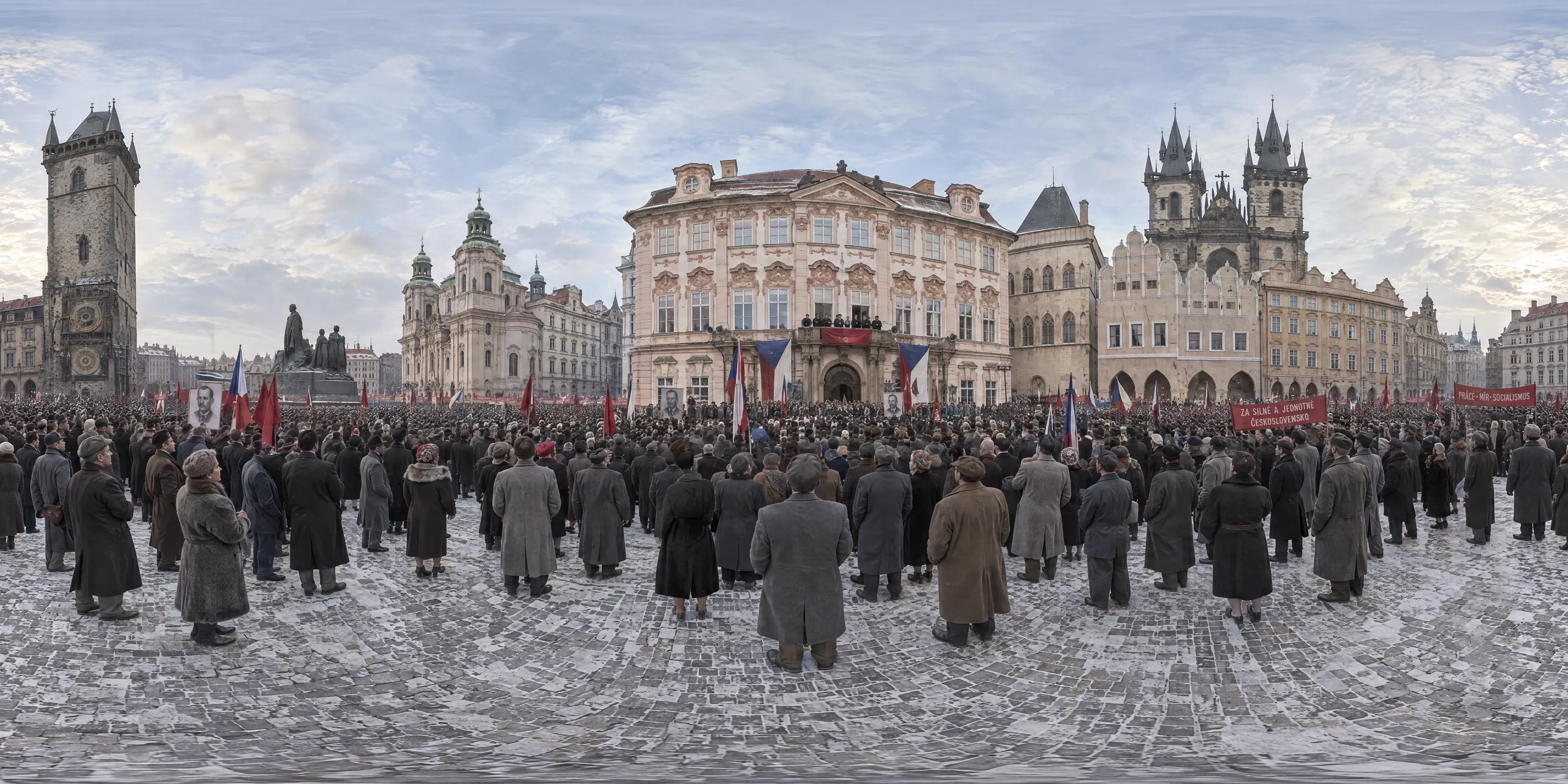
On Saturday 21 February 1948, the day after the non-communist ministers resign, Klement Gottwald speaks from the balcony of the Kinsky Palace to more than 100,000 people standing in hard frost. Four days later President Beneš gives way and the communists take power for 41 years; the photo from this balcony, with Vladimír Clementis later airbrushed out, went round the world.
- Year
- 1948
- Where
- Bohemia · CZ
- Era
- modern_postwar
- Coordinates
- 50.087, 14.421
The moment
A crowd in the frost
On Saturday 21 February 1948, in hard frost, more than 100,000 people packed the Old Town Square in Prague. On the balcony of the rococo Kinsky Palace, the communist prime minister Klement Gottwald spoke to them through microphones, and the radio carried his speech across the country.
The day before, the non-communist ministers had resigned from the government. The rally was the communists' answer: a show of force in the streets while the president decided what to do.
It was not a celebration, whatever the propaganda later claimed. It was pressure, and it worked.
Four days to a dictatorship
On 25 February President Edvard Beneš gave way. The communists took power, and they held it for 41 years.
The regime called those days Victorious February. In Czech schools they are a fixed chapter of twentieth-century history, the start of four decades of one-party rule that ended only in November 1989.
The man who vanished from the photograph
Beside Gottwald on the balcony stood Vladimír Clementis, who became foreign minister on 18 March 1948, succeeding Jan Masaryk. The photograph of the two men on the balcony went round the world.
Clementis did not survive the regime he served. Accused of "bourgeois nationalism", he was tried with Rudolf Slánský and hanged in December 1952. After his execution he was removed from the photograph.
Milan Kundera opened The Book of Laughter and Forgetting with that picture. In his telling, Clementis had put his own fur hat on the bareheaded Gottwald, and after the retouching the hat was all that was left of him. Clementis was rehabilitated in 1963.
A square still scarred by war
The square itself bore the damage of May 1945. The town hall tower had been damaged by fire in the uprising, and its astronomical clock stood silent, under repair until July 1948.
Beside the tower, where the neo-Gothic wing of the town hall had burned, lay an empty lot; the ruin had been pulled down in 1947. Across the square the House at the Stone Bell still hid behind a plain Baroque front, and its Gothic facade was restored only in 1975 to 1987.
Above the rooftops rose the twin towers of the Týn church, and in the middle of the square stood the Jan Hus monument of 1915. The hour of the rally and the banners in the crowd are not recorded with certainty, and whether snow was falling, as Kundera has it, is not confirmed.
Sources
Further reading
Tagged
- czechia
- prague
- old-town-square
- communism
- february-1948
- coup
- cold-war
- 20th-century
Published
See also

1968
National Museum, Wenceslas Square, Prague
On the morning of 21 August 1968, hours after Warsaw Pact armies invaded to crush the Prague Spring, Soviet tanks coming from Vinohradská rake the facade of the National Museum with machine-gun fire. Praguers fill the upper square, surround the tanks to argue with their crews and cover the statue of St Wenceslas with flags and slogans.

1945
Czech Radio Building, Vinohradská, Prague
On Saturday 5 May 1945 the Prague Uprising breaks out at the radio building on Vinohradská: at 12:15 the staff hoist the Czechoslovak and American flags, the station broadcasts desperate calls for help, and at six in the evening the SS inside surrender. That night about 100,000 Praguers raise some 1,600 barricades across the city.

1969
Jan Palach Square, Prague
On 25 January 1969 some 200,000 people follow the coffin of Jan Palach in complete silence. The 20-year-old student had set himself on fire on Wenceslas Square on 16 January in protest against the resignation that followed the Soviet invasion; the procession halts before his Faculty of Arts, on a square students have already renamed after him.