Devín (Dowina), Great Moravian Stronghold
August 864: the East Frankish king Louis the German crosses the Danube and besieges Prince Rastislav in a fortress the Annals of Fulda call Dowina, 'the maiden', the first written mention of Devín. Rastislav gives hostages and an oath instead of battle, and Great Moravia, a year into the mission of Constantine and Methodius, holds.
- Year
- 864
- Where
- Great Moravia, Devín Gate · SK
- Era
- Medieval
- Coordinates
- 48.173, 16.980
The moment
A fortress called "the maiden"
In August 864 the East Frankish king Louis the German crossed the Danube and besieged Prince Rastislav of Great Moravia in a fortress. The Annals of Fulda call it Dowina, "the maiden", and most historians read the name as the first written mention of Devín.
Not all of them. The identification is widely but not universally accepted, and archaeology has not settled it.
There was no battle. Rastislav gave hostages and swore an oath instead, and Great Moravia, a year into the mission of Constantine and Methodius, survived.
A church with three apses on a crag
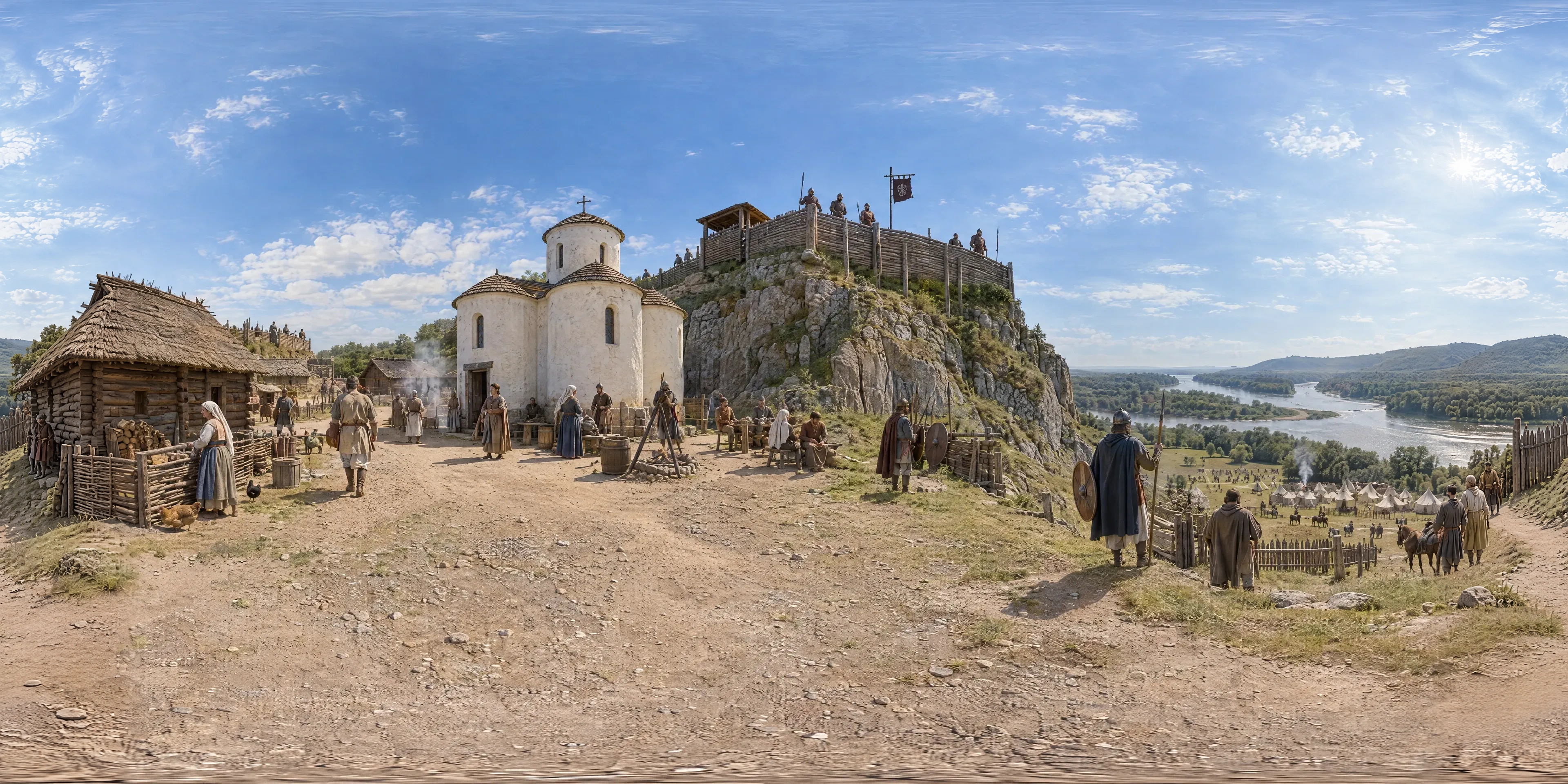
The stronghold stood on the plateau of the Devín crag, high above the point where the Morava flows into the Danube. The fort covered almost the whole top of the rock, its edge ringed by an earth-and-timber rampart; in one excavated stretch the face was a wall of thick oak beams.
Inside stood a small stone church, built partly of reused Roman material and plastered white. Its east end closed in three semicircular apses, a cloverleaf plan, and its frescoes used pigments from northern Italy.
Two styluses found there suggest clergy who wrote and taught. The church is dated only to about 850 to 870, so it may not have been finished by the summer of the siege.
Wrecked by the French in 1809
The rock stayed fortified for most of the next thousand years. A stone castle guarding the western frontier of Hungary is documented in 1271, a palace was added in the fifteenth century, and the fortifications were strengthened during the Ottoman wars.
In 1809, after the siege of Pressburg, retreating French troops destroyed it. What remained became a Romantic ruin that inspired poets.
Until 1989 the castle stood inside a restricted military zone on the Iron Curtain, behind watchtowers and barbed wire.
Why Devín is a national symbol
Great Moravia is the founding chapter of Slovak history, invoked in the preamble of the Slovak Constitution, and Devín is its most famous stronghold. The young patriots of Ľudovít Štúr's generation made a pilgrimage to the ruins in 1836.
The castle has appeared on Slovak currency and is among the nation's strongest symbols. The heritage is shared, since Great Moravia belongs to Czech history as well, and in Slovakia it is a core, sometimes politicised, part of the national story.
What survives is the rock itself, still standing over the meeting of the two rivers, with the wooded hills around Hainburg on the far side.
Sources
Further reading
Tagged
- slovakia
- bratislava
- devin
- great-moravia
- early-medieval
- rastislav
- danube
- hillfort
Published
See also

1741
Coronation Hill, Pressburg (Bratislava)
Sunday, 25 June 1741: freshly crowned in St Martin's Cathedral, 24-year-old Maria Theresa rides up an earthen mound by the Danube and swings St Stephen's sword to the four corners of the world, vowing to defend Hungary. That September the Hungarian estates, gathered in this city, pledged her 'our life and blood' and saved her throne.

960s
Malá Strana below Prague Castle
Around 965 the traveller Ibrahim ibn Yaqub finds Prague the richest trading place of the region: Rus and Slav merchants from Kraków and Muslim and Jewish traders from the east meet in the settlement below the Přemyslid castle, where saddles, bridles and shields are made and slaves, tin and furs are sold.

1250s
Cliff Palace, Mesa Verde
Around 1250, the Ancestral Puebloans build Cliff Palace into a sandstone alcove high in a Colorado canyon wall: over a hundred and fifty rooms and two dozen round ceremonial kivas tucked beneath an overhang, the largest cliff dwelling in North America.