The Crane on the Motława, Gdańsk
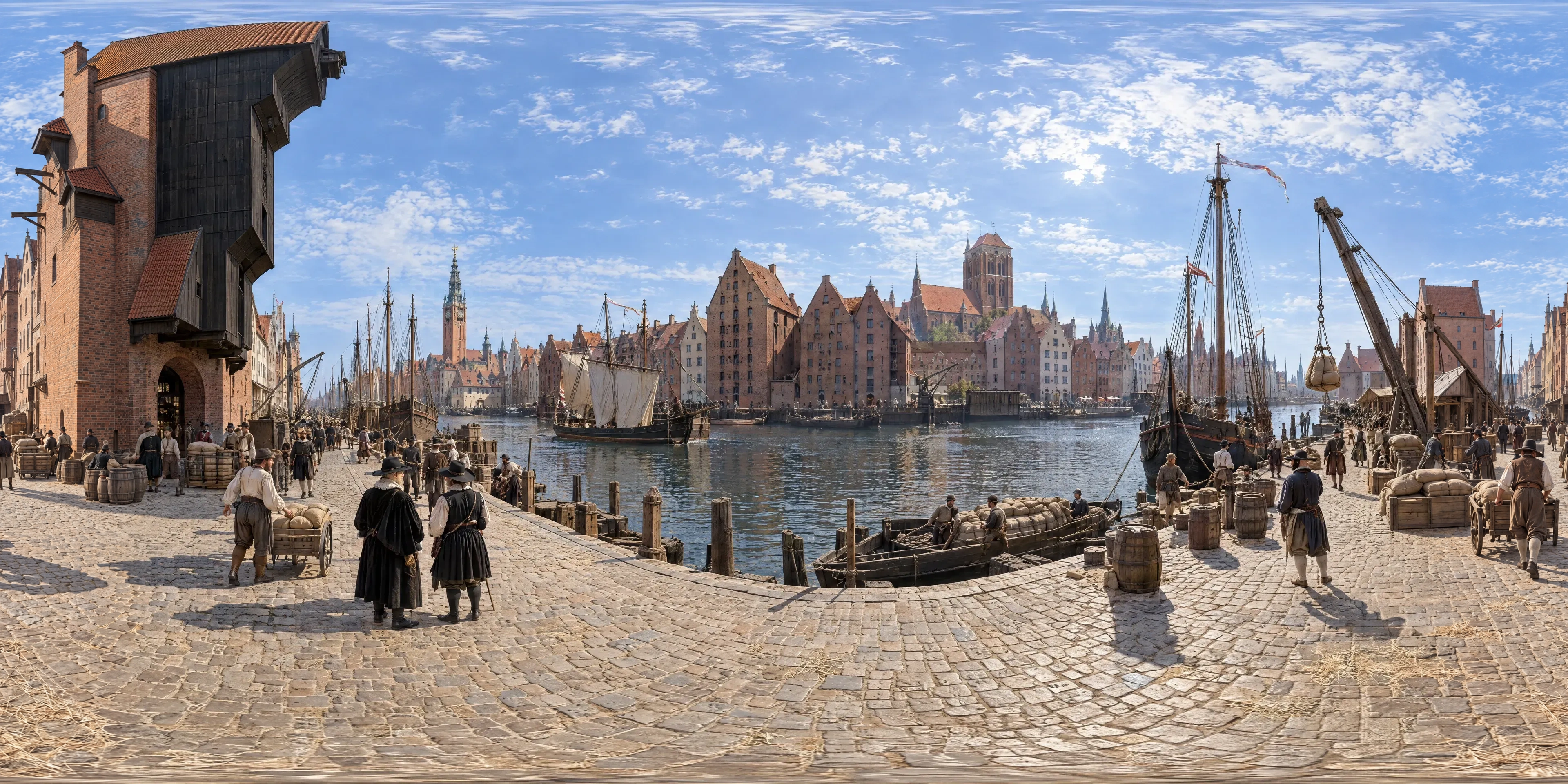
Around 1620, at the peak of the grain trade, Gdańsk is the Commonwealth's gateway to the sea: rye from noble estates along the Vistula floats down on barges, fills the granaries of Granary Island and is loaded onto Dutch ships under the great Crane, whose treadwheels, walked by men, lift two tonnes at a time.
- Year
- 1620s
- Where
- Pomerania (Royal Prussia) · PL
- Era
- Early modern
- Coordinates
- 54.350, 18.658
The moment
The Commonwealth's grain left from here
Around 1620 Gdańsk was the busiest port of the Polish-Lithuanian Commonwealth, at the peak of its grain trade. Rye from noble estates along the Vistula came downriver on long, flat barges handled by raftsmen, was stored in the city's granaries and was loaded onto ships bound west.
The scale was enormous. In this period grain made up some 65 to 85 per cent of the value of exports, and between 1562 and 1599 rye accounted for more than 80 per cent of the grain. Exports peaked in 1618 or 1619, depending on the source; one count gives a record 103,000 lasts for 1619.
Most of it went to the Netherlands, Spain and Italy. The Dutch relied on Polish grain for about a quarter of what they consumed, and in 1583 alone 1,070 ships under the Dutch flag entered the port.
A crane walked by men
Ships loaded under the Crane, one of the city's water gates on the Motława. It was built in 1442 to 1444: two massive brick towers flanking the gate, and a tall timber hoisting house jutting out over the river. It is the largest surviving port crane of medieval Europe.
Inside the hoisting house, men walked two pairs of treadwheels, each about six metres across. The machinery could lift two tonnes to a height of 27 metres, or four tonnes to 11 metres with both pairs coupled, enough for anything from sacks of grain to a ship's mast.
Granaries with names, not numbers
Across the water lay Granary Island, created in 1576 when the New Motława channel was dug. In the sixteenth century the area already held about 340 granaries, tall and narrow, several storeys high under steep roofs, built of timber, brick and clay. Each had a name rather than a number.
Behind the quay rose the gabled merchant houses and brick water gates of the Main Town, the huge brick tower of St Mary's and the slender Renaissance spire of the town hall, crowned since 1561 by a gilded figure of King Sigismund Augustus. On the quay, merchants in black doublets and ruffs mixed with Polish nobles in long żupans, sabres at their sides.
Whose golden age
Polish schools use the grain shipped through Gdańsk to explain how the nobles' Commonwealth grew rich, and the Crane is the emblem of the city. The city itself was not simply Polish. Danzig was German-speaking and largely Lutheran, with wide autonomy under the Polish Crown, and German and Polish histories claim its golden age in different ways.
Little on the quay is original. In 1945, when the Red Army took the city, the Crane was set on fire, and Granary Island was almost entirely destroyed; only three granaries survived. The Crane was rebuilt in the late 1950s and now houses a branch of the National Maritime Museum. Hotels stand on the island today.
Which ships lay at the quay in any given year, and how the quay was surfaced, are not recorded in detail.
Sources
Further reading
Tagged
- poland
- gdansk
- pomerania
- royal-prussia
- grain-trade
- port
- early-modern
- everyday-life
Published
See also

1682
Place d'Armes, Versailles
On 6 May 1682 Louis XIV makes Versailles the permanent seat of his court and government, turning his father's hunting lodge, now wrapped in new wings, into the stage of absolute monarchy. The palace is still a vast building site: the Hall of Mirrors is being decorated, the Grand Commun is just begun and the north wing not yet started.

1747
Sanssouci Palace, Potsdam
On 1 May 1747 Frederick II of Prussia inaugurates Sanssouci, the small summer palace built to his own sketches on top of six curved vineyard terraces outside Potsdam, though not all its rooms are finished. Here the philosopher king will spend every summer, playing the flute and gathering Voltaire and other guests at his table.

1741
Coronation Hill, Pressburg (Bratislava)
Sunday, 25 June 1741: freshly crowned in St Martin's Cathedral, 24-year-old Maria Theresa rides up an earthen mound by the Danube and swings St Stephen's sword to the four corners of the world, vowing to defend Hungary. That September the Hungarian estates, gathered in this city, pledged her 'our life and blood' and saved her throne.