Tomb of Gül Baba, Buda
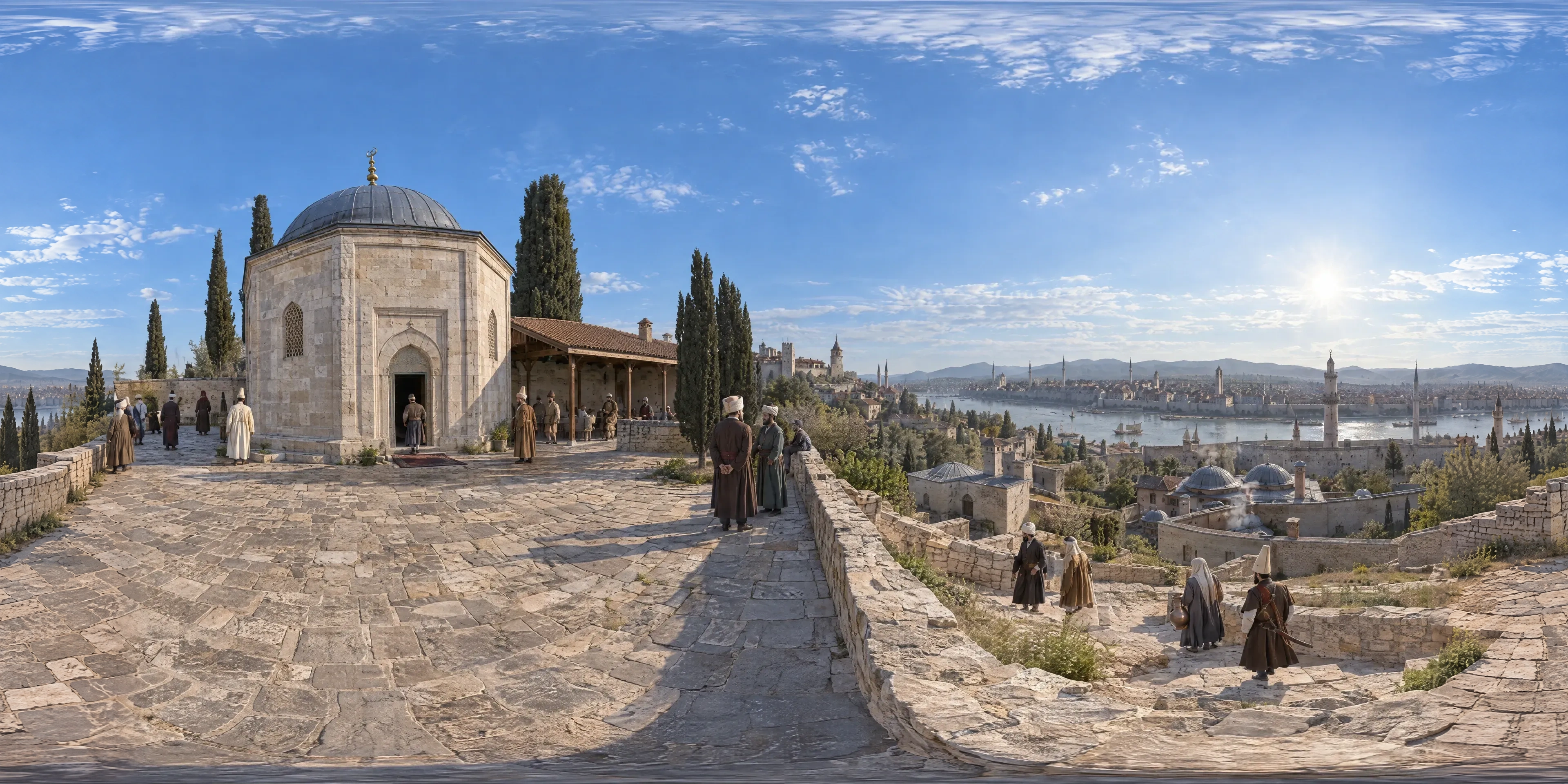
In the 1660s, when the Ottoman traveller Evliya Çelebi visits Buda, the hillside tomb of Gül Baba, the 'father of roses', is a busy pilgrimage place kept by Bektashi dervishes. Below it lies a Muslim city of 24 great mosques, domed baths and minarets, the seat of an Ottoman pasha since 1541 and until 1686.
- Year
- 1660s
- Where
- Buda (Ottoman Hungary) · HU
- Era
- Early modern
- Coordinates
- 47.516, 19.035
The moment
The father of roses died in 1541
Gül Baba, whose name means "father of roses", was a dervish of the Bektashi order. He died in Buda in 1541, during the conquest of the city by Suleiman the Magnificent, and the Ottomans declared him its patron saint.
Between 1543 and 1548 Mehmed, son of Yahya Pasha and the third pasha of Buda, built his tomb, or türbe, on the hillside north of the town. It was a small octagon of unplastered Buda limestone on a stone base, with an ogee-arched door and a hemispherical dome sheathed in lead.
Below it, on level ground beside the Buda road, stood the dervish lodge, or tekke, with prayer halls, cells and a kitchen that fed pilgrims. At least sixty dervishes lived there.
A Muslim city of 24 great mosques
The Ottoman traveller Evliya Çelebi came to Buda in the 1660s, though the exact date of his visit is not pinned down. He noted the lead on the tomb's dome, and he claimed that more than 200,000 Muslims had attended Gül Baba's funeral prayer, a number best read as reverence rather than a count.
Below the hill lay a Muslim city of 24 great mosques, domed baths and minarets. The old Church of Our Lady on Castle Hill had become the Sultan Süleyman mosque, the Fethiye mosque carried a clock tower, and the medieval royal palace served as barracks and arsenal.
In the walled Water Town rose the lead domes of the Kakaskapu bath, begun in 1565 and known today as the Király bath. Buda was the seat of an Ottoman pasha from 1541 until 1686, for 145 years.
A Jesuit chapel, then a monument
Habsburg-led armies retook Buda in 1686, and in 1690 the Jesuits turned the tomb into a Catholic chapel dedicated to St Joseph, reshaping its arches and adding a Baroque lantern to the dome. After 1790 it became a private residence.
The Ottoman state came back for it. In 1885 the Ottoman government commissioned the Hungarian engineer Lajos Grill to restore the tomb, and when the work was finished in 1914 it was declared a monument. Pergolas and fountains were added in 1996. After a further restoration it reopened on 9 October 2018, with the Turkish president Recep Tayyip Erdoğan and the Hungarian prime minister Viktor Orbán in attendance.
Why the tomb still matters in Budapest
For Hungarians the 145 years of Ottoman Buda are one of the most taught chapters of their history, remembered as a foreign occupation. Gül Baba's tomb is the best-known Ottoman monument in the capital. It is still a place of Muslim pilgrimage, often described as the northernmost in the world, and a symbol of the ties between Turkey and Hungary.
The name is familiar from the stage too. Jenő Huszka's operetta Gül Baba, with a libretto by Ferenc Martos, opened at the Király Theatre in Budapest on 9 December 1905, with thousands of live roses built into the set.
The Ottoman city itself lives on most vividly in Budapest's Turkish baths, the Király bath of 1565 among them.
Sources
Further reading
Tagged
- hungary
- budapest
- buda
- ottoman-empire
- turkish-baths
- dervishes
- early-modern
- everyday-life
Published
See also

1618
Prague Castle (Ludwig Wing)
On May 23, 1618, Bohemian Protestant nobles throw two imperial Catholic regents out of the upper window of the Ludwig Wing of Prague Castle, triggering the Thirty Years' War.

1650s
Tōkaidō road, Mt. Fuji
Around 1650 AD, a daimyō and his retinue of 2,000 retainers march along the Tōkaidō road past Mt. Fuji on the mandatory alternate-year residence journey to Edo: the Tokugawa shogunate's masterstroke of social control.

1640s
Taj Mahal under construction, Agra
Around 1640, the white marble dome of the Taj Mahal rises on its riverside platform at Agra: some twenty thousand workers and a thousand elephants raising Shah Jahan's tomb for his wife Mumtaz Mahal, partway through a project that will take more than twenty years.