Salzberg High Valley, Hallstatt
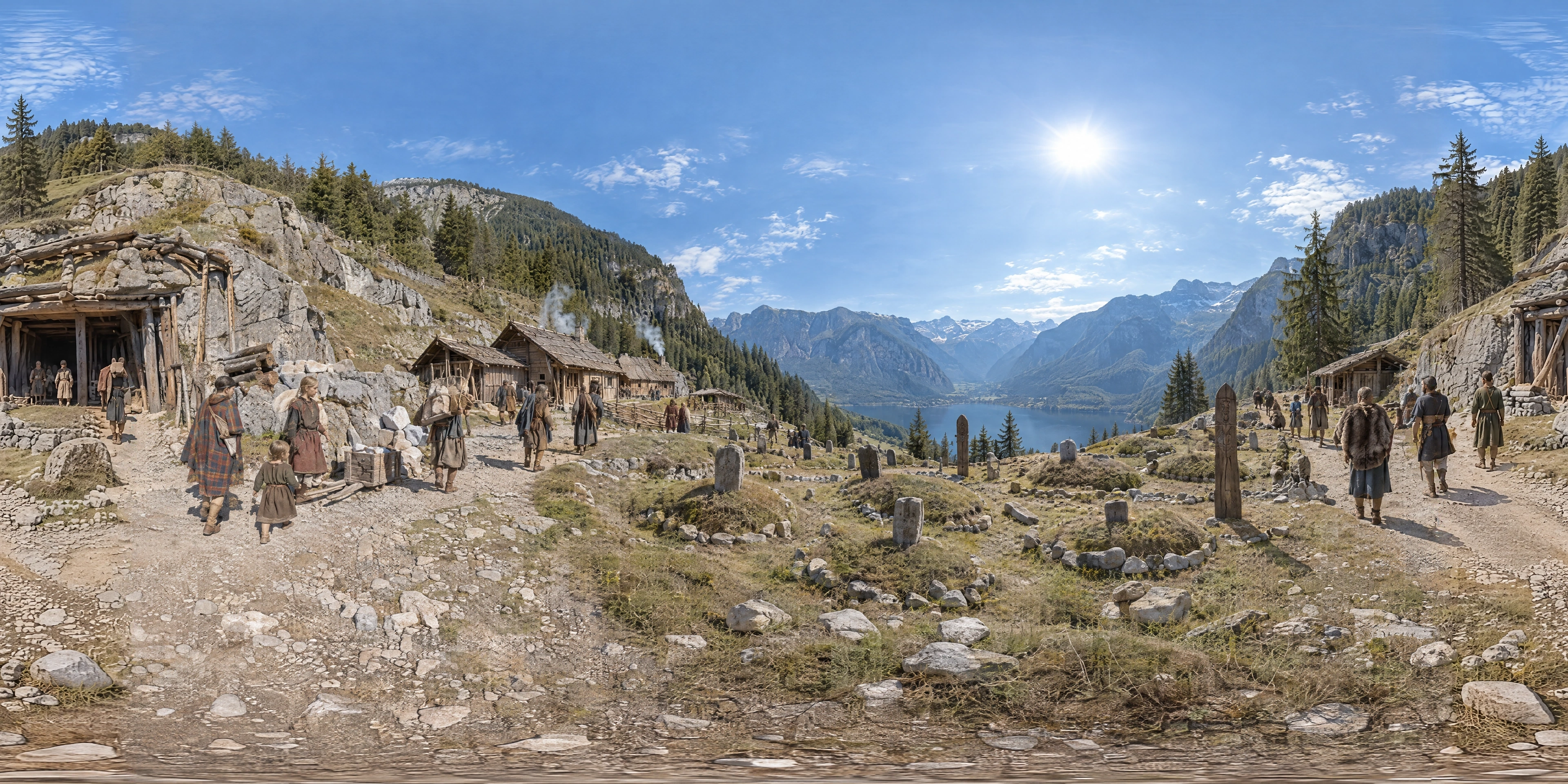
Around 650 BC the salt miners of Hallstatt are among Europe's wealthiest communities: in a high valley above the lake they cut rock salt from galleries up to 200 m deep and bury their dead with bronze vessels, imported luxuries and ivory-hilted swords. Their cemetery gave its name to a whole era, the Hallstatt period of the early Iron Age.
- Year
- 7th century BC
- Where
- Salzkammergut, Upper Austria · AT
- Era
- Ancient
- Coordinates
- 47.563, 13.640
The moment
Rich on salt, long before Rome
Around 650 BC the salt miners of Hallstatt were among the wealthiest communities in Europe. In a high valley about 300 metres above Lake Hallstatt, in the limestone Alps of the Salzkammergut, they cut rock salt from galleries up to 200 metres deep.
The work was hard and it involved everyone. Women and children, some of them eight years old or younger, carried heavy loads of salt out of the galleries on their shoulders, with straps and carrying poles. The miners lit the tunnels with bundles of pine splints and cut the salt with bronze-headed picks on wooden handles.
What they wore survives too: woollen cloth woven in coloured checks and bands, fur caps and leather shoes.
A cemetery that named an age
On a gentle slope near the mouth of the valley the miners buried their dead. Between about 800 and 350 BC some 5,000 to 6,000 people were laid to rest here, some cremated, others laid out on their backs with their arms at their sides.
The richest graves hold bronze vessels, jewellery, goods traded from far across Europe and some twenty swords of bronze or iron, a few of them with elaborate ivory hilts.
In 1846 Johann Georg Ramsauer, who ran the salt mine, found the cemetery. He excavated about a thousand graves, and his records remain one of the best documentations from the early years of archaeology. The finds were so rich and so typical of their time that the site gave its name to a whole era: the Hallstatt period of the early Iron Age.
Where the miners lived is unknown
For all the finds underground, one question is still open. No Iron Age settlement has been found in the high valley, and nobody knows where the miners lived or what stood at the mine entrances. Any picture of their buildings is a reconstruction.
Much of what visitors see today came far later. The Rudolfsturm, the tower above the valley mouth, was built in 1282 to 1284, and the village of Hallstatt, crowded onto the lakeshore below, did not exist at all.
Why Austrians start their history here
Every Austrian pupil meets Hallstatt early, and the name reaches far beyond Austria: archaeologists across Central Europe speak of the Hallstatt culture.
The salt mine is described as the oldest working salt mine in the world, and the valley lies at the heart of the Hallstatt-Dachstein/Salzkammergut cultural landscape, a UNESCO World Heritage Site since 1997.
For Austrians it is the deepest root of their story. Long before the Romans, a community in their mountains grew rich on salt, and it was salt, not gold, that filled its graves with treasure from across a continent.
Sources
Further reading
Tagged
- austria
- hallstatt
- salzkammergut
- iron-age
- hallstatt-culture
- salt-mining
- prehistory
- unesco
Published
See also

1869
Court Opera on the Ringstraße, Vienna
On the evening of 25 May 1869 Emperor Franz Joseph opens the new Court Opera, the first great public building on Vienna's Ringstraße, with Mozart's Don Giovanni sung in German. Neither of its architects lives to see the night: both died in 1868, after Viennese mockery of the 'sunken box'.

1897
Giant Ferris Wheel, Prater, Vienna
On 3 July 1897, a hot summer day, Vienna's Giant Ferris Wheel opens in the Prater, built by English engineers for the jubilee of Emperor Franz Joseph's 50 years on the throne. Its 30 cabins turn up to 64.75 m above the canals of the 'Venice in Vienna' pleasure park, making it one of the largest wheels in the world; a ride costs a gulden.

1955
Upper Belvedere, Vienna
Around noon on Sunday 15 May 1955, just after the State Treaty is signed in the Marble Hall of the Upper Belvedere, Foreign Minister Leopold Figl steps onto the balcony with the Allied foreign ministers and holds up the signed treaty to the crowd waiting in the palace garden. After ten years of occupation, Austria is free.