Hampi (Vijayanagara)
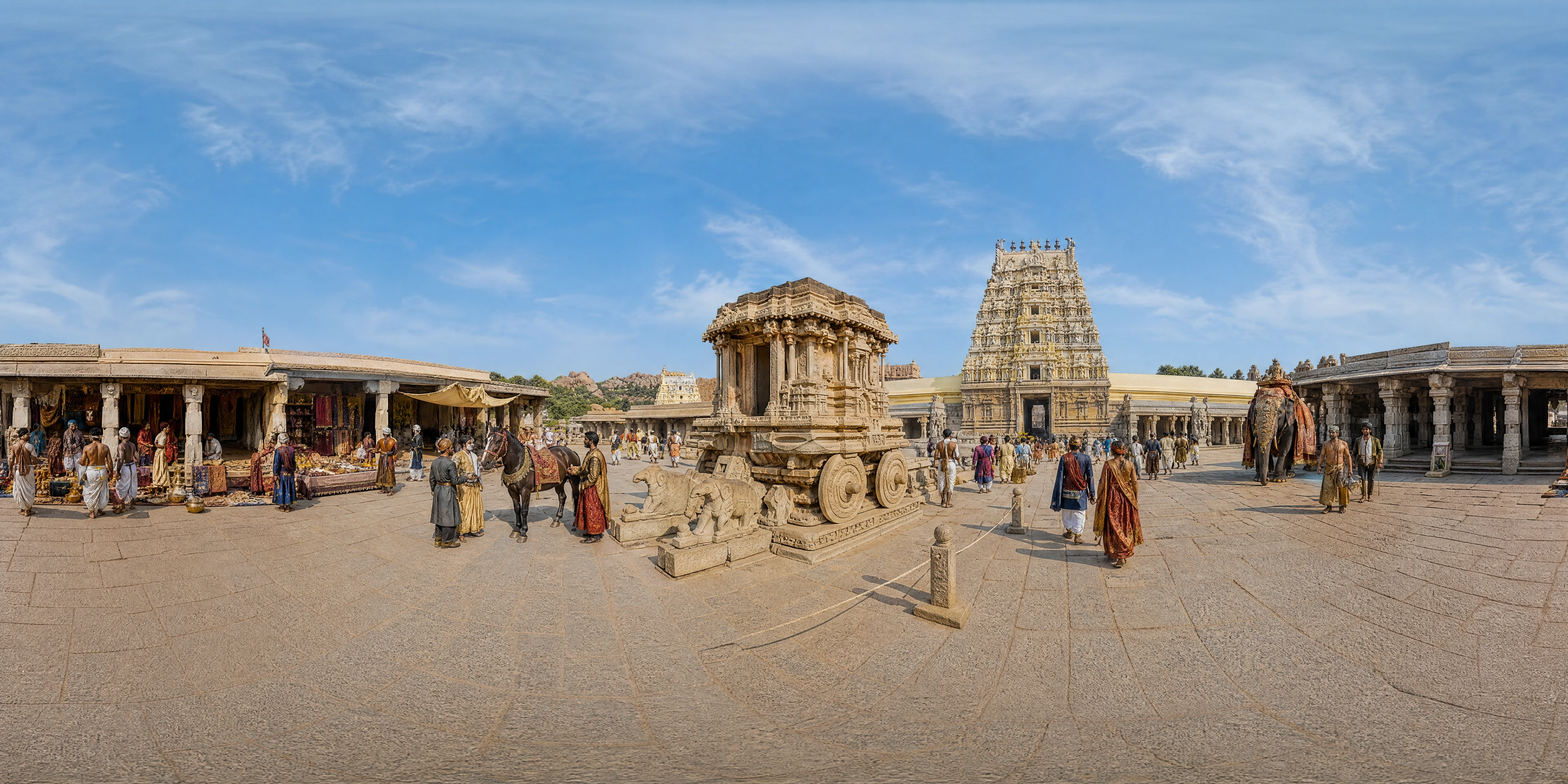
Around 1500 AD, the Vijayanagara empire reigns from Hampi (the largest Hindu state in Indian history) and its bazaars throng with Arabian horse merchants and diamond dealers from across the Indian Ocean.
- Year
- 1500s
- Where
- Karnataka, southern India · IN
- Era
- Renaissance
- Coordinates
- 15.335, 76.460
The moment
A city Europe had not heard of
In 1500, the city of Vijayanagara on the Tungabhadra river in southern India was, by population and by trade volume, one of the five largest cities in the world.
The Portuguese traveller Domingos Paes, who visited around 1520, estimated the population at 500 000 and described streets so wide that ten elephants could walk abreast. The Persian ambassador Abdur Razzaq, visiting in 1442, wrote:
The pupil of the eye has never seen a place like it, and the ear of intelligence has never been informed that there existed anything to equal it in the world.
The city was the capital of the Vijayanagara Empire (the last great Hindu state of southern India before Muslim conquest) and controlled the diamond mines of Golconda and the spice trade out of the Malabar coast.
A stone chariot pulled by stone elephants
The most visited monument in modern Hampi is the Stone Chariot of the Vitthala Temple complex. A free-standing temple-shrine carved entirely from granite in the form of a wheeled chariot, with two stone elephants harnessed in front.
The original sculpture, dating from the reign of Krishna Deva Raya (1509–1529), had two stone horses pulling the chariot. The horses were damaged at an unknown date and replaced with the elephants visible today.
The chariot wheels are functional: they once rotated on their axles, though they have been cemented in place in modern times to prevent damage. The shrine inside the chariot houses an image of Garuda, the eagle mount of Vishnu.
Musical pillars
The Maharanga Mantapa (great hall) of the Vitthala Temple is held up by 56 carved granite pillars, each one cut from a single block of stone with smaller surrounding pillarets left attached to the central column.
When struck with a stick, each pillar, and each pillaret, produces a different musical pitch.
The system was designed for ritual music. Temple musicians would strike the pillars in sequence as part of religious ceremonies. British engineers in the colonial period cut a section out of one pillar to investigate; they found the resonance derives from the natural quality of the stone and the precise geometry, not from any hidden internal mechanism.
The pillars still ring when struck, though striking them is now forbidden to preserve them.
Sacked by an alliance that lasted six months
The Vijayanagara empire fell at the Battle of Talikota on 23 January 1565, when an alliance of the Deccan Sultanates (Bijapur, Ahmadnagar, Golconda and Bidar) overwhelmed the Vijayanagara army through defection of two key Muslim commanders.
The defeated emperor Rama Raya was beheaded. Vijayanagara city was sacked for five months, its temples systematically defaced, its palaces destroyed, its treasures looted. The population fled south.
The alliance that destroyed the city fell apart within months of the victory. The Sultanates were then conquered one by one by the Mughal Empire in the following century.
The site of Vijayanagara was abandoned permanently, and the granite ruins of Hampi (temples, palaces, markets, the Stone Chariot) stand empty among scattered boulders on the Tungabhadra river.
Further reading
Tagged
- india
- vijayanagara
- hampi
- hindu
- krishnadevaraya
- medieval
Published
See also

1511
Sistine Chapel, Vatican
In 1511, Michelangelo Buonarroti paints the ceiling of the Sistine Chapel; currently working on the Creation of Adam fresco while standing on his custom flat-bridge scaffolding.

1492
Guanahani (San Salvador Island), Bahamas
At dawn on 12 October 1492, Christopher Columbus and about 40 Spanish sailors land at a Lucayan-Taíno island in the Bahamas they will rename *San Salvador*: the encounter that begins five centuries of Atlantic exchange and the destruction of indigenous Caribbean populations.

15th century AD
Great Wall of China, Jinshanling
Around 1500, Ming China rebuilds the Great Wall in brick and stone across the mountain ridges north of Beijing: a battlemented rampart with watchtowers that climbs and plunges over the peaks as far as the eye can see, the most ambitious fortification ever built.