Harland & Wolff Shipyard, Belfast
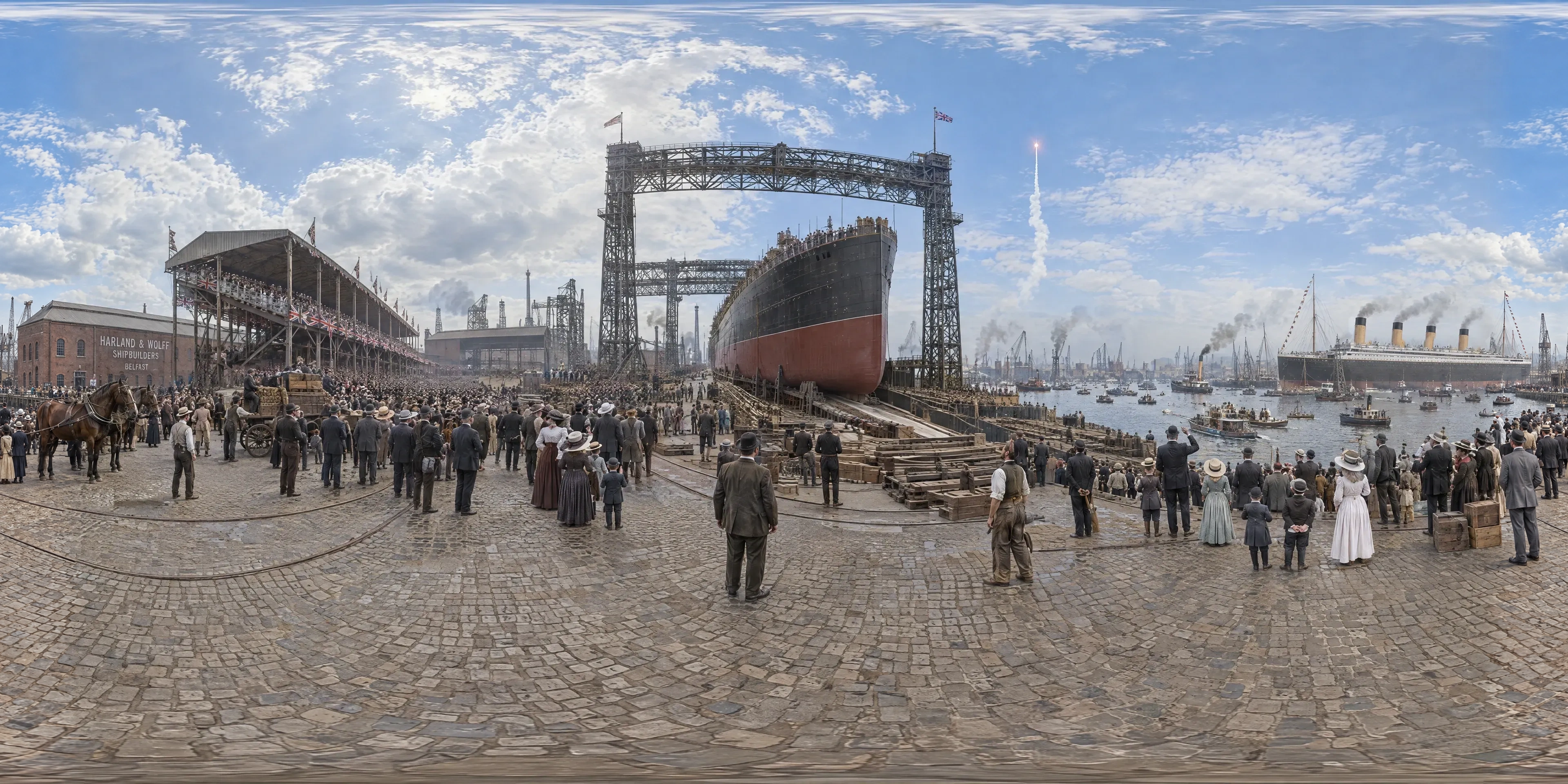
At 12.15 on 31 May 1911 the hull of the Titanic, the largest ship yet built, slides stern first from Slipway No. 3 at Harland & Wolff into the River Lagan before some 100,000 onlookers, greased by 22 tonnes of soap and tallow and never christened. Her finished sister Olympic lies the same day in Belfast Lough, awaiting her owners.
- Year
- 1911
- Where
- Ulster, Northern Ireland · GB
- Era
- modern_early
- Coordinates
- 54.610, -5.913
The moment
Launched without a name
At 12.15 on Wednesday 31 May 1911, the bare hull of the Titanic began to slide stern first from Slipway No. 3 at Harland & Wolff into the River Lagan. It took about a minute. Twenty-two tonnes of soap and tallow had been spread on the slipway to ease her down.
No bottle was broken. In keeping with the White Star Line's policy, the ship was not formally named or christened with champagne. Some 100,000 people watched, and present were Lord Pirrie, head of Harland & Wolff, J. Bruce Ismay, chairman of the White Star Line, and the American financier J. Pierpont Morgan, whose International Mercantile Marine controlled it.
A gantry built for two giants
Nothing in the yard had been big enough. Harland & Wolff demolished three slipways and built two new ones, the largest ever made, and over them the Scottish firm of Sir William Arrol, builders of the Forth Bridge and Tower Bridge, raised a steel gantry 69 metres high and 260 metres long, weighing more than 6,000 tonnes.
The two liners rose under it almost side by side. The keel of Olympic was laid on 16 December 1908, that of Titanic on 31 March 1909. Some 15,000 men worked at the yard, where safety precautions were rudimentary at best, and just before the launch a worker was killed by a falling piece of wood.
Olympic sailed the same afternoon
The launch was only half of the day's business. Later that day the completed Olympic left Belfast for Liverpool, her port of registration, some 29 months after her keel was laid.
Titanic went to be fitted out. She was given extra first-class cabins on B Deck and a Café Parisien that Olympic lacked, changes that made her slightly heavier and let her claim to be the largest ship afloat. Her completion was delayed when Olympic came back for repairs after a collision in September 1911.
In the early hours of 15 April 1912, on her maiden voyage from Southampton to New York, she sank after striking an iceberg. About 1,500 of the 2,208 people aboard died, among them Thomas Andrews, the yard's chief naval architect.
Why Belfast is proud of a ship that sank
For Northern Ireland the Titanic is its best-known contribution to world history, and a pride shared across its communities. The yard had built ships for the White Star Line since 1867, and in 1911 the Arrol Gantry dominated the city's skyline.
The memory is not simple. The yard's workforce was largely Protestant, a sensitive point in a divided city, and the launch cannot be separated from the deaths of 1912.
The ground has taken the ship's name. Queen's Island, where both liners were built, is now called the Titanic Quarter, and the Titanic Belfast museum stands on it.
Sources
Further reading
Tagged
- united-kingdom
- northern-ireland
- belfast
- titanic
- shipbuilding
- harland-and-wolff
- edwardian
- 20th-century
Published
See also

1939
Lower Wenceslas Square, Prague
On the morning of 15 March 1939, in a heavy fall of wet snow, German columns roll down Wenceslas Square as Hitler's troops occupy what remains of Czechoslovakia. Thousands of Praguers watch from the pavements, weeping, booing and singing the national anthem; that evening Hitler reaches Prague Castle, and the next day he proclaims the Protectorate of Bohemia and Moravia.

1918
Wenceslas Square, Prague
Late in the morning of 28 October 1918, as news spreads that Austria-Hungary has accepted President Wilson's terms, crowds pour onto Wenceslas Square and the priest Isidor Zahradník proclaims an independent Czechoslovak state at the St Wenceslas monument. That evening the National Committee passes the new republic's first law.

1939
Westerplatte, Gdańsk
At 4:45 on Friday 1 September 1939 the German training battleship Schleswig-Holstein, moored in the Gdańsk harbour channel, opens fire on the Polish Military Transit Depot at Westerplatte, the first shots of the Second World War in Europe. The 182 defenders, expected to hold for up to twelve hours, hold out for seven days.