Jasna Góra, Częstochowa
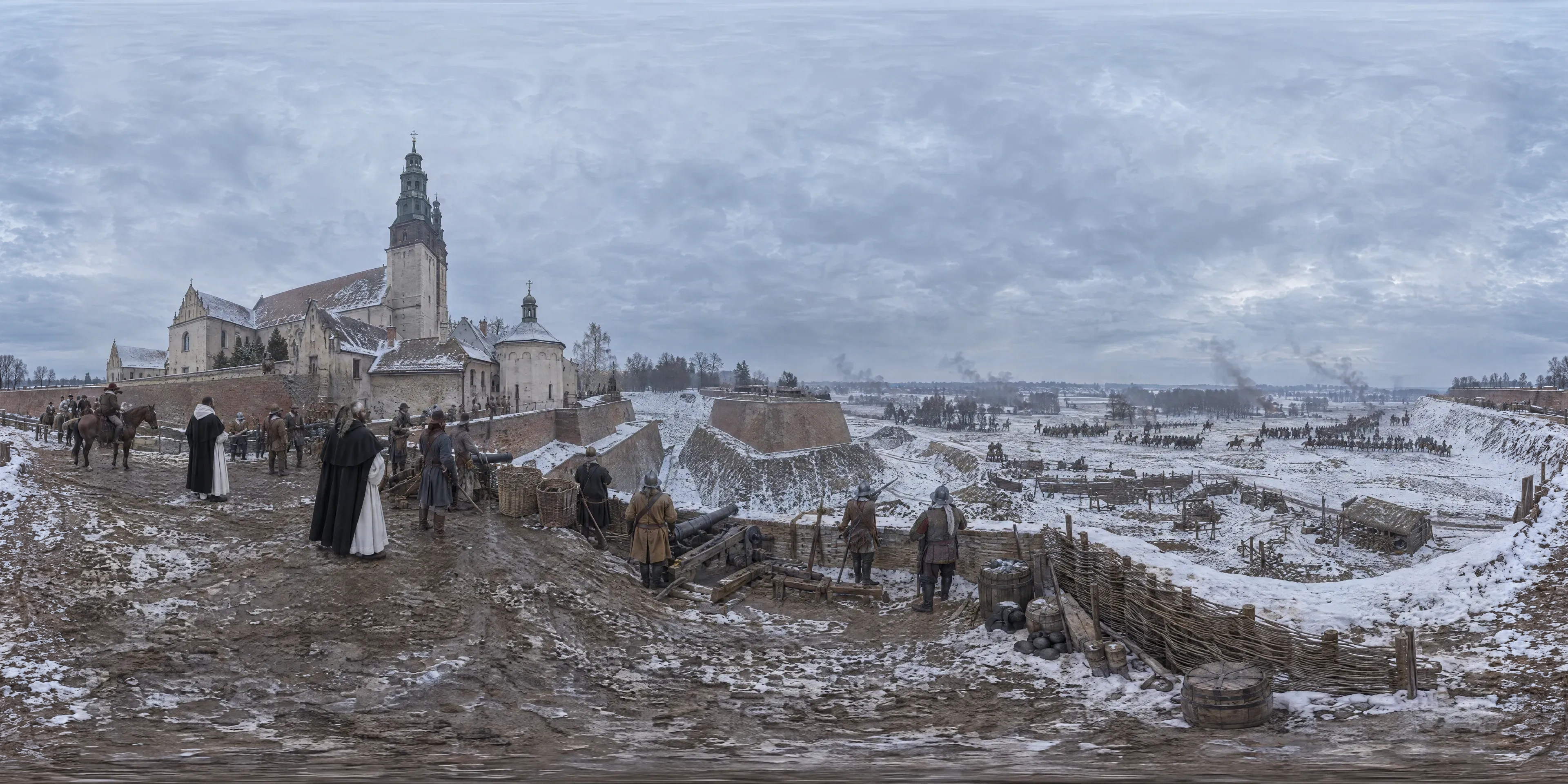
On 27 December 1655, after almost six weeks of siege, the Swedish corps of General Burchard Müller marches away from Jasna Góra, the fortified Pauline monastery that guards the icon of the Black Madonna, held by some 250 monks, soldiers and local nobles under Prior Augustyn Kordecki. The news rallies the country against the Swedish invasion known as the Deluge.
- Year
- 1655
- Where
- Lesser Poland · PL
- Era
- Early modern
- Coordinates
- 50.813, 19.098
The moment
The besiegers left in the night
On 18 November 1655 a Swedish corps under General Burchard Müller arrived below Jasna Góra, the fortified Pauline monastery above Częstochowa that guards the icon of the Black Madonna. It was the year of the Swedish invasion that Poles call the Deluge.
Müller began with about 2,000 men, mostly cavalry of little use in a siege, and eight light guns. At its peak his force numbered about 3,200, some 2,400 of them German mercenaries and 800 Polish horsemen in Swedish service, with seventeen guns. Prior Augustyn Kordecki held the walls with some 250 people: monks, soldiers and local nobles.
After almost six weeks the besiegers gave up. They marched away in the night of 26 to 27 December.
A fortress, not just a church
The monks were defending a modern fortress. Between 1621 and the 1640s the monastery had been enclosed in a bastioned rectangle of about 130 by 104 metres, with pointed bastions at the corners, brick-faced scarps, earth ramparts and a deep moat. By December the walls were scarred by shot and the northern wall was partly broken.
Inside rose the tower of 1617 to 1625, a six-storey brick shaft topped by three storeys of timber sheathed in copper. Around it stood the Gothic church, the chapel of the Miraculous Image, the Knights' Hall of 1647 to 1649 and the Royal Rooms of 1644. The present 106-metre tower dates from 1906, and the baroque basilica was built after a fire in 1690.
Kordecki wrote the legend himself
The record is more tangled than the legend. Before the siege Kordecki had written to Charles X Gustav and accepted a Swedish letter of protection; what he refused, on 18 November, was to let a Swedish garrison in. Most of the besiegers were German mercenaries and Poles serving the Swedish king.
Even the icon was elsewhere. On 7 November the monks had sent it, with their most precious treasures, to Lubliniec and then to a Pauline house at Mochów in Silesia, leaving a copy in the chapel.
In 1658 Kordecki published his own account, Nova Gigantomachia, and embellished it. Henryk Sienkiewicz went further in The Deluge, published as a book in 1886, where his fictional hero Andrzej Kmicic blows up the great Swedish siege gun.
Why the hill became the nation's shrine
The news that the monastery had held spread through the country and helped rally it against the invasion. On 1 April 1656, in Lwów cathedral, King John Casimir took vows that placed the country under the Virgin's protection and named Mary Queen of Poland. Three centuries later, on 26 August 1956, about a million people renewed them at Jasna Góra, in a text written by the imprisoned Primate Stefan Wyszyński.
Every Pole knows the siege from Sienkiewicz, and Jasna Góra is Poland's best-known shrine. A walking pilgrimage has set out for it from Warsaw every August since 1711.
The weather on 27 December is not recorded, and the church as it stood before the fire of 1690 is known only in outline.
Sources
Further reading
Tagged
- poland
- czestochowa
- jasna-gora
- deluge
- sweden
- siege
- 17th-century
- black-madonna
Published
See also

1655
Dam Square and the New Town Hall, Amsterdam
On 29 July 1655 Amsterdam's burgomasters process from the Prinsenhof to the Dam to inaugurate Jacob van Campen's new Town Hall, a classical palace for a city of merchants, though it is still far from finished. Six companies of civic guards fire three volleys as the city at the height of its Golden Age celebrates.

1741
Coronation Hill, Pressburg (Bratislava)
Sunday, 25 June 1741: freshly crowned in St Martin's Cathedral, 24-year-old Maria Theresa rides up an earthen mound by the Danube and swings St Stephen's sword to the four corners of the world, vowing to defend Hungary. That September the Hungarian estates, gathered in this city, pledged her 'our life and blood' and saved her throne.

1682
Place d'Armes, Versailles
On 6 May 1682 Louis XIV makes Versailles the permanent seat of his court and government, turning his father's hunting lodge, now wrapped in new wings, into the stage of absolute monarchy. The palace is still a vast building site: the Hall of Mirrors is being decorated, the Grand Commun is just begun and the north wing not yet started.