Krakowskie Przedmieście, Warsaw
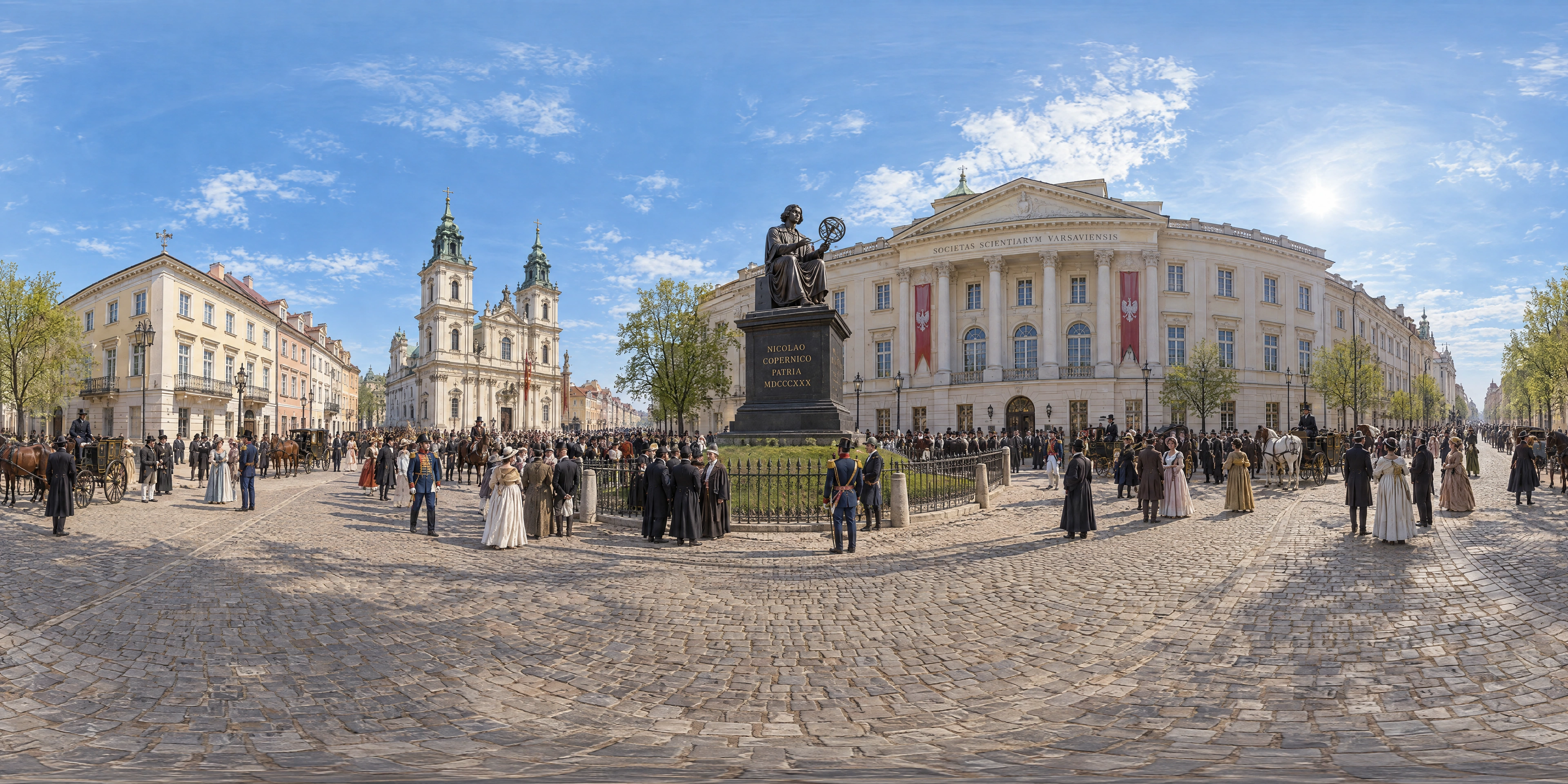
On 11 May 1830 Julian Ursyn Niemcewicz unveils Thorvaldsen's bronze Copernicus in front of the Staszic Palace, seat of the Society of Friends of Learning, paid for by Staszic and a public collection. It is Warsaw's last spring before the November Uprising; young Chopin, living a few hundred metres up the street, will leave the city for good in November.
- Year
- 1830
- Where
- Masovia · PL
- Era
- Industrial
- Coordinates
- 52.239, 21.018
The moment
The statue took ten years to arrive
The monument was Stanisław Staszic's idea. It was commissioned in 1820 from the Danish sculptor Bertel Thorvaldsen in Rome, and Staszic paid for half of it himself; a public collection raised the rest.
The work dragged on. Thorvaldsen's plaster model of the astronomer reached Warsaw only in 1827, and the bronze was cast in the city by the founders Jan Gregoire and Sebastian Norblin. Staszic did not live to see it finished, and part of his estate went to complete it.
It was to stand in front of the Staszic Palace, a pale classicist building of the 1820s and the seat of the Society of Friends of Learning.
The Mass was never said
On 11 May 1830 a crowd gathered on Krakowskie Przedmieście and walked with musicians and singers to Holy Cross church, across the street, to open the day with a Mass ordered in advance. There was no Mass. "What was our surprise," Julian Ursyn Niemcewicz reported, "when we did not find the Mass we had ordered."
So Niemcewicz stood on the pedestal himself and gave a short speech. The veil fell, the band struck up a hymn, and by his account the cheering tore the air.
The crowd saw a seated bronze Copernicus holding a compass in his right hand and an armillary sphere in his left. The black pedestal carried gilded inscriptions, in Latin Nicolao Copernico grata patria, from a grateful fatherland, and in Polish Mikołajowi Kopernikowi rodacy, from his countrymen. It stood on a low grassy mound inside an iron railing, kept until 1928 to 1931.
Warsaw's last spring before the rising
Warsaw was then the capital of a Kingdom of Poland ruled by the Russian tsar. Young Fryderyk Chopin lived a few hundred metres up the same street; whether he watched the unveiling is not known. In November he left Warsaw for good, and that same month the November Uprising broke out.
Polish pupils study 1830 as a turning point, the year of Chopin's farewell and of the rising.
The inscription Warsaw took back
The monument is one of the best-known landmarks of the Royal Route, and part of its fame comes from the German occupation. In 1940 the Germans covered both inscriptions with new plaques, one of them in German, "to the great astronomer Nikolaus Kopernikus". The sculptor Maksymilian Potrawiak, working for the city, greased the screws so they would come off easily.
On 11 February 1942 Maciej Aleksy Dawidowski, known as Alek, of the Wawer minor-sabotage organisation, removed the German plaque. On 25 May 1943, the 400th anniversary of Copernicus's death, three young poets laid a wreath at the statue; a German patrol opened fire, and Wacław Bojarski was mortally wounded.
After the Warsaw Uprising the statue was taken away, probably as scrap metal. It was found at a scrapyard in Hajduki Nyskie and set back on its pedestal on 22 July 1945. Since 2007 a model of the solar system has been laid into the paving around it.
Sources
Further reading
Tagged
- poland
- warsaw
- masovia
- congress-poland
- copernicus
- chopin
- 19th-century
- everyday-life
Published
See also

1897
Giant Ferris Wheel, Prater, Vienna
On 3 July 1897, a hot summer day, Vienna's Giant Ferris Wheel opens in the Prater, built by English engineers for the jubilee of Emperor Franz Joseph's 50 years on the throne. Its 30 cabins turn up to 64.75 m above the canals of the 'Venice in Vienna' pleasure park, making it one of the largest wheels in the world; a ride costs a gulden.

1810
Theresienwiese, Munich
On 17 October 1810 a horse race on a meadow outside Munich crowns the celebrations for the wedding of Crown Prince Ludwig of Bavaria and Princess Therese of Saxe-Hildburghausen; 50,000 spectators watch from the hillside, and the field is named Theresienwiese after the bride. Repeated the next year, the race becomes the Oktoberfest.

1839
Gräfenberg Spa, Jeseník
In 1839 some 1,500 patients, among them a monarch, 22 princes and 149 counts and countesses, climb to Gräfenberg in the Jeseníky mountains of Austrian Silesia to take the cold-water cure of Vincenz Priessnitz, a self-taught farmer whose spa is the first hydrotherapy resort in the world; 120 doctors come to study his methods.