Harbour of Marsala
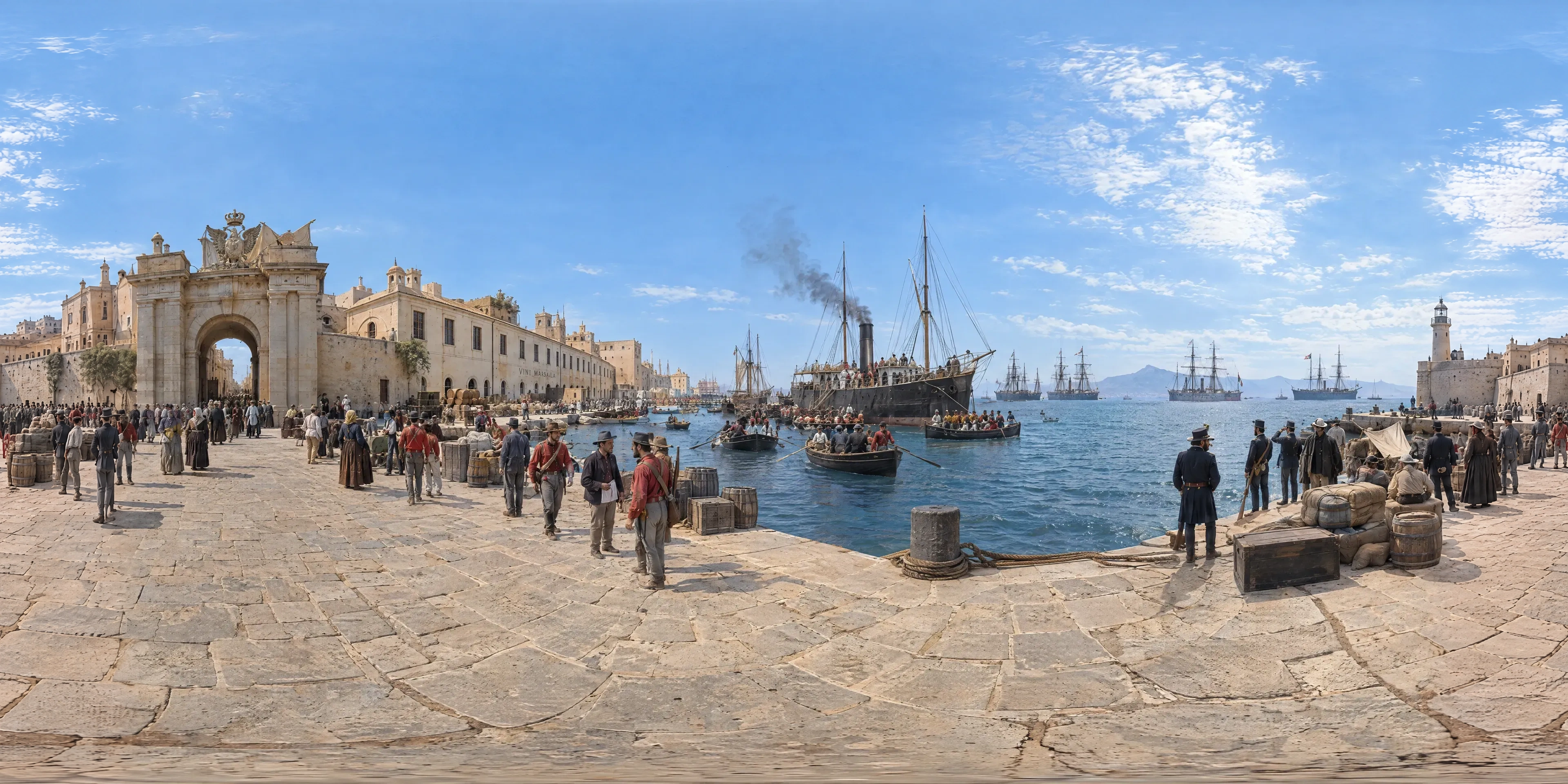
Around 1.30 pm on 11 May 1860 the steamer Piemonte ties up among British merchant ships in Marsala harbour and Giuseppe Garibaldi's volunteers, some in red woollen shirts, pour ashore, while their second ship, the Lombardo, lies stranded on a shoal. Almost unopposed, the Expedition of the Thousand began the conquest of the Bourbon south and the unification of Italy.
- Year
- 1860
- Where
- Sicily (Kingdom of the Two Sicilies) · IT
- Era
- Industrial
- Coordinates
- 37.791, 12.437
The moment
The Thousand were 1,089
On the night of 5 May 1860 Giuseppe Garibaldi sailed from Quarto, near Genoa, with 1,089 volunteers on two steamers seized from the Rubattino shipping company and renamed the Piemonte and the Lombardo. Most were students and skilled craftsmen of middle-class families.
They came overwhelmingly from the north: 434 from Lombardy, 194 from Venetia, 156 from Genoa, 78 from Tuscany, with only 45 Sicilians and 46 Neapolitans among them, and 33 foreigners. Some wore red woollen shirts, but estimates of how many shirts there were run from 300 to 1,000; many men landed in civilian jackets and hats.
Landing under British eyes
Around half past one on the afternoon of 11 May, the Piemonte tied up in the harbour of Marsala, on the western tip of Sicily, among British merchant ships. The Lombardo ran aground on a shoal farther out, and rowing boats ferried its men ashore.
The British presence mattered. Marsala was the home of English wine houses such as Woodhouse and Ingham, whose warehouses lined the waterfront, and two Royal Navy ships, the Argus and the Intrepid, lay offshore; their presence deterred the Bourbon navy from interfering.
The Bourbon warships Stromboli, Capri and Partenope arrived too late to stop the landing. The volunteers marched into town through the Baroque Porta di Mare of 1685, crowned by a Habsburg eagle and now called Porta Garibaldi.
From Marsala to Naples in four months
The landing was almost unopposed, and the campaign moved fast. On 15 May the volunteers beat some 3,000 royal troops at Calatafimi; they reached Palermo on 27 May, fought through its streets, and saw the Bourbon garrison capitulate on 6 June.
On 19 August Garibaldi crossed to Calabria, and on 7 September 1860 he entered Naples. On 17 March 1861 the Kingdom of Italy was proclaimed.
Why every town has a Via dei Mille
The landing of the Thousand is the best-known episode of the Risorgimento. Almost every Italian town has a Via dei Mille or a Via Garibaldi because of this afternoon in Marsala.
Not everyone remembers it as liberation. In parts of southern Italy the end of the Bourbon kingdom is viewed critically, and neo-Bourbon accounts tell the story as a conquest.
The harbour itself has been rebuilt, and the exact quay where the Piemonte tied up is known only approximately. The sea gate the volunteers marched through still stands, renamed for the man who led them in.
Sources
Further reading
Tagged
- italy
- sicily
- marsala
- risorgimento
- garibaldi
- expedition-of-the-thousand
- 1860
- harbour
Published
See also

1839
Gräfenberg Spa, Jeseník
In 1839 some 1,500 patients, among them a monarch, 22 princes and 149 counts and countesses, climb to Gräfenberg in the Jeseníky mountains of Austrian Silesia to take the cold-water cure of Vincenz Priessnitz, a self-taught farmer whose spa is the first hydrotherapy resort in the world; 120 doctors come to study his methods.

1869
Court Opera on the Ringstraße, Vienna
On the evening of 25 May 1869 Emperor Franz Joseph opens the new Court Opera, the first great public building on Vienna's Ringstraße, with Mozart's Don Giovanni sung in German. Neither of its architects lives to see the night: both died in 1868, after Viennese mockery of the 'sunken box'.

1897
Giant Ferris Wheel, Prater, Vienna
On 3 July 1897, a hot summer day, Vienna's Giant Ferris Wheel opens in the Prater, built by English engineers for the jubilee of Emperor Franz Joseph's 50 years on the throne. Its 30 cabins turn up to 64.75 m above the canals of the 'Venice in Vienna' pleasure park, making it one of the largest wheels in the world; a ride costs a gulden.