Lutheran Church Green, Martin (Memorandum Square)
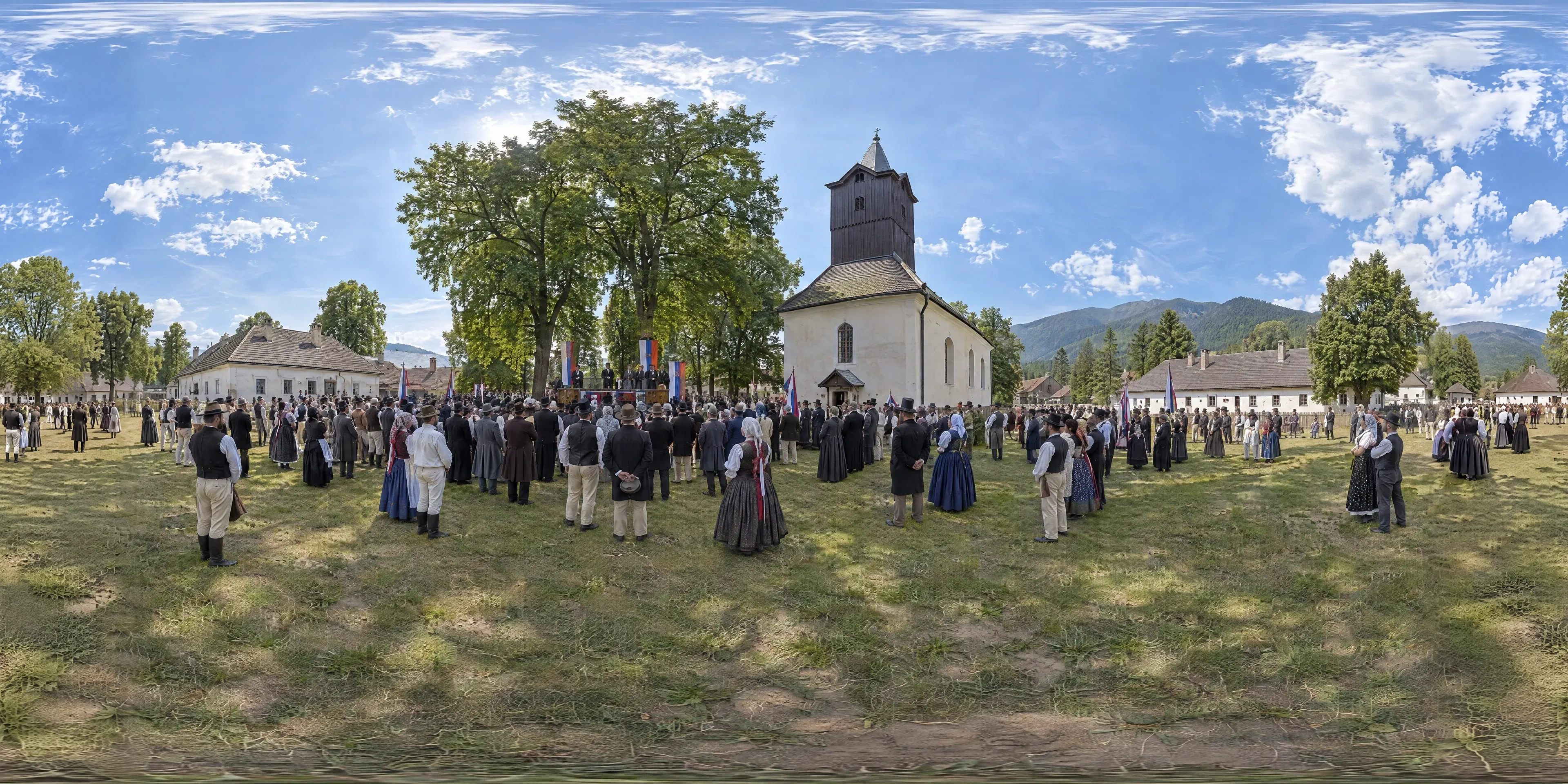
6 and 7 June 1861: thousands of Slovaks gather under the old lindens before the Lutheran church of Turčiansky Svätý Martin and adopt the Memorandum of the Slovak Nation, demanding recognition as a nation and a self-governing Slovak district within Hungary. It was the most important Slovak mass political gathering between 1849 and 1918, and Matica slovenská grew directly out of it.
- Year
- 1861
- Where
- Turiec, Upper Hungary · SK
- Era
- Industrial
- Coordinates
- 49.068, 18.923
The moment
Thousands under the lindens
On 6 and 7 June 1861 thousands of Slovaks gathered on the green before the Lutheran church of Turčiansky Svätý Martin, a small market town in the Turiec basin. Estimates of the crowd range from about 2,000 to more than 6,000.
The church they stood before was modest: a single-nave classicist toleration church of 1784, with a wooden tower added after 1789. Its masonry tower came only in 1885 and its neo-Romanesque front in 1895.
Old lindens shaded the meeting, which Ján Francisci chaired over two days. Patriots, Lutheran and Catholic clergy, townsmen and peasants from the Turiec villages came; the white-blue-red tricolour had been the Slovak colours since 1848.
A Slovak district inside Hungary
The assembly adopted the Memorandum of the Slovak Nation, drafted by Štefan Marko Daxner. It asked for four things.
It demanded that Slovaks be recognised as a nation within Hungary, and that a self-governing Upper Hungarian Slovak District be created, run by elected Slovak representatives. It asked for Slovak to be used in offices, courts and schools, and for a Slovak cultural society, Matica slovenská.
It added a law academy, university chairs of Slovak language and literature, and Slovak publications. It was the first time a Slovak assembly had asked for a territory of its own.
Ignored by the Diet, answered in Martin
The Hungarian Diet brushed the Memorandum aside. In December 1861 Slovak leaders took a revised programme to Vienna instead.
One demand was met. Matica slovenská was founded in Martin on 4 August 1863, during celebrations of the arrival of Cyril and Methodius, with the Catholic bishop Štefan Moyses as its first chairman. Hungarian authorities suspended it in 1875 and confiscated its property.
Why Martin became the heart of Slovak culture
The Memorandum is the founding programme of modern Slovak politics. It was the most important Slovak mass political gathering between 1849 and 1918, and it made Martin the heart of national culture.
The town kept that role. In 1918 Slovak politicians met in Martin again to adopt the Martin Declaration of 30 October and join the Czechoslovak state, and Matica slovenská still has its seat there.
The demand for a Slovak district is read differently in Slovak and Hungarian historiography, and it went unanswered in its own time. Still, the green before the Lutheran church marks the place where Slovaks first put a claim to self-government in writing.
Sources
Further reading
Tagged
- slovakia
- martin
- national-revival
- memorandum
- 19th-century
- turiec
- assembly
Published
See also

1869
Court Opera on the Ringstraße, Vienna
On the evening of 25 May 1869 Emperor Franz Joseph opens the new Court Opera, the first great public building on Vienna's Ringstraße, with Mozart's Don Giovanni sung in German. Neither of its architects lives to see the night: both died in 1868, after Viennese mockery of the 'sunken box'.

1897
Giant Ferris Wheel, Prater, Vienna
On 3 July 1897, a hot summer day, Vienna's Giant Ferris Wheel opens in the Prater, built by English engineers for the jubilee of Emperor Franz Joseph's 50 years on the throne. Its 30 cabins turn up to 64.75 m above the canals of the 'Venice in Vienna' pleasure park, making it one of the largest wheels in the world; a ride costs a gulden.

1810
Theresienwiese, Munich
On 17 October 1810 a horse race on a meadow outside Munich crowns the celebrations for the wedding of Crown Prince Ludwig of Bavaria and Princess Therese of Saxe-Hildburghausen; 50,000 spectators watch from the hillside, and the field is named Theresienwiese after the bride. Repeated the next year, the race becomes the Oktoberfest.