Mendel's Garden, St Thomas's Abbey, Brno
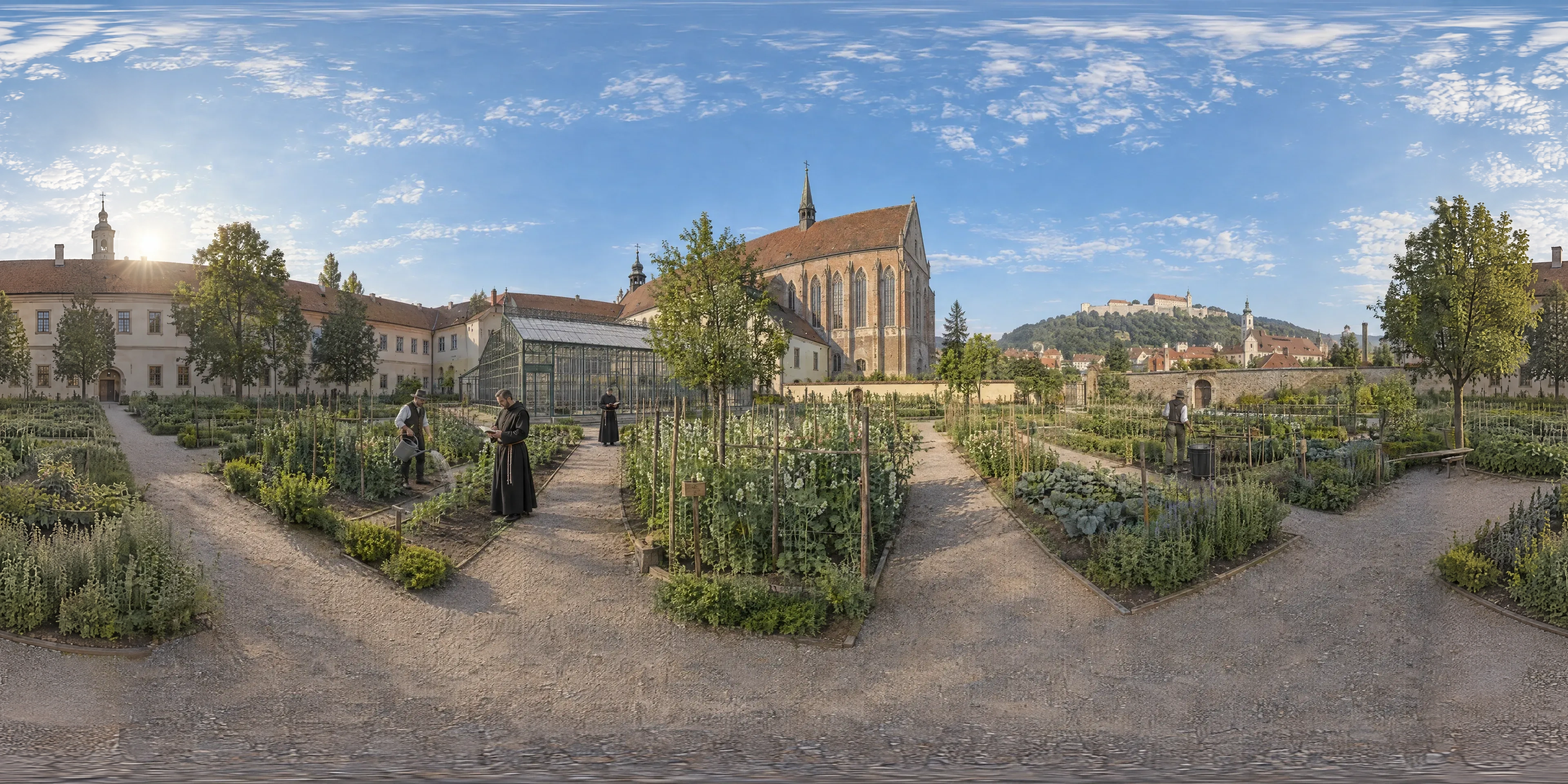
Between 1856 and 1863 the Augustinian friar Gregor Mendel grows and records some 28,000 plants, most of them peas, in the garden of St Thomas's Abbey in Old Brno. In 1865 he presents the results to the Brno natural history society, laying down the laws of heredity that make him the father of genetics.
- Year
- 1860s
- Where
- Moravia · CZ
- Era
- Industrial
- Coordinates
- 49.191, 16.593
The moment
Twenty-eight thousand plants in a monastery garden
Between 1856 and 1863 Gregor Mendel, an Augustinian friar, grew and recorded some 28,000 plants, most of them peas, in the garden of St Thomas's Abbey in Old Brno. He followed seven traits: seed shape, flower colour, seed-coat colour, pod shape, the colour of unripe pods, flower position and plant height.
By crossing varieties and counting their offspring generation after generation, he found that traits were passed on in regular, predictable ratios. Those patterns are now taught as Mendel's laws of heredity.
The garden lay below Špilberk hill. The abbey occupied a former Cistercian convent, long Baroque wings beside the tall Gothic basilica of the Assumption in bare red brick, and Mendel's small glass greenhouse stood in its quadrangle.
A friar who studied under Doppler
Mendel was born on 20 July 1822 in Heinzendorf, in Austrian Silesia, today's Hynčice in the Czech Republic. He entered St Thomas's Abbey and took the name Gregor.
The abbey invested in him. In 1851 it sent him to the University of Vienna, where he studied under the physicist Christian Doppler. Five years later he began counting peas.
Thirty-five years of silence
On 8 February and 8 March 1865 Mendel presented his results to the Natural History Society of Brno. The society published his paper, "Experiments on Plant Hybridization", in 1866, and almost nobody noticed: in the next 35 years it was cited about three times.
In 1868 he became abbot, and administration ended his experiments. He kept bees, recorded the weather, was among the founders of the Austrian Meteorological Society in 1865, and died in Brno on 6 January 1884.
In 1900 three botanists, Hugo de Vries, Carl Correns and Erich von Tschermak, independently rediscovered his work. The friar of Old Brno became the father of genetics sixteen years after his death.
Why Brno claims him
Mendel's laws are taught in every Czech school biology class. Brno claims him as the country's greatest contribution to world science, and he appears in the top hundred of the Greatest Czech poll.
The claim is shared. Mendel was a German-speaking Silesian in Austrian Moravia, and Czechia, Austria and Germany all count him as their own.
Science has kept returning to him. In 2021 his remains were exhumed for DNA analysis, and his own genome turned out to carry a predisposition to heart problems: the man who founded genetics, read by genetics at last.
Sources
Further reading
Tagged
- czechia
- moravia
- brno
- gregor-mendel
- genetics
- science
- 19th-century
- everyday-life
Published
See also

1839
Gräfenberg Spa, Jeseník
In 1839 some 1,500 patients, among them a monarch, 22 princes and 149 counts and countesses, climb to Gräfenberg in the Jeseníky mountains of Austrian Silesia to take the cold-water cure of Vincenz Priessnitz, a self-taught farmer whose spa is the first hydrotherapy resort in the world; 120 doctors come to study his methods.

1897
Giant Ferris Wheel, Prater, Vienna
On 3 July 1897, a hot summer day, Vienna's Giant Ferris Wheel opens in the Prater, built by English engineers for the jubilee of Emperor Franz Joseph's 50 years on the throne. Its 30 cabins turn up to 64.75 m above the canals of the 'Venice in Vienna' pleasure park, making it one of the largest wheels in the world; a ride costs a gulden.

1810
Theresienwiese, Munich
On 17 October 1810 a horse race on a meadow outside Munich crowns the celebrations for the wedding of Crown Prince Ludwig of Bavaria and Princess Therese of Saxe-Hildburghausen; 50,000 spectators watch from the hillside, and the field is named Theresienwiese after the bride. Repeated the next year, the race becomes the Oktoberfest.