Mikulčice-Valy, Great Moravia
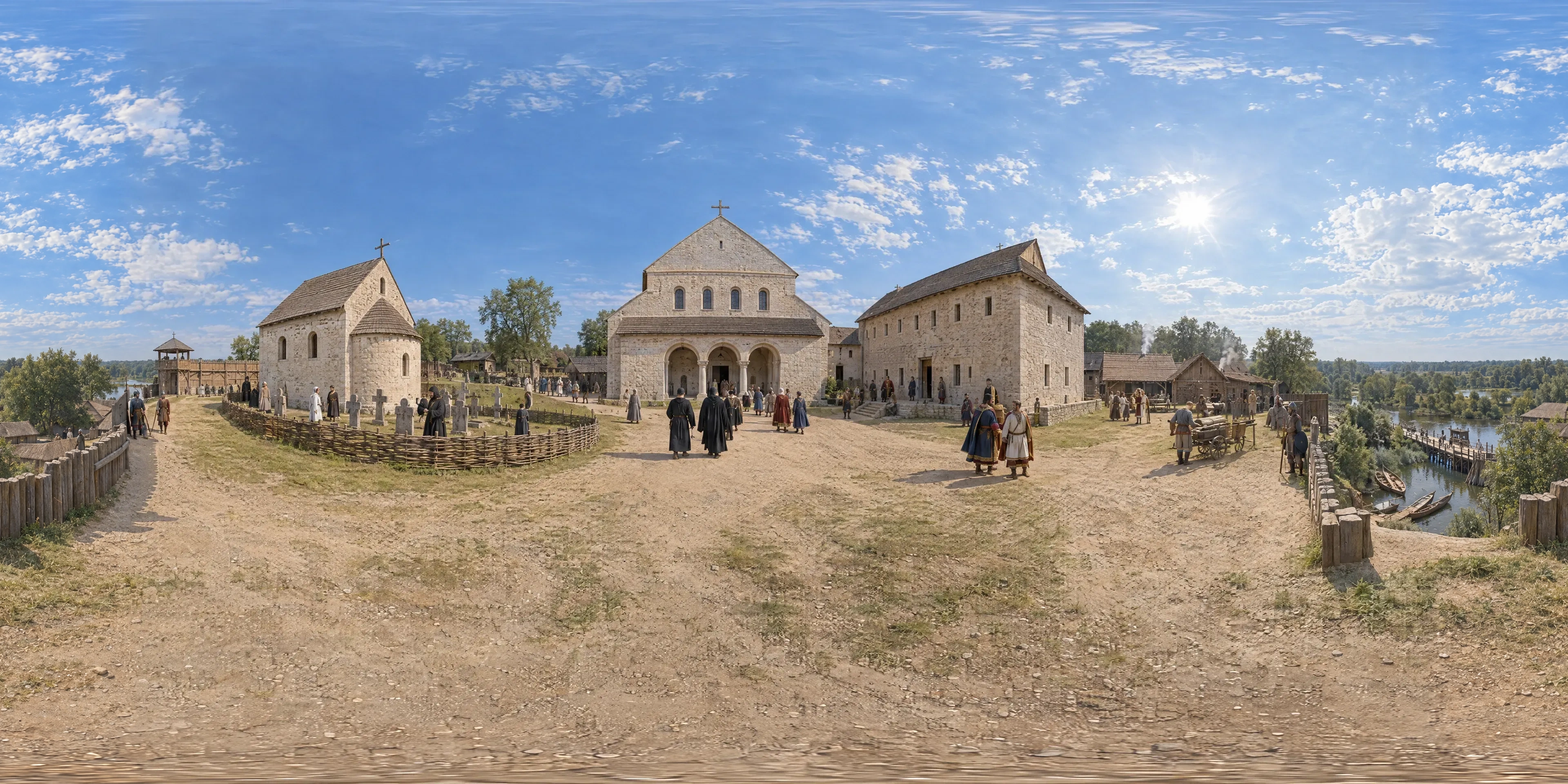
In 863 the Byzantine brothers Constantine (later Cyril) and Methodius arrive in Prince Rastislav's Great Moravia with a liturgy in Slavonic and the new Glagolitic script. Mikulčice, a princely stronghold among the arms of the Morava and a leading candidate for Rastislav's seat, already has a stone basilica and several churches.
- Year
- 863
- Where
- Moravia · CZ
- Era
- Medieval
- Coordinates
- 48.804, 17.087
The moment
A prince asked Constantinople for teachers
In 862 Prince Rastislav of Great Moravia asked the Byzantine emperor Michael III to send missionaries to his Slavic subjects. In 863 two brothers arrived: Constantine, later known as Cyril, and Methodius.
They brought something new. They were translating the Gospels and the liturgy into Slavonic and had devised an alphabet for it, the Glagolitic script, the first used for Slavonic manuscripts.
It was also politics. Rastislav, who ruled from 846, stood in a long contest between Frankish and Byzantine influence over who would Christianise Moravia.
Churches among the river channels
Mikulčice, in the wooded floodplain of the Morava in southern Moravia, is a leading candidate for Rastislav's seat. Its acropolis of about six hectares stood on raised ground ringed by slow river channels, behind a timber-framed rampart faced with stone, and a long wooden bridge crossed to the outer bailey.
By 863 it already had stone churches. Archaeologists have found at least eleven, among them church 3, a three-aisled basilica about 35 metres long and 11 wide, with an eastern apse, a western atrium and a narthex, built of stone brought from the White Carpathians. It is the largest church known from Great Moravia, and near it stood a stone princely hall of about 26 by 10 metres.
The graves describe the court. More than 2,600 burials have been excavated since Josef Poulík began large-scale digging in 1955: nobles with swords, spurs and gilded spherical buttons called gombíky, women with gold earrings shaped like bunches of grapes.
Nobody wrote down where the brothers arrived
The sources say the mission came to Rastislav; they do not say where. Mikulčice and Staré Město near Uherské Hradiště both claim to be his seat, and placing the brothers here is a reasonable guess, not a recorded fact. Their route and the season of their arrival are unknown too.
What followed is better documented. Pope Adrian II authorised the Slavonic liturgy, and Constantine became a monk in Rome, took the name Cyril, and died there on 14 February 869. Methodius, made archbishop with jurisdiction over Moravia and Pannonia, died on 6 April 885, and his disciples, expelled from Great Moravia, carried Slavonic letters to Bulgaria.
Mikulčice did not outlast the state. Settled perhaps from the eighth century, it faded with the collapse of Great Moravia early in the tenth.
Why Czechs keep 5 July
The Czech state holiday on 5 July honours Cyril and Methodius as the bringers of Slavonic letters. For Czechs the mission is the founding story of writing in a Slavic language, and it puts Moravia at the very start of their history.
The inheritance is shared. Great Moravia and the mission are Slovak national heritage too, and the modern border runs through the old landscape: about two kilometres east, across the Morava in Slovakia, the church of St Margaret of Antioch at Kopčany dates to the ninth century.
Mikulčice is on UNESCO's tentative list for World Heritage status. Only foundations survive, and the reconstructed shingle roofs are an informed guess.
Sources
Further reading
Tagged
- czechia
- moravia
- great-moravia
- cyril-and-methodius
- early-medieval
- christianity
- slavs
- archaeology
Published
See also

960s
Malá Strana below Prague Castle
Around 965 the traveller Ibrahim ibn Yaqub finds Prague the richest trading place of the region: Rus and Slav merchants from Kraków and Muslim and Jewish traders from the east meet in the settlement below the Přemyslid castle, where saddles, bridles and shields are made and slaves, tin and furs are sold.

1357
Charles Bridge, Prague
In 1357 Emperor Charles IV lays the foundation stone of a new stone bridge on the Old Town bank near St Clement's, fifteen years after ice and floodwater wrecked the Judith Bridge. Tradition sets the moment at 5:31 on 9 July, a palindrome of odd numbers; the bridge will take 45 years to finish.

1250s
Cliff Palace, Mesa Verde
Around 1250, the Ancestral Puebloans build Cliff Palace into a sandstone alcove high in a Colorado canyon wall: over a hundred and fifty rooms and two dozen round ceremonial kivas tucked beneath an overhang, the largest cliff dwelling in North America.