Národní třída, Prague
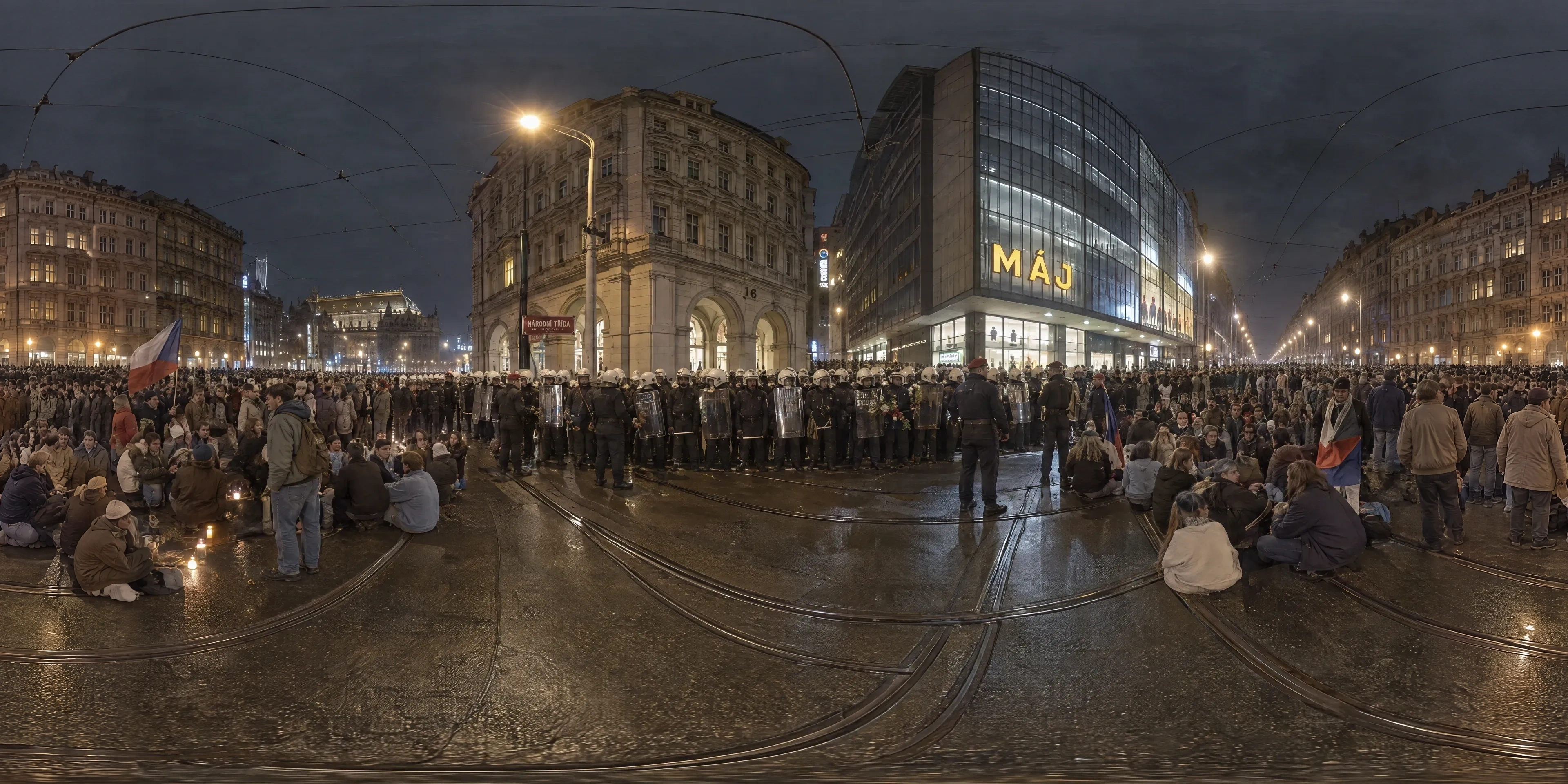
On the evening of 17 November 1989 a student march marking fifty years since the Nazis closed the Czech universities is trapped on Národní třída between police cordons. About ten thousand people sit down before the white helmets with candles and flowers, chanting 'We have bare hands!', until the riot police beat them; outrage at the attack starts the Velvet Revolution.
- Year
- 1989
- Where
- Bohemia · CZ
- Era
- Contemporary
- Coordinates
- 50.082, 14.419
The moment
A march for an anniversary
On 17 November 1989 Prague students marked fifty years since the Nazis stormed the Czech universities, and since the death of the student Jan Opletal. In November 1939 about 1,200 students had been arrested and nine killed.
Some 15,000 people set out from Albertov and walked to the grave of the poet Karel Hynek Mácha at Vyšehrad. Then, with banners and chants against the regime, the march turned toward the city centre.
"We have bare hands"
On Národní třída it was stopped. Police cordons closed the avenue in front and behind, trapping about ten thousand people between them.
Ahead, where the avenue meets Spálená street by the Máj department store of 1975, stood a wall of riot police of the Public Security emergency regiment, in white helmets with shields and batons, and behind them a special unit in red berets. The students in front sat down on the cold asphalt, lit candles, pushed flowers toward the shields, raised their empty hands and chanted "Máme holé ruce", we have bare hands.
Later that night the riot police attacked the trapped crowd, and hundreds were injured. Since 1990 a memorial plaque in the arcade of the building at No. 16 has marked what happened.
A rumour and a revolution
Outrage spread across the country. A false report that a student, Martin Šmíd, had been killed went round Prague; it was refuted days later, but by then it had helped bring thousands more onto the streets.
On 19 November the opposition founded Civic Forum. On 27 November a two-hour general strike was backed across the country, and at the end of the month the Communist Party gave up its constitutional monopoly on power.
On 29 December Václav Havel was elected president. In June 1990 Czechoslovakia held its first democratic elections since 1946.
Two anniversaries in one holiday
17 November is a Czech state holiday, the Day of the Struggle for Freedom and Democracy, and it carries both anniversaries: the students of 1939 and the students of 1989. The police attack on Národní třída is the spark every Czech names as the start of the Velvet Revolution.
That night, at the far end of the avenue toward the river, the National Theatre and its glass-clad New Stage of 1983 stood behind the second cordon.
The weather and the exact placing of the candles are not recorded. The chant is, and so are the white helmets it was addressed to.
Sources
Further reading
Tagged
- czechia
- prague
- velvet-revolution
- 1989
- students
- narodni-trida
- communism
- 20th-century
Published
See also

1939
Lower Wenceslas Square, Prague
On the morning of 15 March 1939, in a heavy fall of wet snow, German columns roll down Wenceslas Square as Hitler's troops occupy what remains of Czechoslovakia. Thousands of Praguers watch from the pavements, weeping, booing and singing the national anthem; that evening Hitler reaches Prague Castle, and the next day he proclaims the Protectorate of Bohemia and Moravia.

1918
Wenceslas Square, Prague
Late in the morning of 28 October 1918, as news spreads that Austria-Hungary has accepted President Wilson's terms, crowds pour onto Wenceslas Square and the priest Isidor Zahradník proclaims an independent Czechoslovak state at the St Wenceslas monument. That evening the National Committee passes the new republic's first law.

1968
National Museum, Wenceslas Square, Prague
On the morning of 21 August 1968, hours after Warsaw Pact armies invaded to crush the Prague Spring, Soviet tanks coming from Vinohradská rake the facade of the National Museum with machine-gun fire. Praguers fill the upper square, surround the tanks to argue with their crews and cover the statue of St Wenceslas with flags and slogans.