Holy Trinity Column, Upper Square, Olomouc
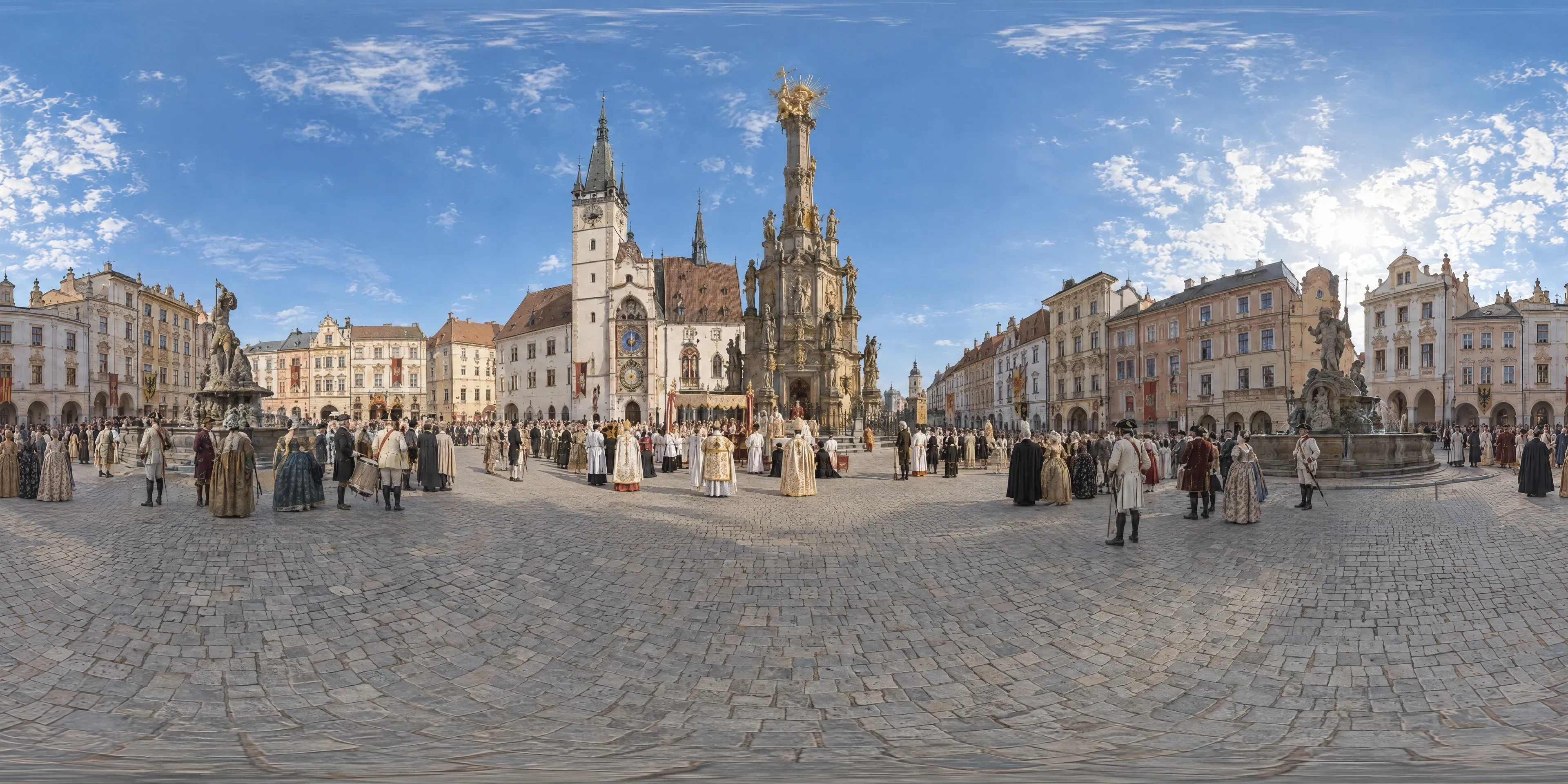
On 9 September 1754 Olomouc consecrates its Holy Trinity Column, 38 years in the making and raised entirely by local masters, in the presence of Empress Maria Theresa and Emperor Francis I. With its gilded copper Trinity and a chapel inside its base, it has no equal among the Baroque columns of Central Europe.
- Year
- 1754
- Where
- Moravia · CZ
- Era
- Early modern
- Coordinates
- 49.594, 17.250
The moment
A monument that outlived its makers
The Holy Trinity Column in Olomouc took 38 years to build, from 1716 to 1754. It was the idea of Wenzel Render, a mason and privileged imperial architect who pressed it on the city council, and he was the first of its makers to die before it was finished.
He was not the last. The masons Franz Thoneck, Johann Wenzel Rokický and Augustin Scholtz all died during the work, and it was Johann Ignaz Rokický who completed the structure.
The sculptors fared little better. Philipp Sattler began the decoration; Andreas Zahner carved 18 sculptures and 9 reliefs in seven years before his own death; and the goldsmith Simon Forstner, who made the gilded copper figures, lost his health to the mercury used in fire-gilding.
Gold, copper and a chapel inside
The result stands about 32 metres high, in three tiers of pale stone. At the top the gilded copper Holy Trinity is joined by the Archangel Michael, and below it on the shaft the gilded Virgin rises in her Assumption.
Around the base stand more stone saints and fourteen reliefs, and inside it is something no ordinary column has: a small chapel, with reliefs of Old Testament sacrifices and the Crucifixion. The whole was raised by local masters.
It began partly as thanksgiving. A plague struck Moravia between 1713 and 1715, and the column celebrates the Catholic faith and gratitude for its end.
An empress at the consecration
On 9 September 1754 the column was consecrated in a great ceremony attended by Empress Maria Theresa and her husband, Emperor Francis I. The Upper Square around it already had its free-standing town hall with a tall Gothic tower, and on the north wall the pointed niche of the astronomical clock.
Nearby played the Hercules fountain of 1688 and the Caesar fountain of 1725. The clock in its niche is now a socialist-realist remake of 1955, and the Arion fountain arrived only in 2002.
Four years after the consecration, during the Prussian siege of 1758, the column was hit several times. A gilded replica of a stone shot now marks one of the strikes.
The peak of Czech Baroque
UNESCO inscribed the column on the World Heritage List in 2000 as one of the most exceptional examples of the apogee of Central European Baroque art. It is the largest Baroque sculptural group in the Czech Republic.
For Czechs it is the crowning monument of their Baroque, the century of Maria Theresa that shaped the look of countless towns, with their columns, churches and fountains.
That age is remembered with mixed feelings. The splendour of Catholic Baroque is read in Czech memory against the forced re-Catholicisation that followed White Mountain. The column holds both stories: the faith of the Habsburg state, and the skill of Olomouc's own craftsmen, several of whom did not live to see it finished.
Sources
Further reading
Tagged
- czechia
- moravia
- olomouc
- baroque
- maria-theresa
- unesco
- holy-trinity-column
- early-modern
Published
See also

1741
Coronation Hill, Pressburg (Bratislava)
Sunday, 25 June 1741: freshly crowned in St Martin's Cathedral, 24-year-old Maria Theresa rides up an earthen mound by the Danube and swings St Stephen's sword to the four corners of the world, vowing to defend Hungary. That September the Hungarian estates, gathered in this city, pledged her 'our life and blood' and saved her throne.

1618
Prague Castle (Ludwig Wing)
On May 23, 1618, Bohemian Protestant nobles throw two imperial Catholic regents out of the upper window of the Ludwig Wing of Prague Castle, triggering the Thirty Years' War.

1650s
Tōkaidō road, Mt. Fuji
Around 1650 AD, a daimyō and his retinue of 2,000 retainers march along the Tōkaidō road past Mt. Fuji on the mandatory alternate-year residence journey to Edo: the Tokugawa shogunate's masterstroke of social control.