Parliament, Vienna
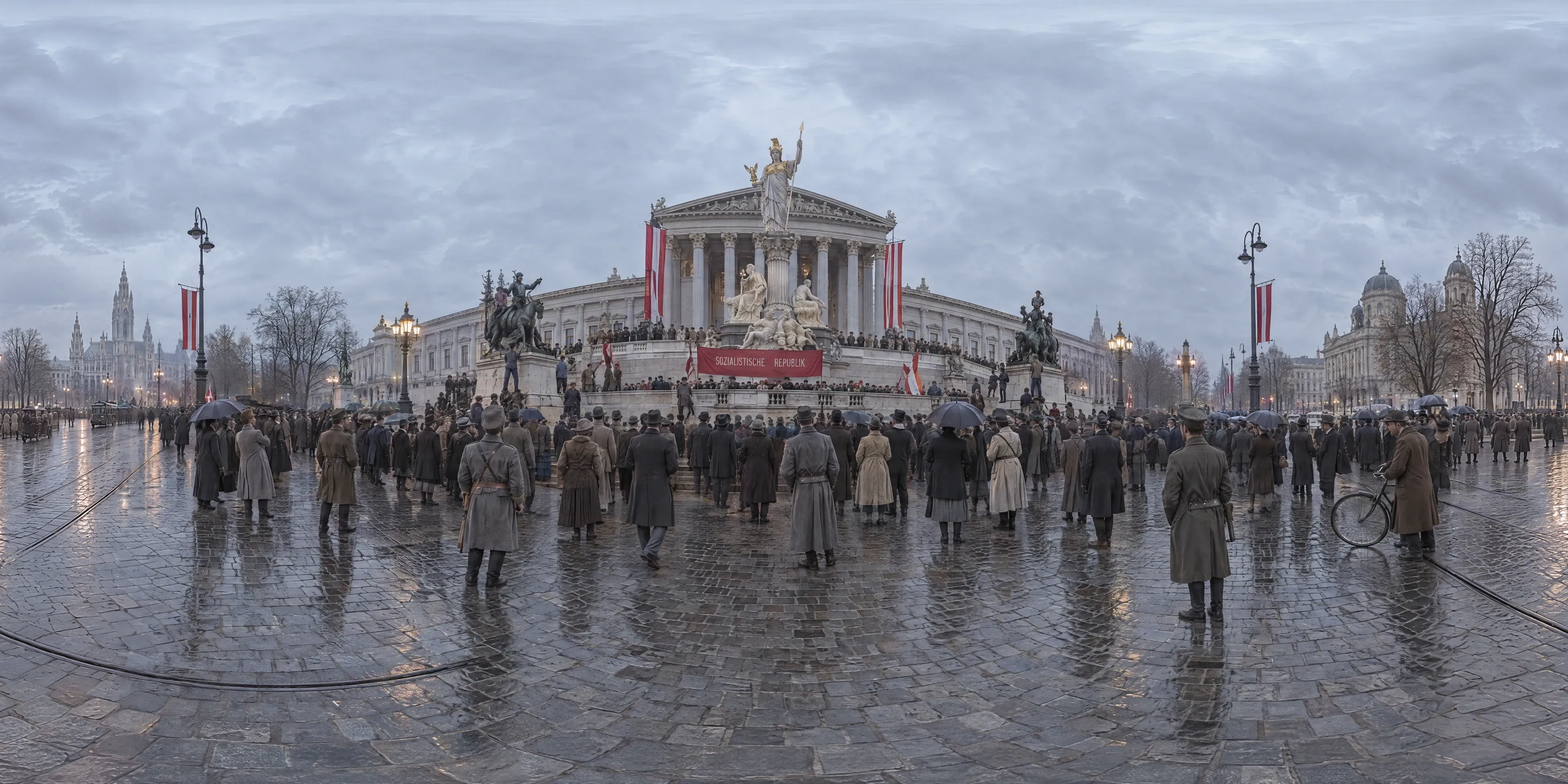
Shortly before four on the afternoon of 12 November 1918, the day after Emperor Karl gave up power, the presidents of the Provisional National Assembly proclaim the Republic of German-Austria from the ramp of the Parliament to tens of thousands standing in the rain. As red-white-red flags go up, Red Guards tear out their white stripes.
- Year
- 1918
- Where
- Vienna · AT
- Era
- modern_early
- Coordinates
- 48.208, 16.360
The moment
The emperor withdrew in pencil
On 11 November 1918, at Schönbrunn Palace, Emperor Karl signed a declaration renouncing any share in the affairs of state. It was not a formal abdication, and he signed it in pencil.
The next day the Provisional National Assembly met in the Parliament on the Ringstraße. The session opened at three in the afternoon, nineteen minutes late, and by a quarter to four it had passed, in about a minute, the law on the form of state: German-Austria was a democratic republic.
Proclaimed from the ramp
Shortly before four the assembly's leaders stepped out onto the ramp before tens of thousands. Franz Dinghofer, one of its three presidents with Jodok Fink and Karl Seitz, spoke on the steps. The State Chancellor, Karl Renner, made an emphatic appeal, and Seitz spoke briefly after him.
The day was sunless, grey and foggy, with heavy rain from midday and darkness closing in early. Estimates of the crowd vary widely, from 30,000 to well over 100,000.
They stood before Theophil Hansen's Greek-revival Parliament of 1883: a portico of Corinthian columns above a broad double ramp with bronze horse tamers, and in front the Pallas Athene fountain of 1902.
Red, white and red, then only red
As the new red-white-red flags went up, members of the Red Guard, a band of left-wing radicals who wanted a socialist republic, tore out the white stripes and hoisted what was left.
Later that afternoon the mood turned. Shots were fired, panic broke out, and two people died in the crush.
The law's second article went further than its first. It declared German-Austria part of the German Republic. The Treaty of Saint-Germain, signed on 10 September 1919, ruled out the union, and on 21 October 1919 the state took the name Republic of Austria.
Why 12 November is a date every Austrian knows
The proclamation ended some 640 years of Habsburg rule. Karl never ruled again: he went into exile in Switzerland in March 1919, and the Habsburg Law that followed banished him and confiscated the family's property.
In the First Republic 12 November was a state holiday. Today Austria's National Day falls on 26 October, but the founding of the republic on the Parliament ramp is a date every Austrian meets in school.
It is also a complicated birthday. The republic proclaimed that afternoon wanted to join Germany, and it took another war, and a new start in 1945, before most Austrians embraced a state of their own.
Sources
Further reading
Tagged
- austria
- vienna
- first-republic
- 1918
- parliament
- end-of-monarchy
- 20th-century
- ringstrasse
Published
See also

1918
Wenceslas Square, Prague
Late in the morning of 28 October 1918, as news spreads that Austria-Hungary has accepted President Wilson's terms, crowds pour onto Wenceslas Square and the priest Isidor Zahradník proclaims an independent Czechoslovak state at the St Wenceslas monument. That evening the National Committee passes the new republic's first law.

1869
Court Opera on the Ringstraße, Vienna
On the evening of 25 May 1869 Emperor Franz Joseph opens the new Court Opera, the first great public building on Vienna's Ringstraße, with Mozart's Don Giovanni sung in German. Neither of its architects lives to see the night: both died in 1868, after Viennese mockery of the 'sunken box'.

1955
Upper Belvedere, Vienna
Around noon on Sunday 15 May 1955, just after the State Treaty is signed in the Marble Hall of the Upper Belvedere, Foreign Minister Leopold Figl steps onto the balcony with the Allied foreign ministers and holds up the signed treaty to the crowd waiting in the palace garden. After ten years of occupation, Austria is free.