St Paul's Church, Frankfurt
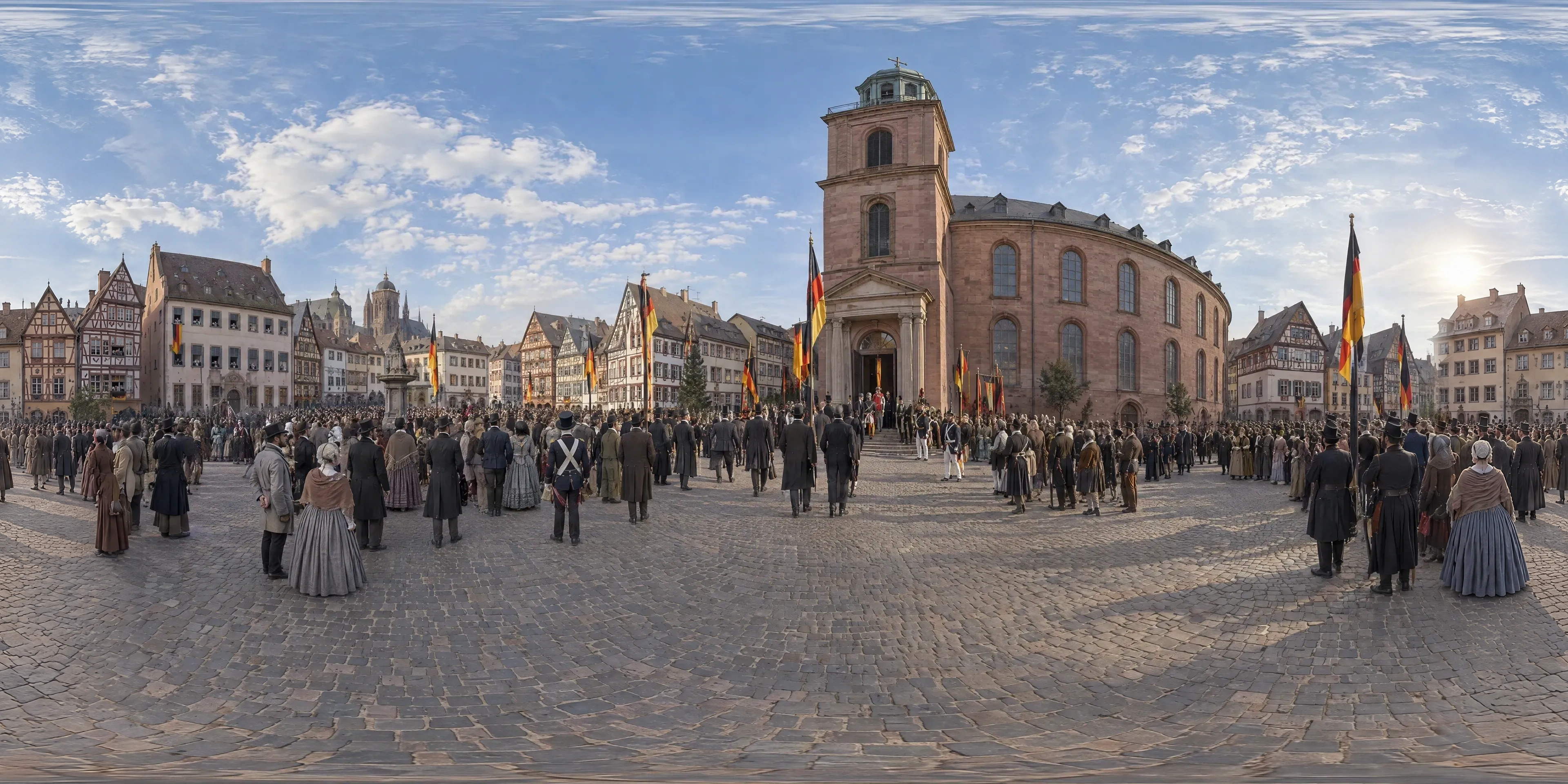
On 18 May 1848 the first freely elected all-German parliament gathers in the Kaisersaal of the Römer and then walks in solemn procession, several hundred deputies strong, to St Paul's Church, hung inside with the new black-red-gold colours. The National Assembly will draft Germany's first democratic constitution.
- Year
- 1848
- Where
- Hesse (Free City of Frankfurt) · DE
- Era
- Industrial
- Coordinates
- 50.111, 8.681
The moment
A parliament walked to church
On 18 May 1848 the first freely elected parliament for all of Germany gathered in the Kaisersaal of the Römer, Frankfurt's town hall. Then its members walked in solemn procession across the old town to St Paul's Church.
Accounts of how many took part range from 330 to 382 deputies. Inside, the church was hung with black, red and gold, the colours the German Confederation had adopted that March.
The assembly chose as its president Heinrich von Gagern, one of the best-known liberals in Germany.
A new church for a new politics
St Paul's was itself new. Built of red Main sandstone between 1789 and 1833, it was a great oval hall with two tiers of tall round-arched windows under a high curved roof. A square tower about 55 metres high rose on its south side, entered through a portal of Doric half-columns.
Around the square stood tall old-town houses, many of them timber-framed. To the east, over the roofs, rose the Gothic tower of St Bartholomew's, still capped by a low provisional dome; its steep ribbed dome and lantern came only in 1877.
The professors' parliament
Over its lifetime some 809 to 830 men sat in the assembly. More than three-quarters had studied at university, and so many were academics and senior officials that it was mocked as the professors' parliament.
On 28 March 1849 it adopted a constitution with a catalogue of basic rights and offered the crown of a German empire to Frederick William IV of Prussia. He refused it, calling such a constitution and such an offer an abridgement of the rights of the princes.
The remaining deputies moved to Stuttgart, where the rump parliament was dispersed in June 1849. The revolution had failed.
Why Germans call it the cradle of democracy
Its work did not vanish. The basic rights of 1849 shaped the Weimar constitution of 1919 and the Basic Law of 1949, and black, red and gold is the flag of Germany today.
The church burned in a bombing raid on 18 March 1944. It was rebuilt in time for the centenary and reopened on 18 May 1948, with a flat roof in place of the old one. In 2019 the decision was taken to keep that post-war form rather than restore the look of 1848.
Today the Paulskirche is a place of ceremony rather than worship. John F. Kennedy spoke here in June 1963, and every year the Peace Prize of the German Book Trade is awarded under its roof. For Germans it is the cradle of their democracy, the room where a democratic Germany was first written down, seventy years before the Weimar Republic made one real.
Sources
Further reading
Tagged
- germany
- frankfurt
- 1848-revolution
- democracy
- national-assembly
- black-red-gold
- 19th-century
- paulskirche
Published
See also

1810
Theresienwiese, Munich
On 17 October 1810 a horse race on a meadow outside Munich crowns the celebrations for the wedding of Crown Prince Ludwig of Bavaria and Princess Therese of Saxe-Hildburghausen; 50,000 spectators watch from the hillside, and the field is named Theresienwiese after the bride. Repeated the next year, the race becomes the Oktoberfest.

1869
Court Opera on the Ringstraße, Vienna
On the evening of 25 May 1869 Emperor Franz Joseph opens the new Court Opera, the first great public building on Vienna's Ringstraße, with Mozart's Don Giovanni sung in German. Neither of its architects lives to see the night: both died in 1868, after Viennese mockery of the 'sunken box'.

1897
Giant Ferris Wheel, Prater, Vienna
On 3 July 1897, a hot summer day, Vienna's Giant Ferris Wheel opens in the Prater, built by English engineers for the jubilee of Emperor Franz Joseph's 50 years on the throne. Its 30 cabins turn up to 64.75 m above the canals of the 'Venice in Vienna' pleasure park, making it one of the largest wheels in the world; a ride costs a gulden.