Petrov Hill, Brno
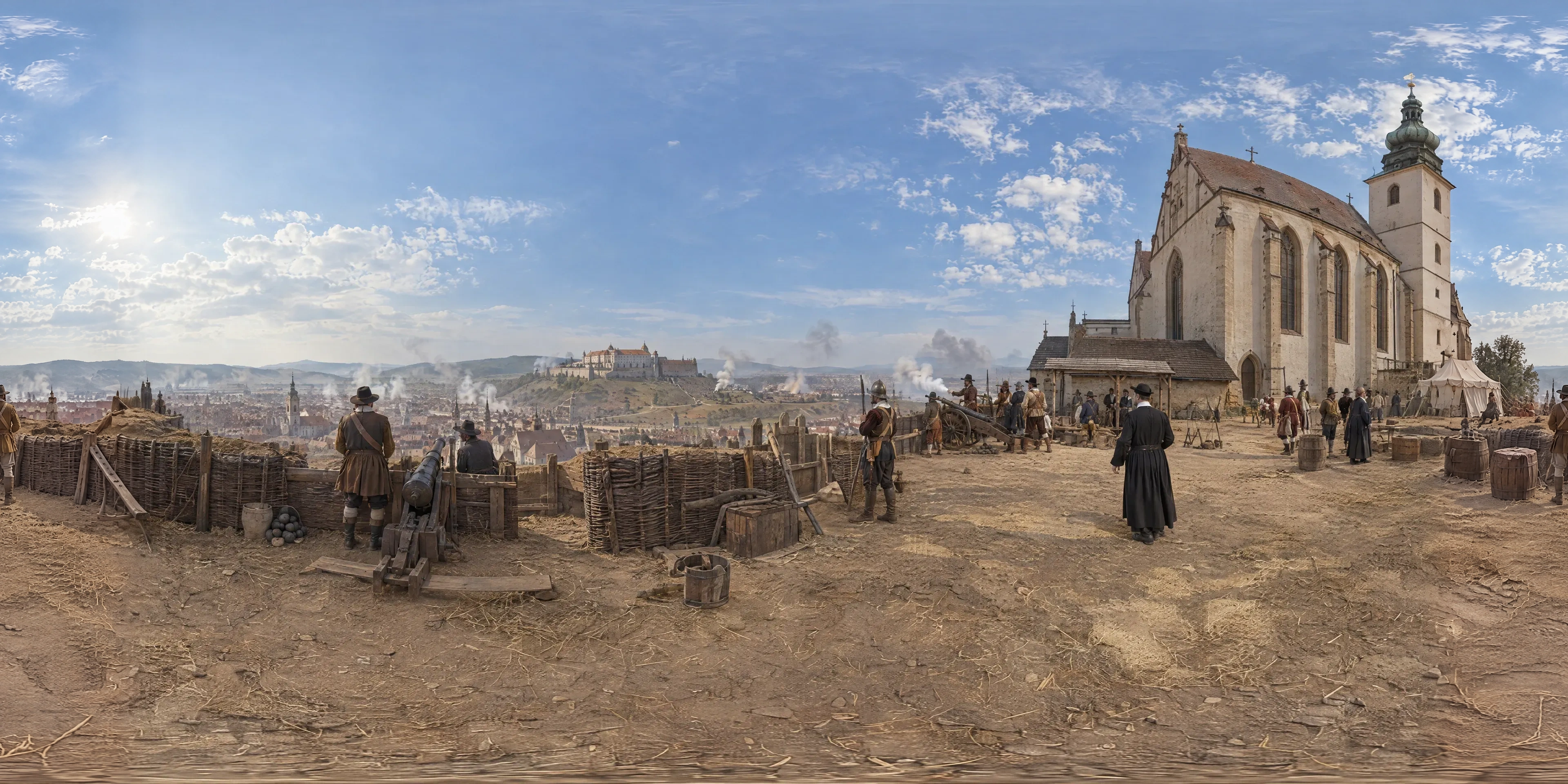
On 15 August 1645, after more than three months of siege, some 28,000 Swedes under Lennart Torstensson launch their general assault on Brno, held by about 1,500 soldiers, burghers and Jesuit students under Louis Raduit de Souches. The attack fails by evening; legend says the city was saved by ringing noon an hour early, which the Petrov bells still do every day at eleven.
- Year
- 1645
- Where
- Moravia · CZ
- Era
- Early modern
- Coordinates
- 49.191, 16.607
The moment
Twenty-eight thousand against fifteen hundred
On 3 May 1645, late in the Thirty Years' War, a Swedish army of about 28,000 men under Lennart Torstensson laid siege to Brno.
Its garrison was tiny. Louis Raduit de Souches commanded 426 regular soldiers and 1,049 armed burghers, 1,475 men in all, together with a company of students from the Jesuit college.
He kept his post on Petrov hill, at the south-west corner of the walls, beside the Gothic church of St Peter and Paul. To the north-west, the castle of Špilberk was still a medieval fortress, patched with earth bastions and timber palisades.
Roofs stripped to the rafters
The defenders prepared for fire. They pulled the wooden shingles off the town's roofs so that burning shot would find nothing to catch, and set barrels of water in the attics.
Outside the walls they levelled the suburbs for 600 paces, leaving the besiegers no cover. The Swedes dug zigzag trenches and batteries through the scorched ground of Staré Brno instead.
On 15 August, Assumption Day, after more than three months, Torstensson ordered a general assault. His guns opened at five in the morning, and his troops attacked at six points at once. By evening every attack had been beaten back, and on 23 August the Swedes marched away.
The bells that ring noon at eleven
Brno tells the ending differently. The legend says the Swedes had resolved to give up if the town had not fallen by noon, so the defenders rang the noon bells an hour early, and the attackers withdrew.
Historians say it is not true: the assault went on until evening and was defeated outright. The legend has won anyway. The bells of Petrov ring noon at eleven o'clock every day.
In 2010, for the 365th anniversary, the city added a black stone clock on Náměstí Svobody. At eleven each morning it releases a glass marble that anyone standing at one of its four openings can catch and keep.
How a siege made a capital
The emperor Ferdinand III rewarded the town. Brno received six years' exemption from taxes and, in 1647, trade fair privileges, and its burghers were rewarded; de Souches was made a count.
The victory also settled Brno's standing. The siege helped make it the capital of Moravia for good, ahead of its rival Olomouc.
That is why the siege is the city's founding legend of pride. The Petrov church no longer looks as it did: its neo-Gothic twin spires were added only in 1904 to 1909, and Špilberk was rebuilt as a Baroque fortress. The eleven o'clock bells are the part of 1645 that visitors still hear.
Sources
Further reading
Tagged
- czechia
- moravia
- brno
- thirty-years-war
- siege
- swedes
- early-modern
- spilberk
Published
See also

1618
Prague Castle (Ludwig Wing)
On May 23, 1618, Bohemian Protestant nobles throw two imperial Catholic regents out of the upper window of the Ludwig Wing of Prague Castle, triggering the Thirty Years' War.

1655
Jasna Góra, Częstochowa
On 27 December 1655, after almost six weeks of siege, the Swedish corps of General Burchard Müller marches away from Jasna Góra, the fortified Pauline monastery that guards the icon of the Black Madonna, held by some 250 monks, soldiers and local nobles under Prior Augustyn Kordecki. The news rallies the country against the Swedish invasion known as the Deluge.

1650s
Tōkaidō road, Mt. Fuji
Around 1650 AD, a daimyō and his retinue of 2,000 retainers march along the Tōkaidō road past Mt. Fuji on the mandatory alternate-year residence journey to Edo: the Tokugawa shogunate's masterstroke of social control.