Piazza del Duomo, Milan
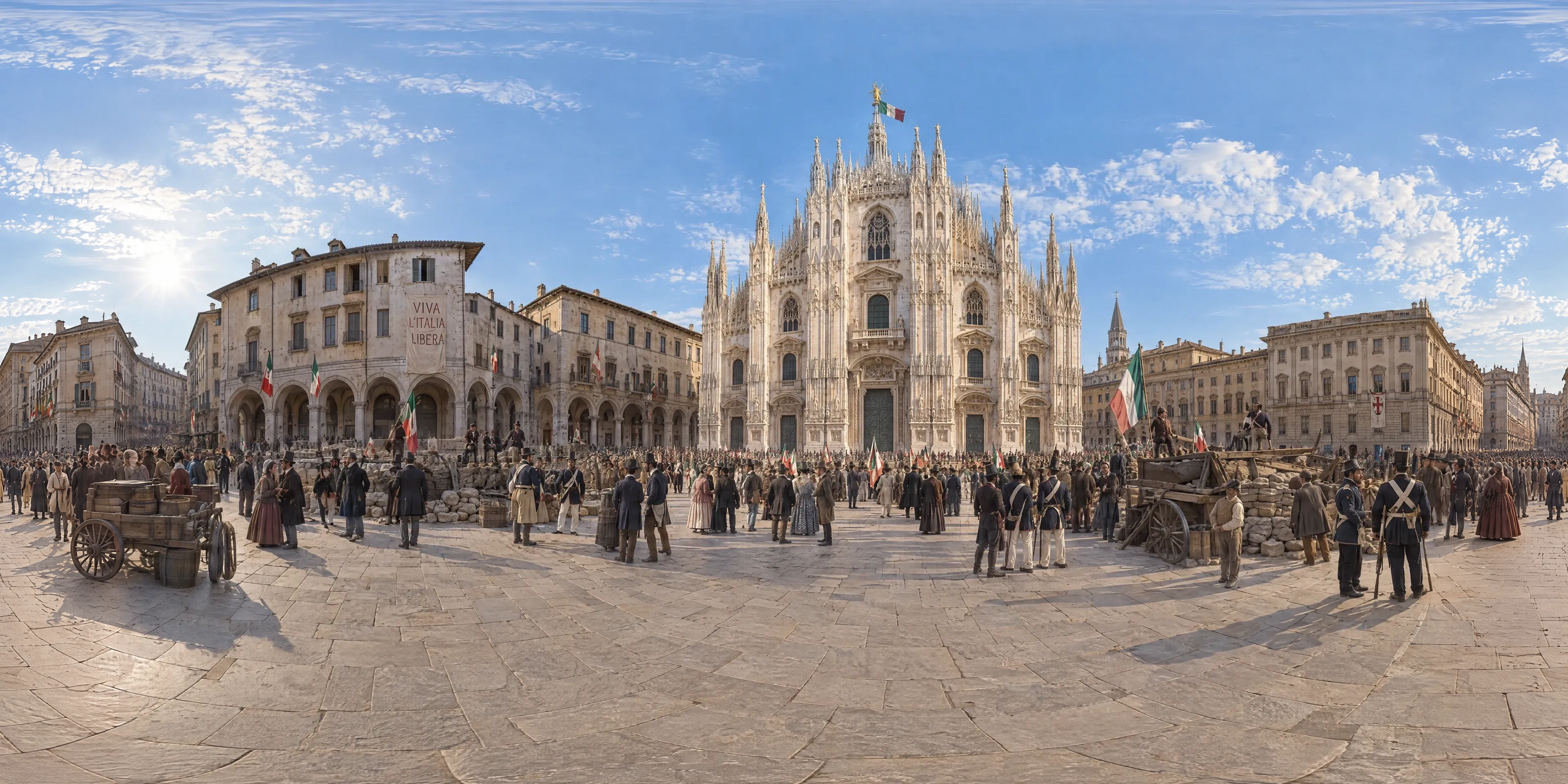
On the morning of 23 March 1848 Milan wakes up free: after five days of street fighting behind some 1,700 barricades, Marshal Radetzky's Austrian army has withdrawn in the night, and the square in front of the Duomo fills with tricolours. The Cinque Giornate became the founding legend of the Risorgimento.
- Year
- 1848
- Where
- Lombardy · IT
- Era
- Industrial
- Coordinates
- 45.464, 9.190
The moment
A city that stopped smoking
The revolution in Milan began with a boycott. From 1 January 1848 the Milanese refused to buy tobacco or to gamble, both state monopolies that earned the Austrian government more than five million lire a year.
Then, in March, news arrived that Vienna itself had risen and that Metternich had fallen. On 18 March Milan rose too.
Five days, 1,700 barricades
For five days, from 18 to 22 March, the city fought the garrison of Marshal Radetzky, some 12,000 men under a commander past eighty. The Milanese built about 1,700 barricades of paving stones, carts, barrels and furniture, and fought with no more than 600 to 650 firearms, plus stones and whatever else came to hand.
Carlo Cattaneo led a council of war, and Gabrio Casati, the podestà, headed the provisional government. Boys from the Martinitt orphanage carried messages across the barricades.
On 20 March two patriots, Luigi Torelli and Scipione Bagaggia, climbed to the gilded Madonnina on the cathedral's main spire and planted a green, white and red tricolour. On the night of 22 March Radetzky withdrew east toward the fortresses of the Quadrilateral. Between 409 and 424 Milanese had been killed, 43 of them women and children; the Austrians lost 181 dead.
The square before the Galleria
On the morning of 23 March the Piazza del Duomo filled with tricolours. It was far smaller and more irregular than the square of today.
The white Candoglia-marble façade of the cathedral had been finished only under Napoleon, after 1805. To one side stood the old royal palace and the jutting block of houses called the Rebecchino; along another ran the Coperto dei Figini, a fifteenth-century arcade of shops under 24 columns. There was no Galleria and no triumphal arch, no equestrian king and no Arengario.
The crowd wore frock coats and top hats, or the conical Calabrian hats that had become a patriotic fashion, with tricolour cockades. Whether Torelli's flag still flew on the spire that morning is not recorded.
The first great rising of the Risorgimento
The freedom did not last the summer. Piedmont's King Charles Albert declared war on Austria in support of the revolt, but after his defeat at Custoza on 24 and 25 July his army fell back on Milan and left it again by 6 August, and Radetzky reoccupied the city.
The memory outlasted the defeat. The Five Days are the first great popular uprising of the Risorgimento, taught in every Italian school, and remembered in Milan's Corso XXII Marzo and in street names across the country.
In 1895 the city unveiled Giuseppe Grandi's monument to the Five Days at Porta Vittoria. The square in front of the Duomo was rebuilt beyond recognition, but the cathedral and its Madonnina, where Torelli and Bagaggia raised their flag, still stand at its end.
Sources
Further reading
Tagged
- italy
- milan
- lombardy
- risorgimento
- 1848
- revolution
- duomo
- barricades
Published
See also

1839
Gräfenberg Spa, Jeseník
In 1839 some 1,500 patients, among them a monarch, 22 princes and 149 counts and countesses, climb to Gräfenberg in the Jeseníky mountains of Austrian Silesia to take the cold-water cure of Vincenz Priessnitz, a self-taught farmer whose spa is the first hydrotherapy resort in the world; 120 doctors come to study his methods.

1869
Court Opera on the Ringstraße, Vienna
On the evening of 25 May 1869 Emperor Franz Joseph opens the new Court Opera, the first great public building on Vienna's Ringstraße, with Mozart's Don Giovanni sung in German. Neither of its architects lives to see the night: both died in 1868, after Viennese mockery of the 'sunken box'.

1897
Giant Ferris Wheel, Prater, Vienna
On 3 July 1897, a hot summer day, Vienna's Giant Ferris Wheel opens in the Prater, built by English engineers for the jubilee of Emperor Franz Joseph's 50 years on the throne. Its 30 cabins turn up to 64.75 m above the canals of the 'Venice in Vienna' pleasure park, making it one of the largest wheels in the world; a ride costs a gulden.