Main Square, Plzeň
On 11 November 1842, at the St Martin's market, Plzeň first tastes the bottom-fermented pale beer of its new Burghers' Brewery, brewed on 5 October by the Bavarian brewer Josef Groll. The first pilsner is a hit, and the style it founded is now brewed all over the world.
- Year
- 1842
- Where
- Bohemia · CZ
- Era
- Industrial
- Coordinates
- 49.747, 13.377
The moment
Plzeň poured away thirty-six barrels
In February 1838 the councillors of Plzeň had 36 barrels of spoiled beer poured away. The town had brewed for centuries, ever since King Wenceslas II granted brewing rights to 260 of its citizens in 1295, and its beer was not good enough.
The burghers decided to start again. On 2 January 1839 an assembly resolved to build a brewery of their own, the Měšťanský pivovar, the Burghers' Brewery. Construction began on 15 September that year under Martin Stelzer and was finished in 1842.
A Bavarian brewer and a pale beer
To brew in the new house the burghers hired a Bavarian, Josef Groll, who brought the method of bottom fermentation. On 5 October 1842 his first mash was ready.
The result was a pale lager, made with the soft local water and hopped with Saaz hops. Groll himself did not stay: he worked in Plzeň only until April 1845.
First served at the St Martin's market
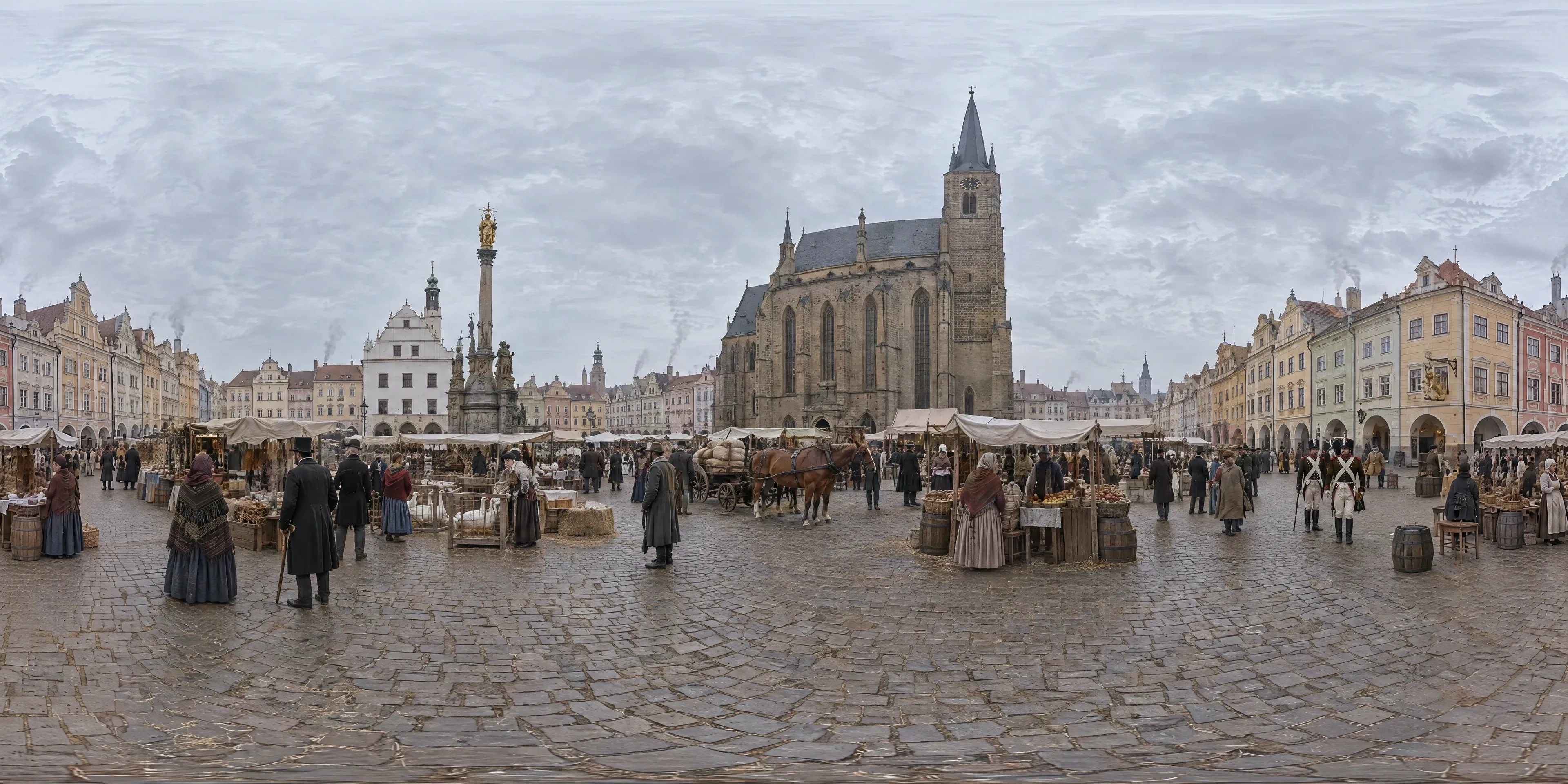
On 11 November 1842, St Martin's Day, the new beer was served for the first time, at the St Martin's market. The market filled the great main square of Plzeň, about 200 by 145 metres, with the Gothic church of St Bartholomew standing in the middle.
The church's north tower, about 102 metres tall, had a new pointed roof, put up in 1837 after lightning burned the old one. On the north side stood the Renaissance town hall, its facade still plain: the sgraffito was added only in 1910. In the north-west corner stood the Baroque plague column of 1681.
Some details of that day are lost. Which inns first poured the beer, and what people drank it from, are not reliably recorded. The date is.
A town's name on the world's beer
The beer took the name of its town, Pilsen in German. The brewery registered "Pilsner Bier" as a trademark in 1859, and in 1898 adopted the name Pilsner Urquell, Plzeňský Prazdroj in Czech: the "original source".
The style it founded is now brewed all over the world, and by one estimate nine out of ten beers brewed today are pale lagers descended from it.
For Czechs, pilsner is their gift to the world's drinking culture and a pillar of national identity. Every Czech knows that the golden lager was born in Plzeň in 1842, on a November market day, under the tower of St Bartholomew.
Sources
Further reading
Tagged
- czechia
- west-bohemia
- plzen
- beer
- pilsner
- 19th-century
- market
- everyday-life
Published
See also

1839
Gräfenberg Spa, Jeseník
In 1839 some 1,500 patients, among them a monarch, 22 princes and 149 counts and countesses, climb to Gräfenberg in the Jeseníky mountains of Austrian Silesia to take the cold-water cure of Vincenz Priessnitz, a self-taught farmer whose spa is the first hydrotherapy resort in the world; 120 doctors come to study his methods.

1897
Giant Ferris Wheel, Prater, Vienna
On 3 July 1897, a hot summer day, Vienna's Giant Ferris Wheel opens in the Prater, built by English engineers for the jubilee of Emperor Franz Joseph's 50 years on the throne. Its 30 cabins turn up to 64.75 m above the canals of the 'Venice in Vienna' pleasure park, making it one of the largest wheels in the world; a ride costs a gulden.

1810
Theresienwiese, Munich
On 17 October 1810 a horse race on a meadow outside Munich crowns the celebrations for the wedding of Crown Prince Ludwig of Bavaria and Princess Therese of Saxe-Hildburghausen; 50,000 spectators watch from the hillside, and the field is named Theresienwiese after the bride. Repeated the next year, the race becomes the Oktoberfest.