Porta Pia, Rome
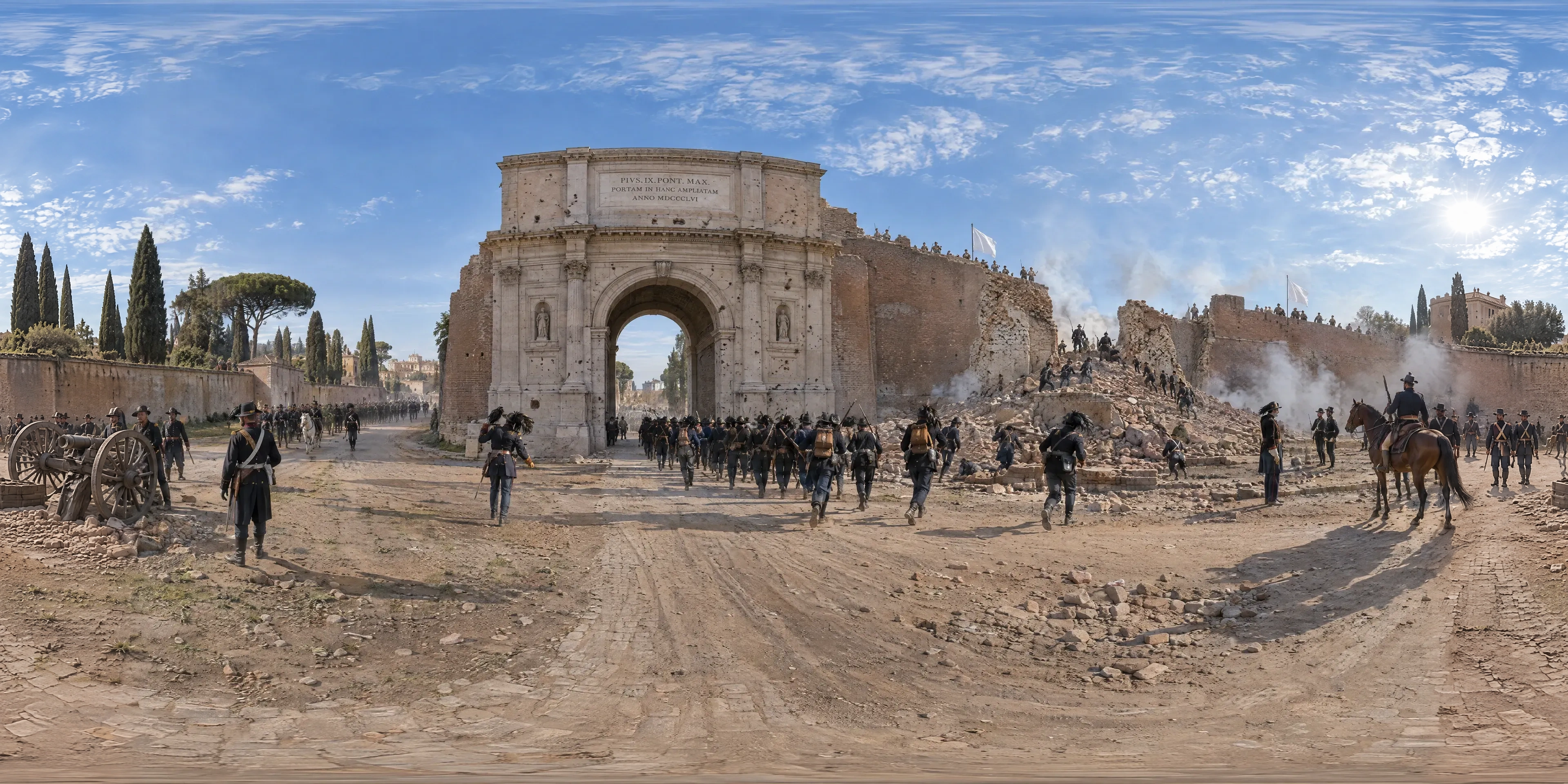
Just after 10 am on 20 September 1870, after five hours of Italian artillery fire, a 30-metre breach gapes in the Aurelian Walls beside Porta Pia, white flags go up along the papal ramparts and plumed bersaglieri surge through. The capture of Rome ended more than a thousand years of the popes' temporal power and gave Italy its capital.
- Year
- 1870
- Where
- Lazio (Papal States) · IT
- Era
- Industrial
- Coordinates
- 41.911, 12.502
The moment
Five hours of guns
At five in the morning of 20 September 1870 Italian artillery opened fire on the Aurelian Walls of Rome, near Porta Pia on the north-eastern edge of the city. General Raffaele Cadorna commanded about 50,000 troops; General Hermann Kanzler had 13,157 papal defenders, including the Swiss Guard, the Palatine Guard and the Papal Zouaves.
Pope Pius IX had ordered only enough resistance to show that Rome was taken by force, not surrendered. By ten o'clock the guns had torn a breach about thirty metres wide in the brick walls just west of the gate, and around 10:05 white flags went up along the ramparts.
The bersaglieri, the Italian light infantry with their round black hats and drooping black feathers, charged up the rubble. The fighting cost 49 Italian and 19 papal soldiers their lives.
A Michelangelo gate under fire
Porta Pia itself was a work of art. Michelangelo designed it for Pope Pius IV, and it was built between 1561 and 1565, finished after his death by Giacomo Del Duca.
Its outer face was brand new. Virginio Vespignani had completed a neoclassical front toward the Via Nomentana only in 1869, working from a 1568 engraving of Michelangelo's design, and the bombardment seriously damaged its two statues of saints, Agnes and Alexander, which were restored and relocated only in 1929.
Today the space between the gate's two arches houses the historical museum of the bersaglieri, and a monument to the bersaglieri of 1932 stands opposite.
Why the French were gone
Rome had been protected for years by a French garrison. In early August 1870 France withdrew it for the war against Prussia, and after Napoleon III's defeat at Sedan on 2 September, nothing stood between the Italian army and the city but the pope's own troops.
The result was confirmed at the ballot box. In a plebiscite on 2 October 1870, 133,681 voters chose union with Italy and 1,507 voted against, and on 3 February 1871 Rome officially became the capital.
XX Settembre
The breach ended more than a thousand years of the popes' temporal power. Pius IX declared himself a "prisoner in the Vatican", despite the Law of Guarantees of 1871; the dispute lasted until the Lateran Treaty of 1929 created the independent state of Vatican City.
The date is everywhere in Italy. Almost every city has a Via XX Settembre, named for the morning the capital was won.
It is remembered differently in Catholic and secular traditions. For one it is the completion of national unity, for the other the loss of the pope's state, and both readings meet at the stretch of wall beside Michelangelo's gate.
Sources
Further reading
Tagged
- italy
- rome
- lazio
- risorgimento
- capture-of-rome
- 1870
- aurelian-walls
- bersaglieri
Published
See also

1839
Gräfenberg Spa, Jeseník
In 1839 some 1,500 patients, among them a monarch, 22 princes and 149 counts and countesses, climb to Gräfenberg in the Jeseníky mountains of Austrian Silesia to take the cold-water cure of Vincenz Priessnitz, a self-taught farmer whose spa is the first hydrotherapy resort in the world; 120 doctors come to study his methods.

1869
Court Opera on the Ringstraße, Vienna
On the evening of 25 May 1869 Emperor Franz Joseph opens the new Court Opera, the first great public building on Vienna's Ringstraße, with Mozart's Don Giovanni sung in German. Neither of its architects lives to see the night: both died in 1868, after Viennese mockery of the 'sunken box'.

1897
Giant Ferris Wheel, Prater, Vienna
On 3 July 1897, a hot summer day, Vienna's Giant Ferris Wheel opens in the Prater, built by English engineers for the jubilee of Emperor Franz Joseph's 50 years on the throne. Its 30 cabins turn up to 64.75 m above the canals of the 'Venice in Vienna' pleasure park, making it one of the largest wheels in the world; a ride costs a gulden.