Town Hall on the Prinzipalmarkt, Münster
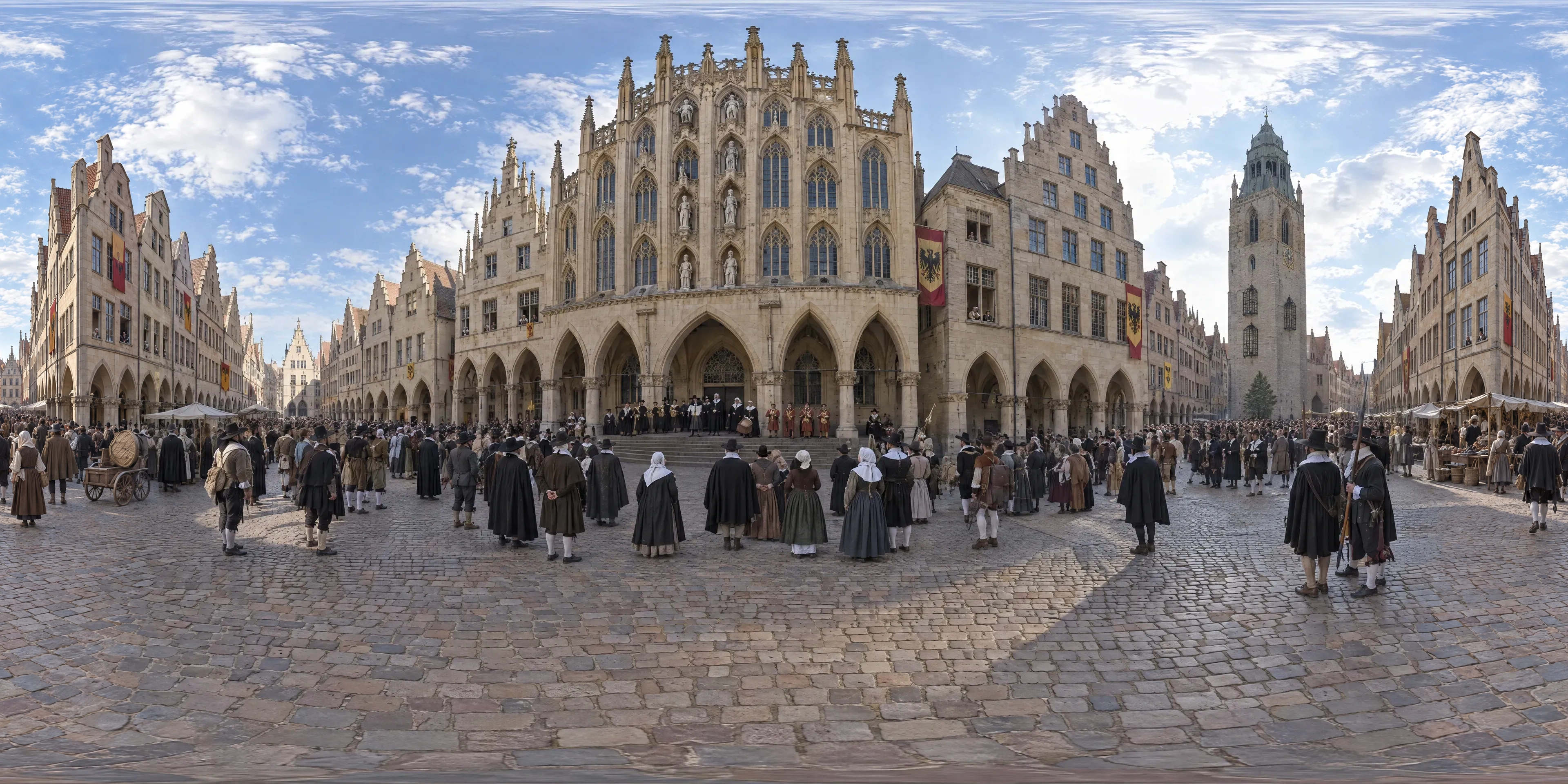
On 25 October 1648, the day after the treaties were signed in Münster, the city proclaims the Peace of Westphalia: the town secretary, with a kettledrummer and six trumpeters, reads the council's announcement at the city's squares while every bell rings from noon to one. Thirty years of war in the Empire are over.
- Year
- 1648
- Where
- Westphalia, North Rhine-Westphalia · DE
- Era
- Early modern
- Coordinates
- 51.962, 7.628
The moment
Peace was read out in the street
On Saturday 24 October 1648 the envoys in Münster signed the treaties that ended the Thirty Years' War. The Swedish and French delegations met the imperial envoys in the afternoon, the documents were checked until about half past five, and representatives of the imperial estates went on signing in the Bishop's Court on the Cathedral Square until midnight.
On Sunday 25 October the city told its people. The councillors attended High Mass in the cathedral. Then the town secretary, with a kettledrummer and six trumpeters, went from square to square, reading the council's proclamation and showing copies of both peace treaties to the crowds.
From noon to one every bell in the city rang. Cannon fire closed the day.
Münster's second peace that year
The peace had two halves. One treaty settled matters between the emperor and France, the other between the emperor and Sweden, and the second had been negotiated in nearby Osnabrück.
Münster had already hosted one peace that year. On 15 May 1648 Spanish and Dutch envoys met in the council chamber of the town hall to swear to the Peace of Münster, which ended the Eighty Years' War and recognised the independent Dutch Republic. The Dutch painter Gerard ter Borch recorded the scene; the original hangs in the National Gallery in London.
The street as it stood
The Prinzipalmarkt was an arcaded street of tall, narrow gabled merchant houses. Its centrepiece was the town hall, with a Gothic show gable of the fourteenth century: a stone screen of tracery, pinnacles and statues above an open arcade. Beside it stood the town wine house, built in 1615 and 1616.
At the north end of the street rose the old tower of St Lambert's, about 50 metres of masonry. On it hung three iron cages, in which the bodies of Anabaptist leaders executed in 1536 had been displayed. The cages still hang there, but the tower does not survive: a neo-Gothic one replaced it between 1887 and 1898.
Why Münster calls itself the city of peace
The town hall did not survive the next great war. On 28 October 1944 incendiary bombs struck it, and the show gable collapsed onto the Prinzipalmarkt. The Renaissance panelling of the council chamber, carved in 1577, had been taken to safety at the start of the war. The rebuilt town hall was handed back to the city on 30 October 1958.
For Germans the Peace of Westphalia ended the greatest catastrophe in their history before the twentieth century. Münster still styles itself the city of peace, and the old council chamber is known as the Peace Hall. In 2022 the foreign ministers of the G7 met there.
Sources
Further reading
Tagged
- germany
- munster
- westphalia
- peace-of-westphalia
- thirty-years-war
- early-modern
- town-hall
- prinzipalmarkt
Published
See also

1747
Sanssouci Palace, Potsdam
On 1 May 1747 Frederick II of Prussia inaugurates Sanssouci, the small summer palace built to his own sketches on top of six curved vineyard terraces outside Potsdam, though not all its rooms are finished. Here the philosopher king will spend every summer, playing the flute and gathering Voltaire and other guests at his table.

1655
Dam Square and the New Town Hall, Amsterdam
On 29 July 1655 Amsterdam's burgomasters process from the Prinsenhof to the Dam to inaugurate Jacob van Campen's new Town Hall, a classical palace for a city of merchants, though it is still far from finished. Six companies of civic guards fire three volleys as the city at the height of its Golden Age celebrates.

1682
Place d'Armes, Versailles
On 6 May 1682 Louis XIV makes Versailles the permanent seat of his court and government, turning his father's hunting lodge, now wrapped in new wings, into the stage of absolute monarchy. The palace is still a vast building site: the Hall of Mirrors is being decorated, the Grand Commun is just begun and the north wing not yet started.