Shore of the Bay of Puck, Puck
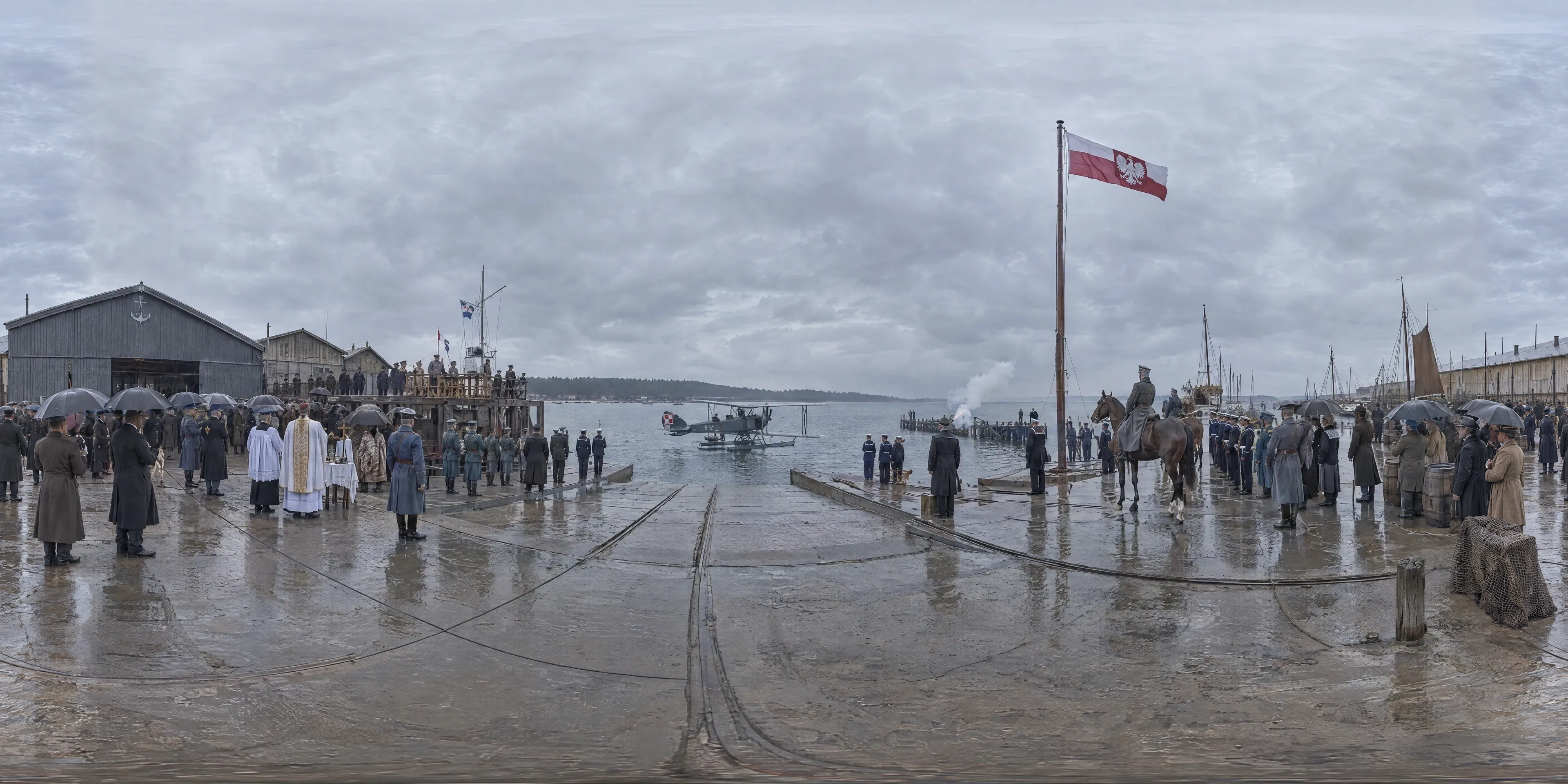
On a rainy 10 February 1920 General Józef Haller rides his horse into the Bay of Puck and throws a platinum ring into the water, wedding Poland to the Baltic after the Treaty of Versailles returns a strip of Pomeranian coast. A naval ensign is raised to a 21-gun salute and a Kashubian skipper hands the watch over the sea to a Polish sailor.
- Year
- 1920
- Where
- Pomerania (Kashubia) · PL
- Era
- modern_early
- Coordinates
- 54.722, 18.415
The moment
The ring came from the Poles of Gdańsk
The Treaty of Versailles gave Poland a strip of the Pomeranian coast, and in October 1919 General Józef Haller took command of the Pomeranian Front, formed to take it over. The handover began at Toruń on 18 January 1920. There were a few attempts at armed resistance and many cases of sabotage, but it went largely to plan.
On 10 February Haller came to Puck with the interior minister, Stanisław Wojciechowski, and the new administration of the Pomeranian province. Earlier that day, in Gdańsk, local Poles presented him with two platinum rings, paid for by families such as the Leszczyńskis and the Raciniewskis.
Two riders in the rain
The ceremony was held at the former German naval air station, founded in 1911 to 1912. The crowd stood on the quays that flanked its seaplane slipway and on the shore in front of it. Every witness describes a grey sky and steady rain.
The heart of the day was a Mass of thanksgiving, said by the army's field dean, Antoni Rydlewski, with a sermon by the priest Józef Wrycza. The clergy blessed the Polish naval ensign, and Eugeniusz Pławski and Florian Napierała hoisted it on a mast while guns fired 21 salvoes. On behalf of the old guardians of the coast, the Kashubian skipper Jakub Myślisz handed the watch over the sea to a Polish sailor.
Then Haller rode from the shore into the bay, with Władysław Zakrzewski beside him, the only two men on horseback in the water, and threw a ring into the sea. Poland had its coast back: about 140 kilometres of neglected shoreline, the Hel Peninsula included.
One account says the bay was frozen that day, which the Kashubians took as a good omen. It is hard to square with the rain that every eyewitness remembers.
The sea came without Gdańsk
The great port at the mouth of the Vistula did not come with it. Versailles made Gdańsk a Free City outside Poland, and German residents of the region saw the transfer of the coast very differently. The wedding at Puck is remembered as the prelude to building a new Polish port at Gdynia.
The day after Puck, Haller repeated the ceremony with the fishermen of Wielka Wieś. A memorial post on the shore at Puck received a Jagiellonian eagle and an inscription saying that the Polish army, led by Haller, had taken the Polish sea into eternal possession.
Why Puck weds the sea every February
The Wedding to the Sea is a textbook symbol of reborn Poland regaining the Baltic. Wojciech Kossak painted it, the Polish army repeated it at three places on the Pomeranian coast in March 1945, and the Sejm declared 2020 the Year of the Wedding to the Sea.
Puck re-enacts it every 10 February. The exact hour of Haller's ride is not recorded.
Sources
Further reading
Tagged
- poland
- puck
- pomerania
- kashubia
- baltic-sea
- haller
- navy
- 1920
Published
See also

1939
Westerplatte, Gdańsk
At 4:45 on Friday 1 September 1939 the German training battleship Schleswig-Holstein, moored in the Gdańsk harbour channel, opens fire on the Polish Military Transit Depot at Westerplatte, the first shots of the Second World War in Europe. The 182 defenders, expected to hold for up to twelve hours, hold out for seven days.

1944
PAST Building, Warsaw
On the morning of 20 August 1944, after a night assault that began at 2:30, Home Army soldiers of the Kiliński Battalion take the PAST telephone exchange, the German stronghold in central Warsaw, setting it ablaze with improvised flamethrowers from fire pumps and capturing over a hundred Germans. The white-and-red flag goes up over the burning tower.

1944
Omaha Beach, Normandy
At 6:30 a.m. on June 6, 1944, the first waves of American soldiers from the 1st and 29th Infantry Divisions wade ashore at Omaha Beach under heavy German machine-gun fire in the bloodiest landing of D-Day.