Rainhill Level, Liverpool and Manchester Railway
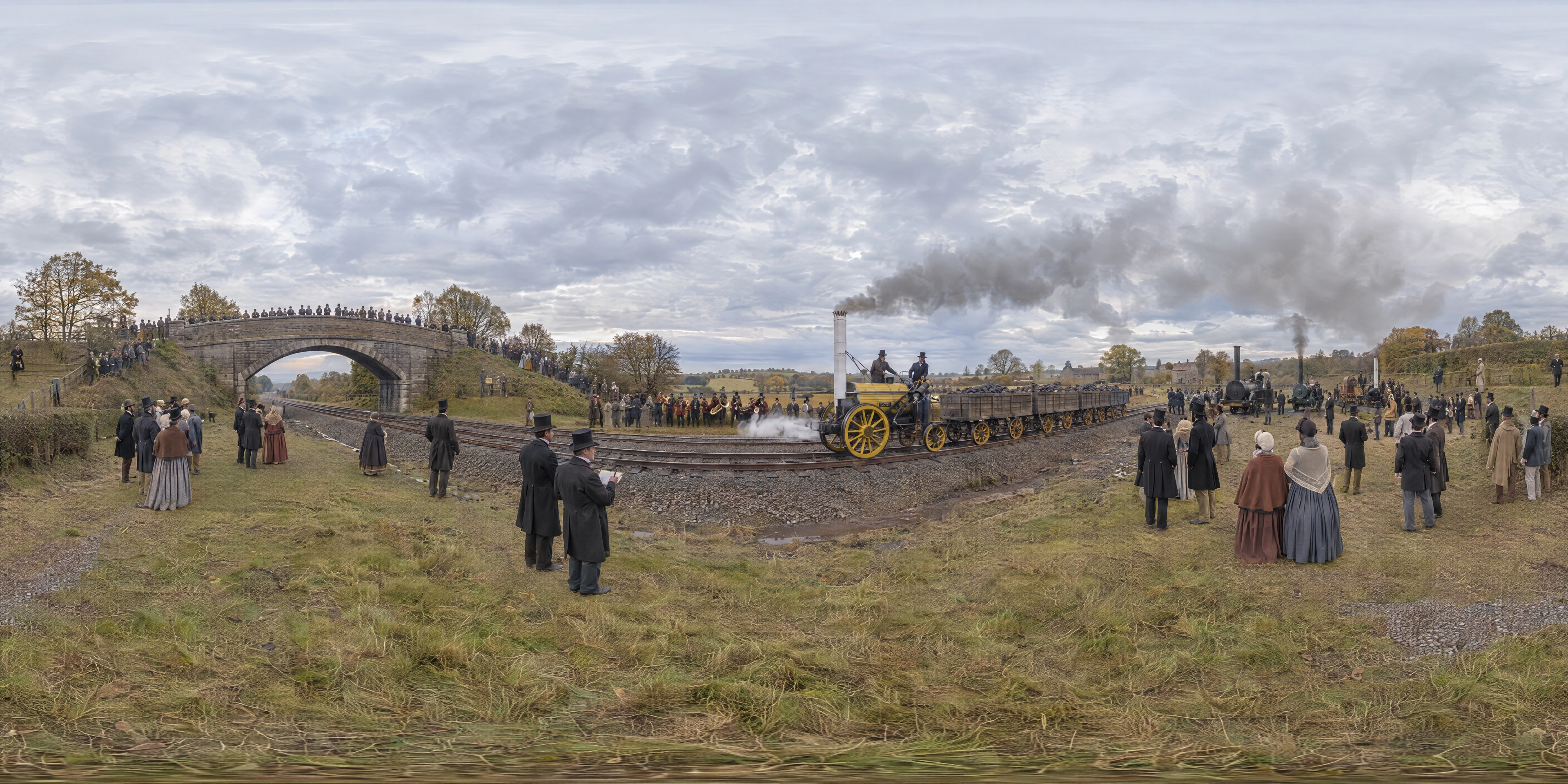
On 8 October 1829, before crowds at Rainhill, Robert Stephenson's yellow-and-black Rocket runs twenty trips along a level mile of the unfinished Liverpool and Manchester Railway, 70 miles in all, and becomes the only engine to meet the trial's conditions. Its victory settles that steam locomotives will work the first inter-city railway.
- Year
- 1829
- Where
- Lancashire · GB
- Era
- Industrial
- Coordinates
- 53.420, -2.755
The moment
A railway that nearly ran on ropes
In 1829, with the Liverpool and Manchester Railway nearly built, its directors had still not settled how to move the trains. They had first intended to use stationary steam engines hauling carriages on cables. George Stephenson argued for locomotives, and the directors put the question to a public trial with a £500 prize.
It was held at Rainhill from 6 to 14 October. The judges were John Urpeth Rastrick, a locomotive engineer from Stourbridge, Nicholas Wood, a mining engineer from Killingworth, and John Kennedy, a Manchester cotton spinner. Each engine had to haul three times its own weight, and between 10,000 and 15,000 people came to watch, with bands playing.
A horse on a belt and three steam rivals
Ten engines were entered and five ran. Cycloped, driven by a horse walking on a belt, withdrew after the horse burst through the floor. Timothy Burstall's Perseverance had been damaged on the way and retired. Timothy Hackworth's Sans Pareil was 300 pounds over the weight limit and nearly completed the trials. Novelty, built by John Braithwaite and John Ericsson, was lighter and faster than any of them, and the crowd favourite.
Robert Stephenson's Rocket did the work on the third day, Thursday 8 October. The Times reported that the engine weighed 4 tons 5 hundredweight with its water and hauled about 13 tons. It covered 70 miles in two halves of ten return journeys each, with a pause for water between, averaging over 11 and then over 12 miles an hour including stops. It burned no more than half a ton of coke, and at its fastest reached about 30 miles an hour.
The famous colours are only half documented
Rocket was the only engine to meet all the conditions, and the £500 was shared between the Stephensons and Henry Booth, the railway's treasurer, who may have suggested its boiler. Twenty-five copper fire tubes carried hot gas through the water, a blastpipe drew the fire, and two cylinders set at an angle drove the large wooden front wheels directly.
What it looked like is less settled. Accounts agree on yellow and black, the colours of the fastest road coaches of the day, but the white chimney of today's replicas is less securely documented, and the surviving engine, rebuilt with near-horizontal cylinders, no longer looks as it did at Rainhill.
Why Britain keeps Rocket as a relic
The Liverpool and Manchester Railway opened on 15 September 1830, worked by locomotives. The day was marred when William Huskisson, MP for Liverpool, was struck and killed by Rocket at Parkside.
For Britons Rocket is the emblem of the Industrial Revolution and of the railway age the country gave the world. It was given to the Patent Office Museum, now the Science Museum, in 1862 and shown in London for 150 years. Since 2019 it has been at the National Railway Museum in York, apart from a spell at Locomotion in Shildon from 2023 to 2025.
When replicas restaged the contest in 2002, neither Sans Pareil nor Novelty completed the course.
Sources
Further reading
Tagged
- united-kingdom
- england
- lancashire
- railways
- stephensons-rocket
- industrial-revolution
- 19th-century
- engineering
Published
See also

1869
Court Opera on the Ringstraße, Vienna
On the evening of 25 May 1869 Emperor Franz Joseph opens the new Court Opera, the first great public building on Vienna's Ringstraße, with Mozart's Don Giovanni sung in German. Neither of its architects lives to see the night: both died in 1868, after Viennese mockery of the 'sunken box'.

1897
Giant Ferris Wheel, Prater, Vienna
On 3 July 1897, a hot summer day, Vienna's Giant Ferris Wheel opens in the Prater, built by English engineers for the jubilee of Emperor Franz Joseph's 50 years on the throne. Its 30 cabins turn up to 64.75 m above the canals of the 'Venice in Vienna' pleasure park, making it one of the largest wheels in the world; a ride costs a gulden.

1810
Theresienwiese, Munich
On 17 October 1810 a horse race on a meadow outside Munich crowns the celebrations for the wedding of Crown Prince Ludwig of Bavaria and Princess Therese of Saxe-Hildburghausen; 50,000 spectators watch from the hillside, and the field is named Theresienwiese after the bride. Repeated the next year, the race becomes the Oktoberfest.