Rue Gay-Lussac, Paris
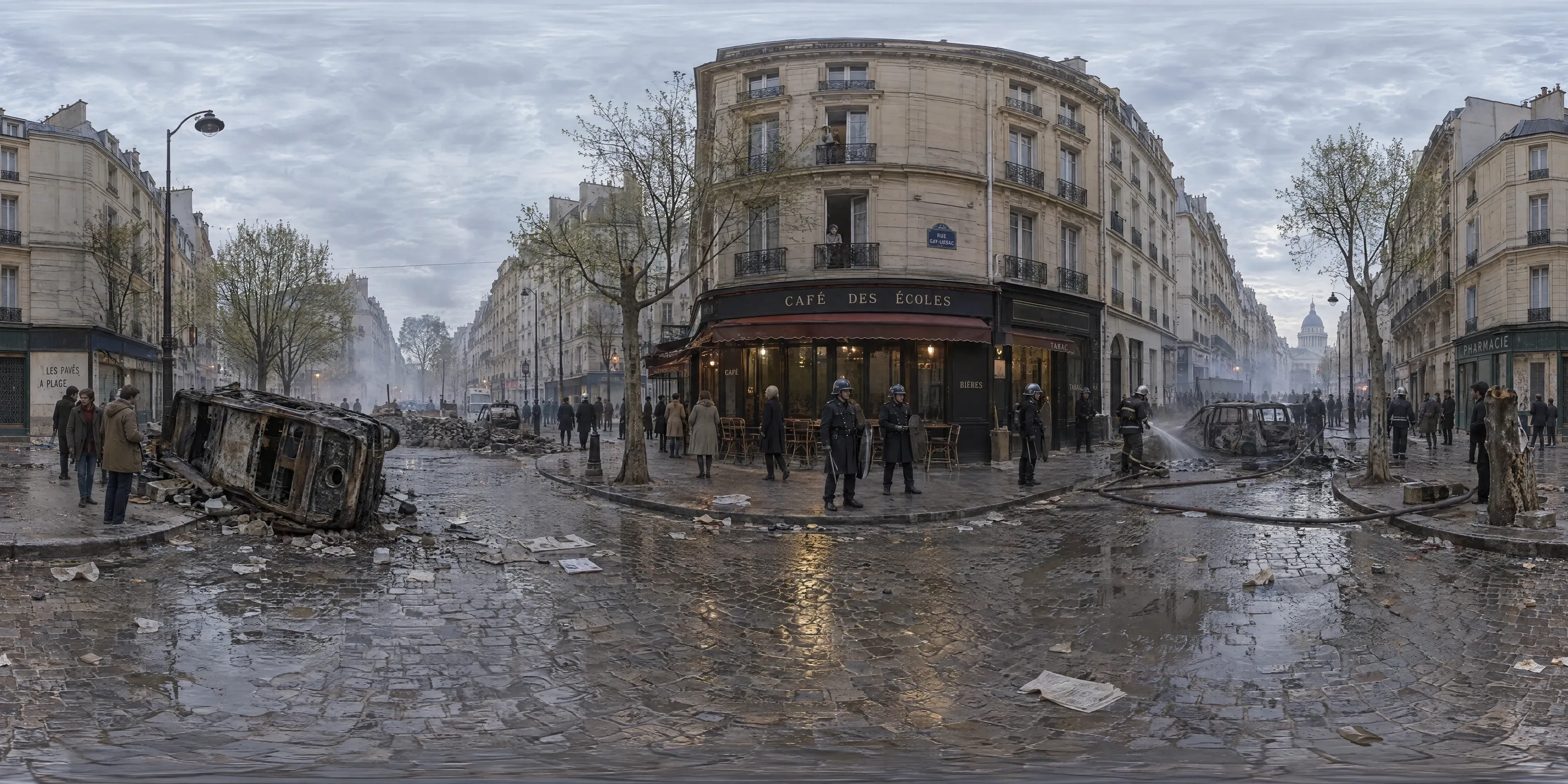
At dawn on Saturday 11 May 1968, after the Night of the Barricades, rue Gay-Lussac lies wrecked: overturned and burnt cars, felled trees and heaps of paving stones where students held barricades until riot police stormed them after 2 a.m. Outrage at the police assault turns a student revolt into the largest general strike in French history.
- Year
- 1968
- Where
- Paris · FR
- Era
- modern_postwar
- Coordinates
- 48.844, 2.342
The moment
Most of the barricades stood in one street
On the night of 10 to 11 May 1968, students held the Latin Quarter behind barricades of paving stones, felled trees, railings and overturned cars. They went up across the Montagne Sainte-Geneviève, in rue Royer-Collard, rue Saint-Jacques and rue de l'Estrapade, but most of them stood in rue Gay-Lussac, a straight street of cream stone apartment buildings running from the Luxembourg Gardens.
It began as a march. A week earlier the police had arrested dozens of students at a meeting in the courtyard of the Sorbonne, and now high-school pupils joined the protest.
At about 6.30 pm a column of more than 10,000, by the police's own count, set off; finding the bridges to the Right Bank blocked by riot police, it settled in the Latin Quarter. At 8.40 pm the student leaders Jacques Sauvageot and Alain Geismar called on the radio for the quarter to be held at all costs. The cobbles came up, baring the sand beneath.
The radio broadcast the night live
State television kept silent: that evening the government pulled a report that would have given the student leaders airtime. The commercial stations RTL and Europe 1 did the opposite, broadcasting minute by minute from the barricades, and an attempt at negotiation even went out live on air.
With Prime Minister Georges Pompidou abroad, the rector Jean Roche received a delegation of seven, Daniel Cohn-Bendit among them, around midnight, but the talks led nowhere. At 2.15 am the riot police attacked. It took them two hours to clear the barricades, and by dawn rue Gay-Lussac lay wrecked: burnt cars on their roofs, trees sawn down, cobbles heaped in low walls, tear gas hanging in the air. Several hundred people had been injured and some 400 arrested.
From provocateurs to martyrs by morning
The morning pictures turned opinion. Newspapers that had condemned the students now condemned the police, and Daniel Cohn-Bendit later wrote that they had gone from provocateurs to martyrs. Pompidou returned on 11 May and gave way, agreeing to free those arrested and to reopen the Sorbonne.
It was too late. The unions called a one-day general strike for 13 May, and the stoppage spread until about 10 million workers, two-thirds of the workforce, had walked out: the largest general strike in French history. The Grenelle agreements of 27 May raised the minimum wage by 35 per cent. On 30 May de Gaulle dissolved the National Assembly, and in June his party won 353 of 486 seats.
Why May 68 still divides France
May 68 is studied in French schools as the great social upheaval of the Fifth Republic, and it still frames French arguments about authority, youth and protest. For some it was a liberation; for others, the start of a long collapse of authority.
Its slogans have outlived it, none more than one born of that street furniture: "Sous les pavés, la plage", beneath the paving stones, the beach, coined by the student Bernard Cousin with the publicist Bernard Fritsch.
Sources
Further reading
Tagged
- france
- paris
- latin-quarter
- may-68
- students
- barricades
- 20th-century
- protest
Published
See also

1944
Champs-Élysées, Paris
On the afternoon of 26 August 1944, the day after the German garrison surrendered, General de Gaulle rekindles the flame of the Unknown Soldier at the Arc de Triomphe and walks down the Champs-Élysées ahead of Leclerc and the Resistance leaders, through a crowd estimated at two million. The march seals his authority as head of liberated France.

1979
Victory Square, Warsaw
On the afternoon of Saturday 2 June 1979, on his first visit home as pope, John Paul II says Mass for about half a million people on Victory Square in communist Warsaw and prays that the Holy Spirit will renew the face of the earth, adding "this land". The words are remembered as the spark of the Solidarity movement.

1955
Upper Belvedere, Vienna
Around noon on Sunday 15 May 1955, just after the State Treaty is signed in the Marble Hall of the Upper Belvedere, Foreign Minister Leopold Figl steps onto the balcony with the Allied foreign ministers and holds up the signed treaty to the crowd waiting in the palace garden. After ten years of occupation, Austria is free.