Runnymede, Surrey
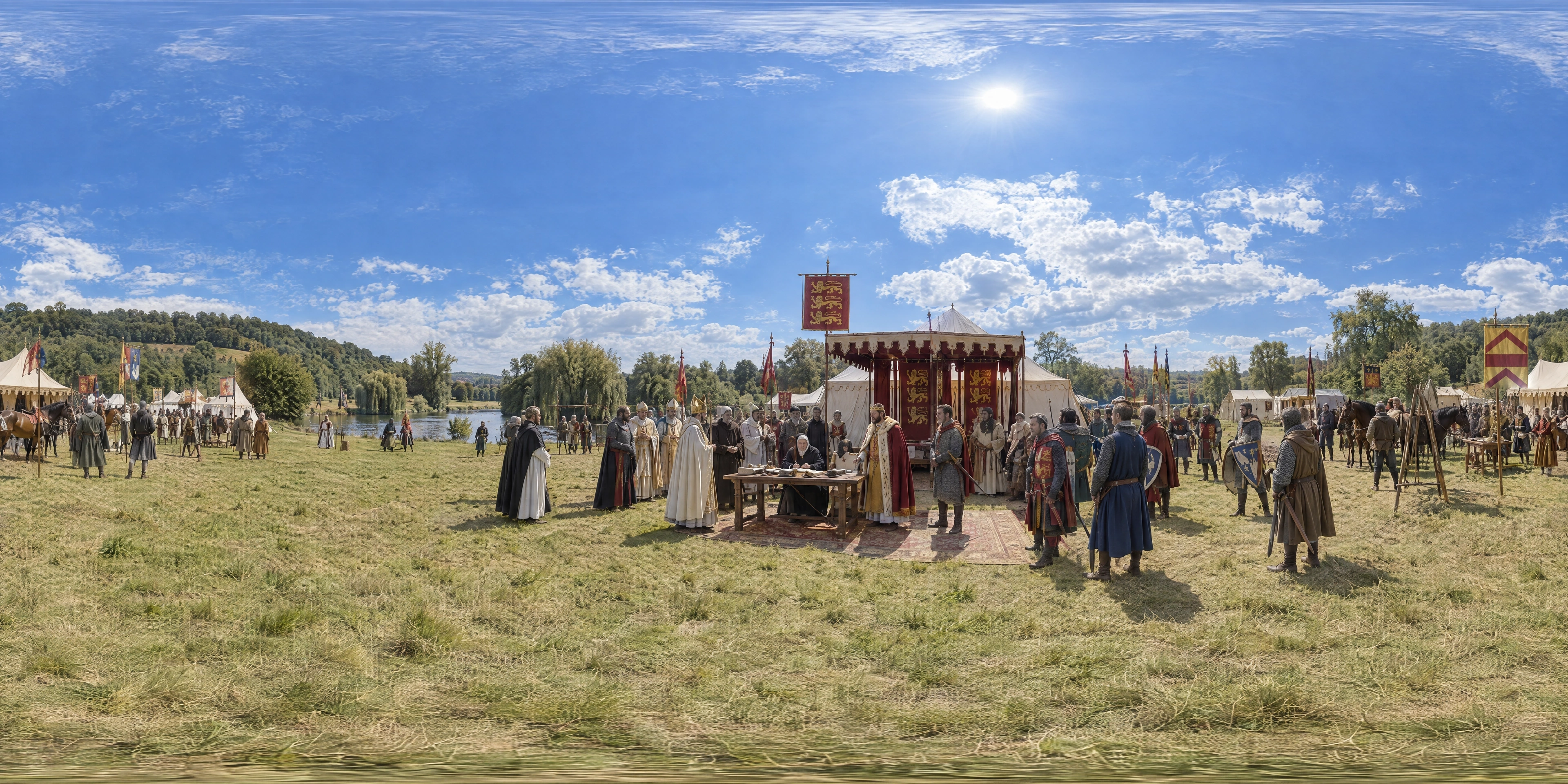
On 15 June 1215, on the water-meadow of Runnymede between Windsor and Staines, King John seals the charter his rebel barons have forced on him, promising justice by lawful judgement and limits on royal power. Repudiated within three months, Magna Carta becomes the founding text of liberty under the law.
- Year
- 1215
- Where
- Surrey · GB
- Era
- Medieval
- Coordinates
- 51.445, -0.564
The moment
The charter names its own meadow
Magna Carta says where it was made. Its dating clause places the grant in the meadow called Ronimed, between Windsor and Staines, on 15 June 1215.
The place was chosen with care. Runnymede, a flat water-meadow on the south bank of the Thames, was a traditional place for assemblies; the name is thought to join the Middle English runinge, taking counsel, to mede, meadow. It also lay on neutral ground between the royal castle at Windsor and the rebel barons' base at Staines, where neither side could easily be caught at a disadvantage.
Exactly where on the meadow the sealing took place is unknown. The Magna Carta memorial itself stands on the neighbouring Long Mede.
Ten days of drafting, and no signature
King John met the rebel leaders at Runnymede on 10 June. They brought their demands, the Articles of the Barons, and over the following days Stephen Langton, Archbishop of Canterbury, mediated them into a charter. By 15 June a text was agreed; on 19 June the rebels renewed their oaths of loyalty and copies were formally issued.
Nothing was signed. The charter was sealed with the king's great seal in wax, as royal grants were.
Its promises were specific. No free man was to be imprisoned or stripped of his rights except by the lawful judgement of his peers or the law of the land, and justice was not to be sold, denied or delayed. A council of 25 barons would watch over the king's compliance.
Void within three months
The peace did not hold. Neither side kept its commitments, and John appealed to Pope Innocent III, who in a letter dated 24 August declared the charter shameful, illegal and unjust, and void for ever. The First Barons' War followed.
The text outlived its failure. It was reissued for John's young son Henry III in 1216 and 1217, when it acquired the name Magna Carta to distinguish it from the smaller Charter of the Forest, and again in 1225. Four copies of the 1215 original survive: two in the British Library, one at Lincoln Castle and one at Salisbury Cathedral.
Why Americans built the memorial
For Britons Magna Carta is the root of the rule of law and of the principle that even the king is bound by it, a named topic in England's secondary history curriculum. Most of the 1215 text has long been repealed, but three of its clauses, carried into the reissue of 1297, are still law in England and Wales.
Runnymede shows how far the idea travelled. The meadow was given to the National Trust in 1929 by an American, Cara Rogers Broughton, and her two sons. The domed temple on the slope of Cooper's Hill, with a granite pillar inscribed to Magna Carta as the symbol of freedom under law, was built by the American Bar Association and unveiled on 18 July 1957. The charter shaped the thinking behind the United States Constitution, and American lawyers still return to rededicate the memorial.
Sources
Further reading
Tagged
- united-kingdom
- england
- surrey
- magna-carta
- king-john
- medieval
- rule-of-law
- thames
Published
See also

1357
Charles Bridge, Prague
In 1357 Emperor Charles IV lays the foundation stone of a new stone bridge on the Old Town bank near St Clement's, fifteen years after ice and floodwater wrecked the Judith Bridge. Tradition sets the moment at 5:31 on 9 July, a palindrome of odd numbers; the bridge will take 45 years to finish.

1253
Basilica of Saint Francis, Assisi
On 25 May 1253 Pope Innocent IV consecrates the new basilica raised over the tomb of Francis of Assisi, just 27 years after the saint's death, before crowds of grey-robed friars and townspeople. Later painted by Cimabue and Giotto, it became the spiritual heart of the country whose patron saint Francis is.

987
Great Mosque of Córdoba
In 987 Almanzor, the all-powerful chamberlain of Caliph Hisham II, begins the third and largest enlargement of the Great Mosque of Córdoba, eight new aisles to the east that make it the largest mosque anywhere outside Abbasid Iraq. From the courtyard, open arches reveal the forest of red-and-white double arches inside.