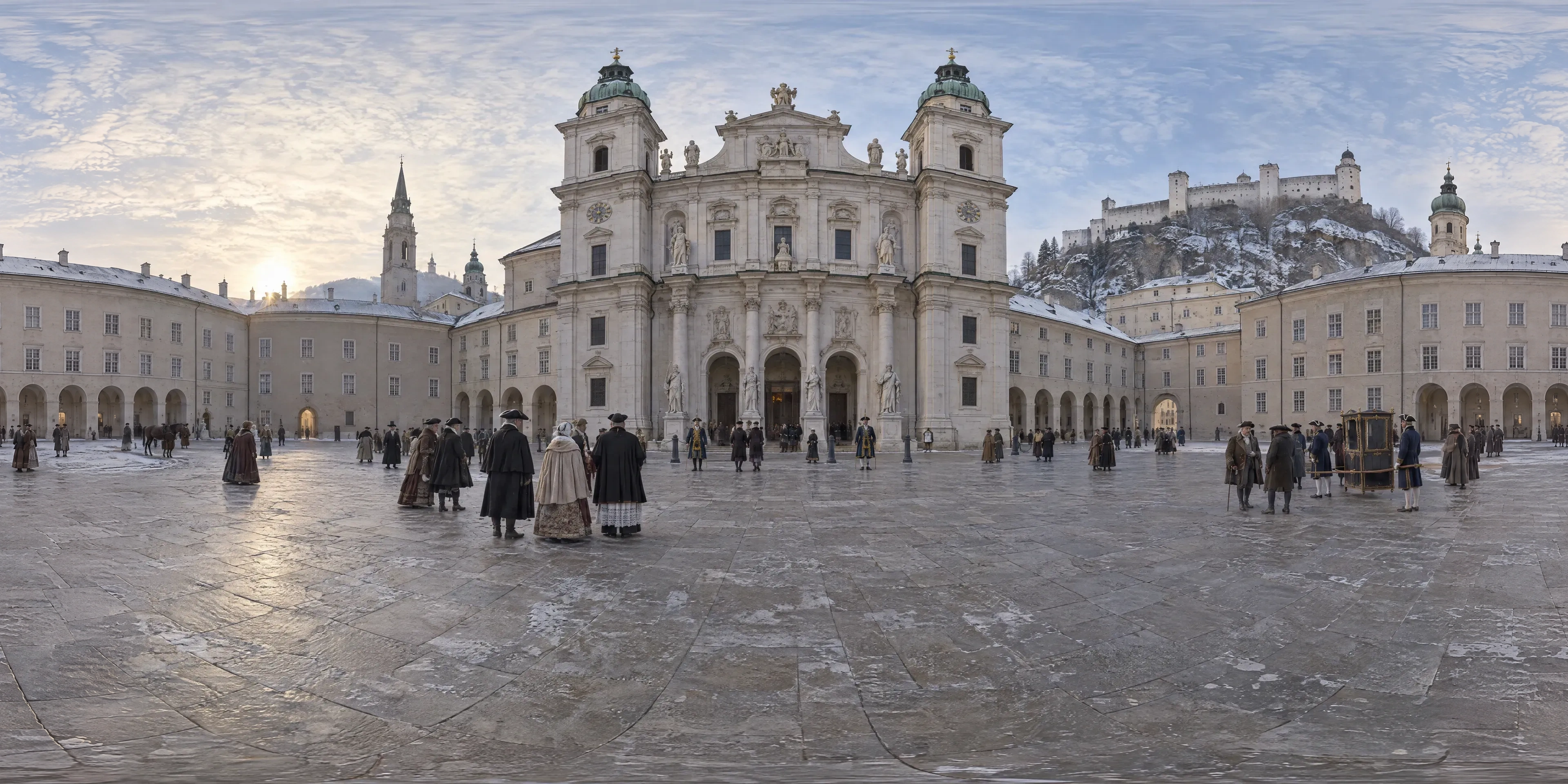
Salzburg Cathedral, Domplatz
On the morning of 28 January 1756, the day after his birth in the Getreidegasse, the son of court musician Leopold Mozart is baptised in Salzburg Cathedral as Joannes Chrysostomus Wolfgangus Theophilus. The city of the prince-archbishops, crowned by its marble-fronted cathedral and hilltop fortress, will be Wolfgang's home for the next 25 years.
- Year
- 1756
- Where
- Salzburg (Prince-Archbishopric) · AT
- Era
- Early modern
- Coordinates
- 47.798, 13.045
The moment
Baptised the morning after
Wolfgang Amadeus Mozart was born in the Getreidegasse on 27 January 1756, the son of the court musician Leopold Mozart. On the morning of the next day, Wednesday 28 January, he was baptised in Salzburg Cathedral as Joannes Chrysostomus Wolfgangus Theophilus.
The last name came from his godfather, the merchant Joannes Theophilus Pergmayr. Theophilus is Greek for "loved by God", and its Latin form, Amadeus, is the name the world remembers.
He was baptised at a Gothic font of the fourteenth century that still stands in the cathedral.
A cathedral finished in wartime
The cathedral was young by Salzburg standards. After fire damaged its medieval predecessor in 1598, Prince-Archbishop Wolf Dietrich von Raitenau had it pulled down. The new cathedral was designed by the Italian architect Santino Solari. Building began in 1614, and the church was consecrated in 1628, in the middle of the Thirty Years' War, under Archbishop Paris Lodron.
Its west front is faced with pale Untersberg marble, 43 metres high to the gable, between two towers of 78 metres. Before the three portals stand four colossal statues: St Rupert with a salt barrel and St Virgil with a model of the church on the outside, St Peter and St Paul in the middle. The four evangelists stand on the balustrade, and Moses, Elijah and Christ on the gable.
The square before the column
In 1756 the Domplatz was enclosed, as it is now, by arcaded wings linking the archbishops' Residence and St Peter's Abbey, with the fortress of Hohensalzburg on its cliff above.
One thing was missing: the Marian column at the centre of the square, made by the Hagenauer brothers between 1766 and 1771. The bronze doors of the cathedral are later still, from 1958.
Why Salzburg lives on his name
Salzburg remained Mozart's home for the next 25 years, until he settled in Vienna in 1781. He is Austria's most famous son and the heart of its cultural identity.
The city built its fame around him: its festival, its museums, its old town on the UNESCO World Heritage List. Every summer the Salzburg Festival sets up a stage on the Domplatz for Hofmannsthal's Jedermann, played in front of the marble facade of the church where Mozart was baptised on the second day of his life.
For Austrians the cathedral square holds both halves of that story: the prince-archbishops' city in which he grew up and chafed, and the festival city that now lives on his name.
Sources
Further reading
Tagged
- austria
- salzburg
- mozart
- baroque
- cathedral
- prince-archbishopric
- 18th-century
- unesco
Published
See also

1741
Coronation Hill, Pressburg (Bratislava)
Sunday, 25 June 1741: freshly crowned in St Martin's Cathedral, 24-year-old Maria Theresa rides up an earthen mound by the Danube and swings St Stephen's sword to the four corners of the world, vowing to defend Hungary. That September the Hungarian estates, gathered in this city, pledged her 'our life and blood' and saved her throne.

193
Legionary Fortress of Carnuntum
On 9 April 193, twelve days after the murder of Emperor Pertinax in Rome, the Pannonian legions proclaim their governor Lucius Septimius Severus emperor at Carnuntum, capital of Upper Pannonia on the Danube frontier. He wins the civil war that follows, founds the Severan dynasty and raises Carnuntum to the rank of a colony.

1869
Court Opera on the Ringstraße, Vienna
On the evening of 25 May 1869 Emperor Franz Joseph opens the new Court Opera, the first great public building on Vienna's Ringstraße, with Mozart's Don Giovanni sung in German. Neither of its architects lives to see the night: both died in 1868, after Viennese mockery of the 'sunken box'.