Cathedral of Santiago de Compostela
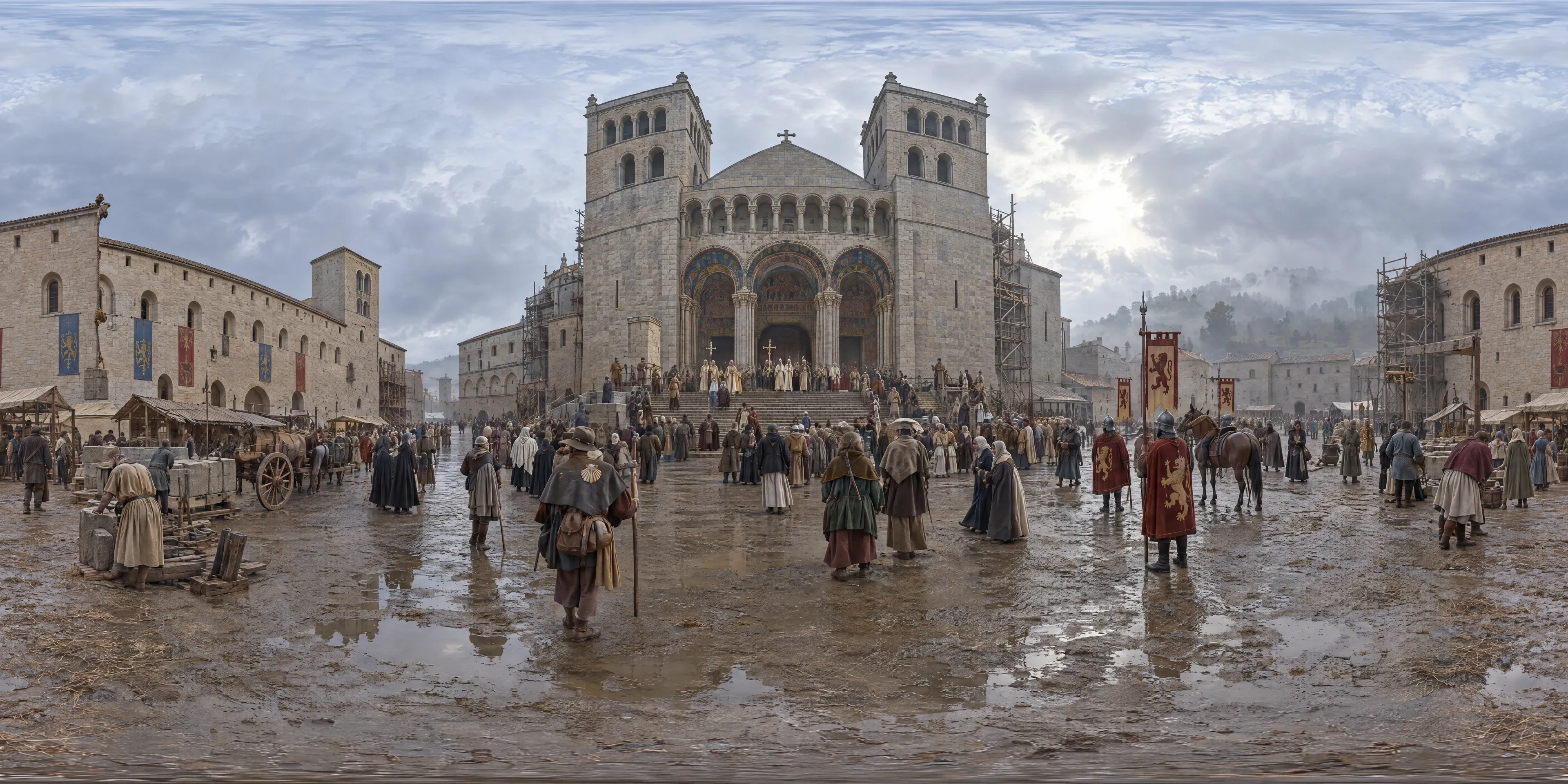
In April 1211 Archbishop Pedro Muñiz consecrates the Romanesque cathedral of Santiago de Compostela before King Alfonso IX of León, his heir and his court, well over a century after work began above the tomb of St James. Pilgrims with scallop shells on their hats crowd the square where Master Mateo's masons have just finished the west front.
- Year
- 1211
- Where
- Kingdom of León (Galicia) · ES
- Era
- Medieval
- Coordinates
- 42.881, -8.546
The moment
Consecrated 136 years after the first stone
In April 1211 Archbishop Pedro Muñiz consecrated the cathedral of Santiago de Compostela before King Alfonso IX of León, his heir and his court. Work had begun in 1075, under Alfonso VI and Bishop Diego Peláez, with a master known as Bernard the Elder.
The sources disagree on the day. Some give 11 April, others 21 April, and the question has not been settled.
The church stood over what tradition holds to be the tomb of the apostle James, found in the early ninth century and reported to King Alfonso II by Bishop Theodemir of Iria. An older basilica on the site had been burned by Almanzor's army in 997. The tomb itself was left untouched.
A workshop gave the square its name
The open ground west of the cathedral is today's Praza do Obradoiro, from the Galician word for a workshop. The masons' lodge had worked here for decades, and in 1211 their blocks and tools still lay at the edge of the square.
The last great job had been the west end, designed by Master Mateo. He raised it on a crypt, so that steps climbed to the entrance, and framed it with two new towers of grey granite.
Behind that front stood his masterpiece, the Pórtico de la Gloria: three arches crowded with sculpted apostles, prophets and elders around Christ, painted in blue, red and gold. An inscription on its lintels records that they were set in place on 1 April 1188. Against the cathedral's north flank stood the palace of the archbishops, built by Diego Gelmírez.
The pilgrims who filled the town wore the badge of the journey, the scallop shell, on broad hats and capes, and walked with staffs.
The front Mateo built is hidden, not lost
Mateo's exterior did not survive. A double stair was added in the seventeenth century, and between 1738 and 1750 Fernando de Casas Novoa wrapped the west end in the Baroque Obradoiro facade, a wall of tall windows between remodelled towers.
The portico survived behind it. Visitors who climb the steps today pass through the Baroque front and find Mateo's figures inside, where the pilgrims of 1211 glimpsed them in the shadow of the porch.
The square changed around the cathedral too. The Catholic Monarchs' pilgrims' hospital, now the Hostal dos Reis Católicos, went up on the north side after 1501, and the Raxoi palace of 1766 now closes the west side.
A cathedral in every Spanish pocket
Santiago is the goal of the Camino de Santiago, Europe's great pilgrimage route, and the square before the cathedral is where the walk ends. The old town has been a UNESCO World Heritage Site since 1985.
The Obradoiro facade is also on Spain's 1, 2 and 5 cent euro coins, so nearly every Spaniard carries the cathedral around in loose change. For Galicians the tie is closer still: 25 July, the feast of St James, is Galicia's national day.
Sources
Further reading
Tagged
- spain
- galicia
- santiago-de-compostela
- camino-de-santiago
- pilgrimage
- romanesque
- cathedral
- medieval
Published
See also

987
Great Mosque of Córdoba
In 987 Almanzor, the all-powerful chamberlain of Caliph Hisham II, begins the third and largest enlargement of the Great Mosque of Córdoba, eight new aisles to the east that make it the largest mosque anywhere outside Abbasid Iraq. From the courtyard, open arches reveal the forest of red-and-white double arches inside.

1357
Charles Bridge, Prague
In 1357 Emperor Charles IV lays the foundation stone of a new stone bridge on the Old Town bank near St Clement's, fifteen years after ice and floodwater wrecked the Judith Bridge. Tradition sets the moment at 5:31 on 9 July, a palindrome of odd numbers; the bridge will take 45 years to finish.

1253
Basilica of Saint Francis, Assisi
On 25 May 1253 Pope Innocent IV consecrates the new basilica raised over the tomb of Francis of Assisi, just 27 years after the saint's death, before crowds of grey-robed friars and townspeople. Later painted by Cimabue and Giotto, it became the spiritual heart of the country whose patron saint Francis is.