Saxon Square, Warsaw
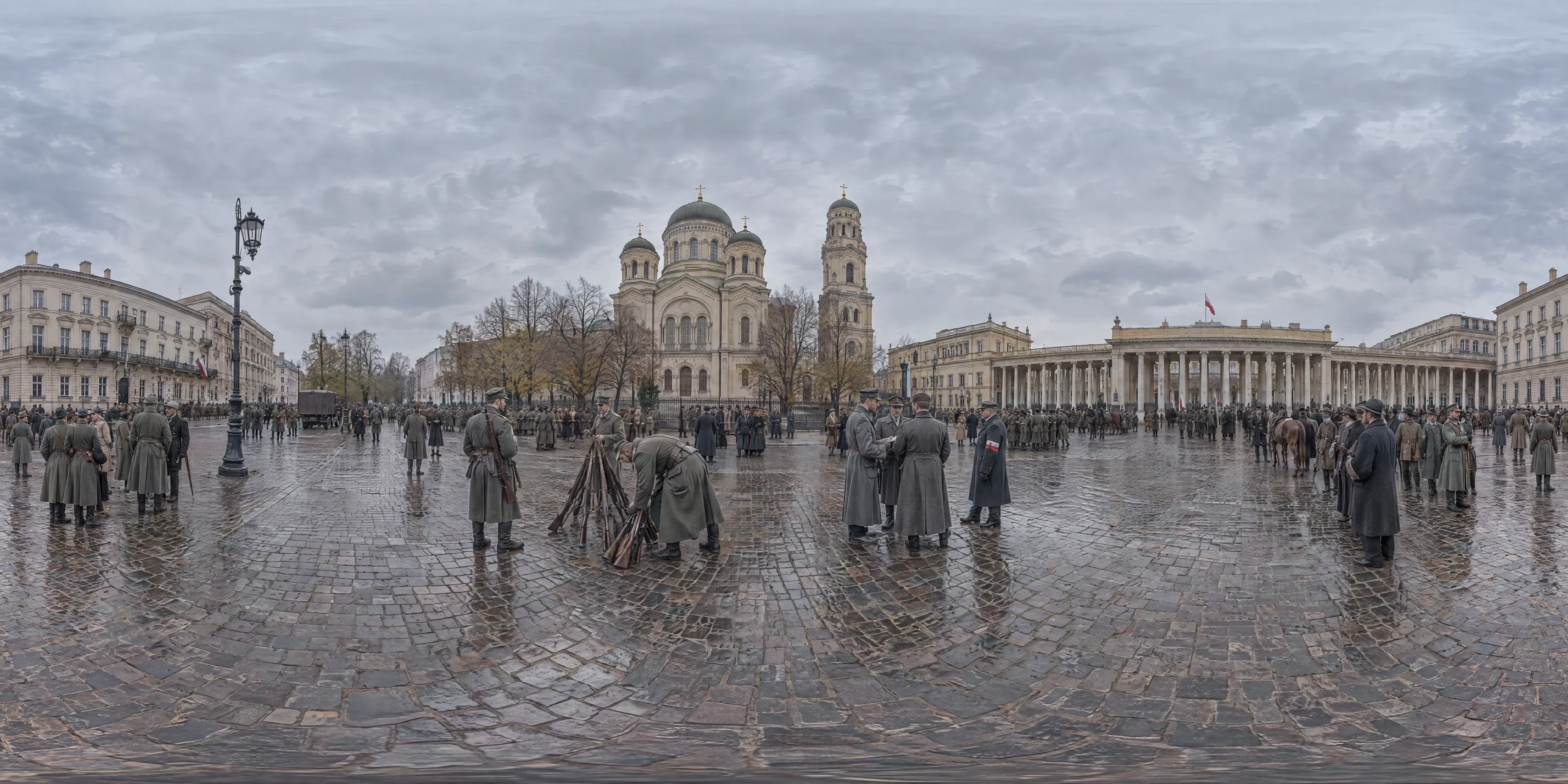
On 11 November 1918, the day the Regency Council hands Józef Piłsudski command of the army and Germany signs the armistice, Polish soldiers, members of the Polish Military Organisation and Warsaw residents disarm German troops in front of their garrison command on Saxon Square. After 123 years of partitions Poland is free.
- Year
- 1918
- Where
- Masovia · PL
- Era
- modern_early
- Coordinates
- 52.241, 21.014
The moment
The Germans wanted only to go home
By November 1918 the German Empire was finished. Exhaustion, hunger, defeat at the front and the November Revolution had broken its army, and the occupation troops in Warsaw put up little resistance. They handed over their weapons and equipment and asked for one thing in return: to be sent home to Germany.
Józef Piłsudski reached Warsaw on 10 November. The next day, Monday 11 November, the Regency Council handed him command of the Polish army, and at Compiègne Germany signed the armistice that ended the First World War.
That day soldiers of the Polish Armed Force, members of the Polish Military Organisation and ordinary Varsovians disarmed German soldiers in the streets of Warsaw. One of the best-remembered scenes played out on Saxon Square, in front of the German garrison command. It was not a single ceremony but a chaotic, drizzly day, and while most of the disarming was peaceful, not all of it was.
A cathedral built as a Russian banner
The square was dominated by the Orthodox cathedral of St Alexander Nevsky, built between 1894 and 1912 to a design by Leonty Benois. Its promoter, the Russian governor-general Iosif Gurko, had called the project a border pillar of Orthodox Russia. It carried five onion domes, and its free-standing bell tower, 70 metres high, was the tallest structure in Warsaw when it was finished.
Varsovians called it the Byzantine cake. The Russians left Warsaw in August 1915, and from February 1916 the cathedral served as a German garrison church. Its copper roof was stripped off for the war effort.
Behind it, the long classicist colonnade of the Saxon Palace opened onto the Saxon Garden. The Kronenberg Palace stood at the north-west corner, and the Hotel Europejski at the east end.
The cathedral stood for less than fifteen years
Independent Poland saw the cathedral as a symbol of Russian rule and pulled it down in 1924 to 1926, less than fifteen years after it was consecrated. The square around it was changing too. A statue of Prince Józef Poniatowski arrived in 1923, the Tomb of the Unknown Soldier was set into the colonnade of the Saxon Palace in 1925, and from 1926 until 1934 Piłsudski reviewed a parade here every 11 November.
A holiday abolished in 1945 and restored in 1989
11 November is Poland's National Independence Day, marking the end of 123 years of partitions. It became a state holiday by law in 1937, was abolished by the communist authorities in 1945 and restored in February 1989. In a 2018 CBOS poll, 40 per cent of Poles named regaining independence in 1918 the most important event of the past hundred years.
The scene on Saxon Square is best known from a painting by Stanisław Bagieński of 1939, now in the Polish Army Museum in Warsaw. The exact building of the German command and the look of the disarming parties are not precisely recorded.
Sources
Further reading
Tagged
- poland
- warsaw
- independence
- 1918
- saxon-square
- world-war-i
- pilsudski
- 20th-century
Published
See also

1944
PAST Building, Warsaw
On the morning of 20 August 1944, after a night assault that began at 2:30, Home Army soldiers of the Kiliński Battalion take the PAST telephone exchange, the German stronghold in central Warsaw, setting it ablaze with improvised flamethrowers from fire pumps and capturing over a hundred Germans. The white-and-red flag goes up over the burning tower.

1918
Wenceslas Square, Prague
Late in the morning of 28 October 1918, as news spreads that Austria-Hungary has accepted President Wilson's terms, crowds pour onto Wenceslas Square and the priest Isidor Zahradník proclaims an independent Czechoslovak state at the St Wenceslas monument. That evening the National Committee passes the new republic's first law.

1979
Victory Square, Warsaw
On the afternoon of Saturday 2 June 1979, on his first visit home as pope, John Paul II says Mass for about half a million people on Victory Square in communist Warsaw and prays that the Holy Spirit will renew the face of the earth, adding "this land". The words are remembered as the spark of the Solidarity movement.