Border Gate on the Old Pozsony Road, Sopron
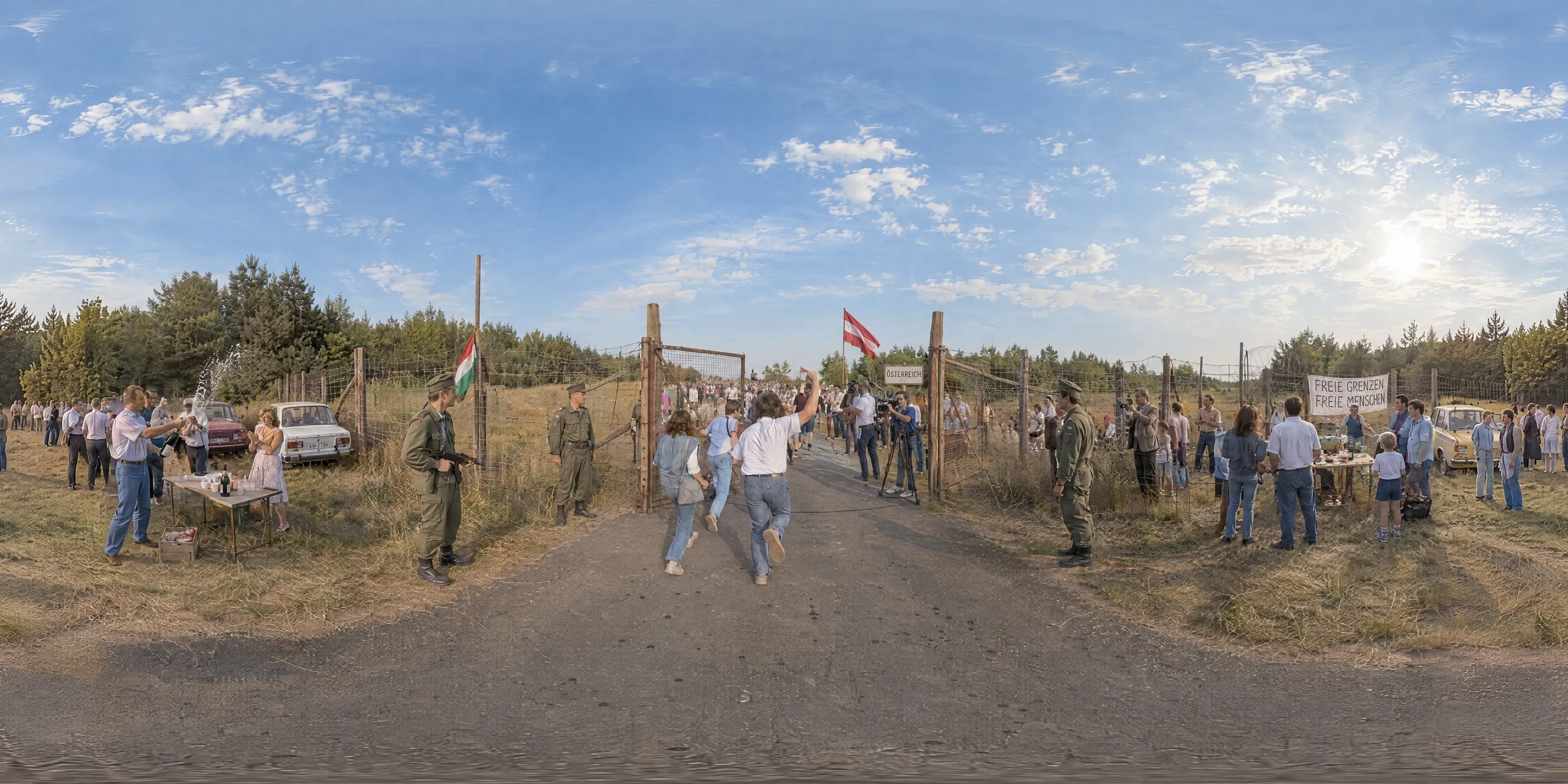
Shortly before three in the afternoon of 19 August 1989, during a 'Pan-European Picnic' on the Austrian border near Sopron, several hundred East Germans push through a rusty, wooden-framed wire gate on the old Pozsony road and run into Austria while the Hungarian border guards stand aside. The largest escape from East Germany since 1961 helped bring down the Berlin Wall less than three months later.
- Year
- 1989
- Where
- Western Transdanubia (Sopron) · HU
- Era
- Contemporary
- Coordinates
- 47.757, 16.622
The moment
A three-hour opening in the Iron Curtain
The plan was symbolic. For three hours on Saturday 19 August 1989, Austria and Hungary agreed to open an old gate on the road from Sankt Margarethen in Burgenland to Sopronkőhida, north of Sopron, during a "Pan-European Picnic".
The picnic was organised by Hungarian opposition parties, among them the Hungarian Democratic Forum and Fidesz, under two patrons: Otto von Habsburg and Imre Pozsgay, the reformist minister of state. On the meadow stood a wooden stage and trestle tables with beer, wine and goulash, under banners showing a dove breaking through barbed wire.
The gate gave way shortly before three
Shortly before three in the afternoon, several hundred East Germans rushed the gate: a rusty wire gate on a wooden frame across the narrow road, still padlocked. They forced it open and ran into Austria, where journalists and an Austrian television crew were waiting.
The four Hungarian border guards on duty stood aside. Their commanding officer, Árpád Bella, did not intervene, and whether a shoot-to-kill order was still in force that day remains disputed. Between 600 and 700 people crossed that day; one count gives 661.
It was the largest escape from East Germany since 1961, the year the Berlin Wall went up. The danger had not passed. During the night of 21 to 22 August a 36-year-old East German, Kurt-Werner Schulz, was killed trying to cross the Austro-Hungarian border.
The fence had been cut in June
Hungary had already begun to take down its part of the Iron Curtain. On 27 June 1989 the foreign ministers Gyula Horn of Hungary and Alois Mock of Austria cut through the border fence together, a symbolic act that announced its dismantling.
Along the road, the old barbed-wire fence had been partly cut away by visitors taking pieces home.
After the picnic, events moved fast. On 11 September Hungary opened its border to East Germans, and some 30,000 left for the West. On 9 November, less than three months after the picnic, the Berlin Wall fell.
Hungary's gift to German unity
Hungarians remember the picnic as their gift to German unity.
On 4 October 1990, the day after reunification, Chancellor Helmut Kohl reminded Germans in Berlin that it was in Hungary that "the first stone was knocked out of the Wall".
The field by the old border is now a memorial park, and the site carries the European Heritage Label. At nearby Fertőrákos stands a stainless-steel sculpture by Gabriela von Habsburg, put up in 1996. The gate itself was a flimsy thing of wire and wood. What went through it that afternoon was not.
Sources
Further reading
Tagged
- hungary
- sopron
- iron-curtain
- pan-european-picnic
- east-germany
- 1989
- cold-war
- border
Published
See also

1989
Karl-Marx-Platz (Augustusplatz), Leipzig
On the evening of 9 October 1989 more than 70,000 people leave the peace prayers in Leipzig's churches and march around the inner ring past armed police and militia, carrying candles and chanting 'Wir sind das Volk' and 'Keine Gewalt'. The security forces hold back, and the peaceful revolution breaks through, a month before the Berlin Wall falls.

2005
Frauenkirche, Dresden
On 30 October 2005 the rebuilt Frauenkirche is consecrated, sixty years after the air raids of February 1945 turned it into a heap of rubble that stood as a memorial against war throughout East German times. Some 60,000 people follow the service on screens on the Neumarkt, beneath a golden cross made by the son of a British bomber pilot.

1955
Upper Belvedere, Vienna
Around noon on Sunday 15 May 1955, just after the State Treaty is signed in the Marble Hall of the Upper Belvedere, Foreign Minister Leopold Figl steps onto the balcony with the Allied foreign ministers and holds up the signed treaty to the crowd waiting in the palace garden. After ten years of occupation, Austria is free.