Voie Sacrée, Souilly
In March 1916, as the Battle of Verdun rages to the north, lorries grind along the one road that keeps the city supplied, on average one every fourteen seconds, carrying fresh troops and shells up and the wounded back. General Pétain directs the defence from Souilly town hall, beside the road Maurice Barrès will call the Voie Sacrée.
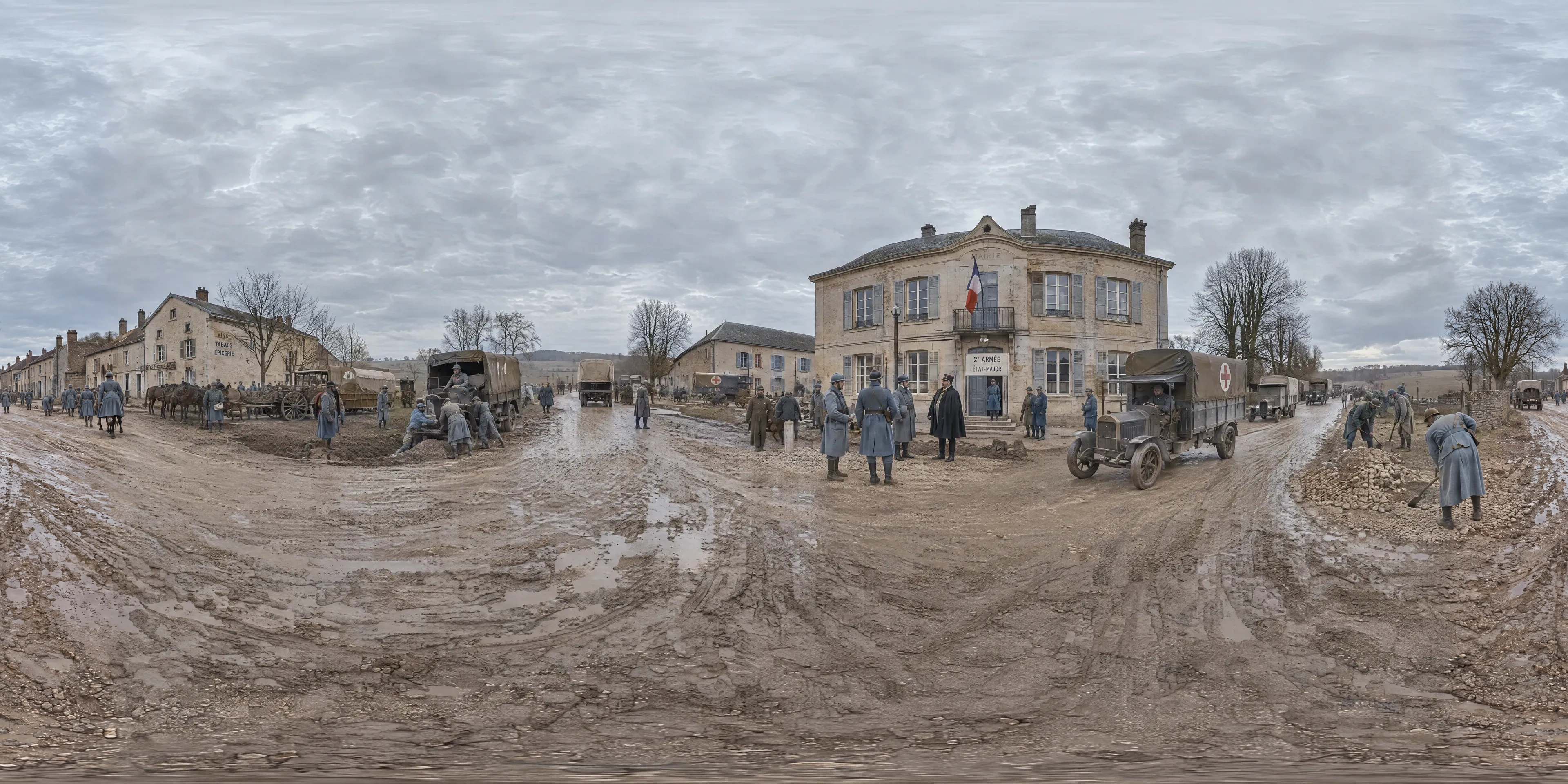
- Year
- 1916
- Where
- Lorraine (Meuse) · FR
- Era
- modern_early
- Coordinates
- 49.028, 5.286
The moment
One lorry every fourteen seconds
The German offensive at Verdun opened on 21 February 1916. The city's railways were cut or under fire, and only one road could carry the men and shells the battle demanded: the departmental road from Bar-le-Duc, 75 km of winding, poorly metalled surface, widened to 7 metres in 1915.
A commission to regulate its traffic was created on 20 February, the eve of the attack, and was ready two days later. Its task was to move 2,000 tonnes of supplies and 15,000 to 20,000 men a day. Only motor vehicles were allowed on the road, and any lorry that broke down and could not be towed was pushed into the ditch.
By 29 February some 3,000 lorries were at work in the sector, besides Paris buses converted to carry fresh meat, and the ambulances. At the height of the battle more than 8,000 vehicles used the road, on average one every fourteen seconds.
The road was rebuilt under the wheels
On 28 February the thaw turned the surface to mud. Commandant Richard noticed that a few centimetres under the fields beside the road lay soft limestone gravel. Quarries were opened along the route, and gangs of territorials, older reservists, stood along the verges shovelling stone under the wheels, so that the lorries themselves served as rollers.
The stone shredded the lorries' solid rubber tyres, and hydraulic presses at Bar-le-Duc and Troyes worked night and day to fit new ones. By the summer of 1916 some 90,000 men and 50,000 tonnes of ammunition and supplies went up the road every week.
Fresh divisions up, worn ones down
The system was the work of Captain Aimé Doumenc, who had devised a strategic reserve of army lorries. In August 1914 the French army had owned just 170 motor vehicles and relied on requisition for the rest.
General Philippe Pétain, who took command of the defence at the end of February and set up his headquarters in the town hall of Souilly, halfway along the road, used it to rotate his regiments quickly, so that the Germans always faced the freshest troops he could send. The French called this rotation the noria, after the endless chain of buckets on a water wheel.
The last 8 km, from the Moulin Brûlé crossroads into Verdun, lay under German artillery fire. The battle lasted until December and cost some 300,000 lives.
Why the road is marked with helmets
Verdun is the central French memory of the First World War, taught in every school. The writer Maurice Barrès named the road the Voie sacrée, after the Via Sacra along which Roman triumphs passed. Today it is marked along its whole length by milestones topped with a soldier's helmet and the letters N VS, for Nationale Voie sacrée, and since 2006 it has been numbered RD 1916, after the year of the battle.
The man in Souilly town hall is a harder memory. Pétain, hailed as the victor of Verdun, went on to lead the collaborationist Vichy regime from 1940. The milestones honour the men who went up the road.
Sources
Further reading
Tagged
- france
- lorraine
- meuse
- verdun
- first-world-war
- voie-sacree
- 20th-century
- logistics
Published
See also

1944
Champs-Élysées, Paris
On the afternoon of 26 August 1944, the day after the German garrison surrendered, General de Gaulle rekindles the flame of the Unknown Soldier at the Arc de Triomphe and walks down the Champs-Élysées ahead of Leclerc and the Resistance leaders, through a crowd estimated at two million. The march seals his authority as head of liberated France.

1939
Lower Wenceslas Square, Prague
On the morning of 15 March 1939, in a heavy fall of wet snow, German columns roll down Wenceslas Square as Hitler's troops occupy what remains of Czechoslovakia. Thousands of Praguers watch from the pavements, weeping, booing and singing the national anthem; that evening Hitler reaches Prague Castle, and the next day he proclaims the Protectorate of Bohemia and Moravia.

1918
Wenceslas Square, Prague
Late in the morning of 28 October 1918, as news spreads that Austria-Hungary has accepted President Wilson's terms, crowds pour onto Wenceslas Square and the priest Isidor Zahradník proclaims an independent Czechoslovak state at the St Wenceslas monument. That evening the National Committee passes the new republic's first law.