Świętojańska Street, Warsaw
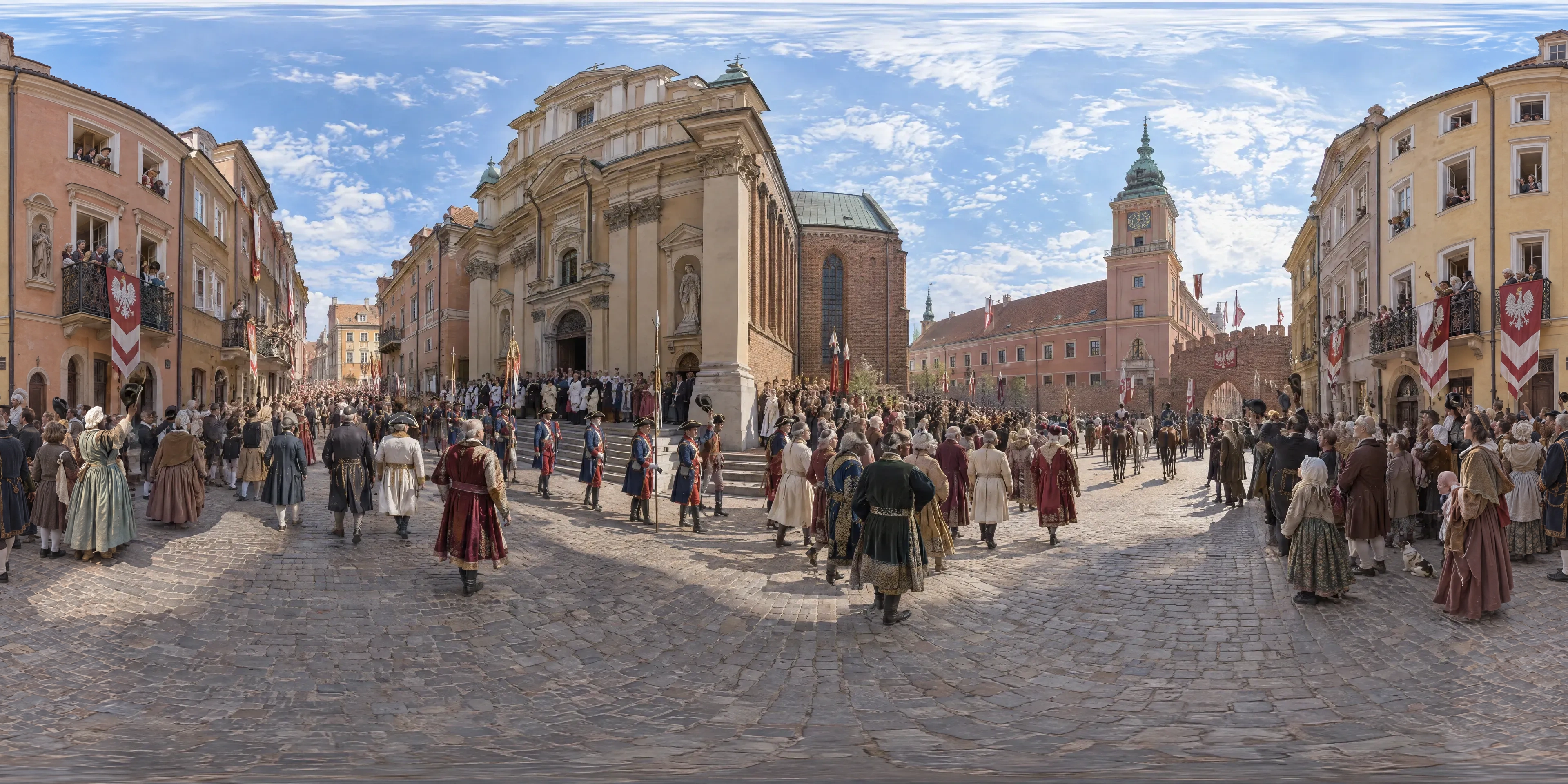
On 3 May 1791, after a stormy seven-hour session in the Royal Castle guarded by troops, the Great Sejm adopts the Government Act, regarded as Europe's first written constitution. Deputies and senators then walk through a cheering crowd along Świętojańska Street to St John's collegiate church to swear it before God.
- Year
- 1791
- Where
- Masovia · PL
- Era
- Early modern
- Coordinates
- 52.248, 21.014
The moment
The vote was timed for the Easter recess
The Great Sejm had been sitting since October 1788. On 3 May 1791, while many opponents of reform were still away for the Easter recess, its leaders brought the Government Act to the floor. The text had been drafted by King Stanisław August Poniatowski with Ignacy Potocki, Hugo Kołłątaj and a few others.
The session in the Royal Castle lasted about seven hours and was stormy. The royal guard, under the king's nephew Prince Józef Poniatowski, stood around the castle to stop any disruption. Only 182 members were present, about half the chamber, and the act passed. Historians have called it something close to a coup.
A short walk to St John's
Then the deputies and senators went to swear the constitution before God. They walked from the castle along Świętojańska Street, the narrow main street of the Old Town, to St John's collegiate church, through a cheering crowd that packed the street and filled the windows and balconies of the tall, narrow burgher houses.
Many wore the Polish national costume: a long żupan under a kontusz with slit sleeves, a sash and a sabre. Others wore French frock coats and powdered hair. At the altar the king repeated the oath. He may have come by the covered passage that linked the castle to the church.
In 1791 St John's was still a collegiate church; it became a cathedral only in 1798. The castle forecourt was not yet an open square either. The Kraków Gate and the city wall closed it off until they were removed in 1818 to 1821.
What the constitution changed
The Government Act abolished the liberum veto, which had let a single deputy break up a session, and turned the elective monarchy into a hereditary one. It separated legislative, executive and judicial power, extended rights to townspeople and placed peasants under the protection of the law, though serfdom remained.
It did not last. Magnates opposed to it formed the Targowica Confederation and invited Russian troops in. In July 1792 the king joined the confederates, and in November 1793 the Grodno Sejm annulled the constitution. In 1795 the Third Partition erased the Commonwealth from the map.
The street is a copy, the date is not
3 May is a national holiday in Poland. It became one in 1919, was pushed aside by the communists after demonstrations in 1946, was abolished in 1951 and returned in 1990. Poles learn that their constitution was the first of its kind in Europe and the second in the world, after that of the United States.
The street itself is a reconstruction. The Old Town was destroyed in 1944, and every façade on Świętojańska was rebuilt after the war. St John's, blown up by the Germans, was rebuilt in the brick Gothic form it was thought to have had in the fourteenth century, not the baroque front it showed in 1791. Stanisław August now lies in its crypt.
Jan Matejko's famous painting of the day includes people who were not there. Even the king's exact route is uncertain.
Sources
Further reading
Tagged
- poland
- warsaw
- masovia
- constitution
- enlightenment
- great-sejm
- royal-castle
- 18th-century
Published
See also

1979
Victory Square, Warsaw
On the afternoon of Saturday 2 June 1979, on his first visit home as pope, John Paul II says Mass for about half a million people on Victory Square in communist Warsaw and prays that the Holy Spirit will renew the face of the earth, adding "this land". The words are remembered as the spark of the Solidarity movement.

1741
Coronation Hill, Pressburg (Bratislava)
Sunday, 25 June 1741: freshly crowned in St Martin's Cathedral, 24-year-old Maria Theresa rides up an earthen mound by the Danube and swings St Stephen's sword to the four corners of the world, vowing to defend Hungary. That September the Hungarian estates, gathered in this city, pledged her 'our life and blood' and saved her throne.

1944
PAST Building, Warsaw
On the morning of 20 August 1944, after a night assault that began at 2:30, Home Army soldiers of the Kiliński Battalion take the PAST telephone exchange, the German stronghold in central Warsaw, setting it ablaze with improvised flamethrowers from fire pumps and capturing over a hundred Germans. The white-and-red flag goes up over the burning tower.