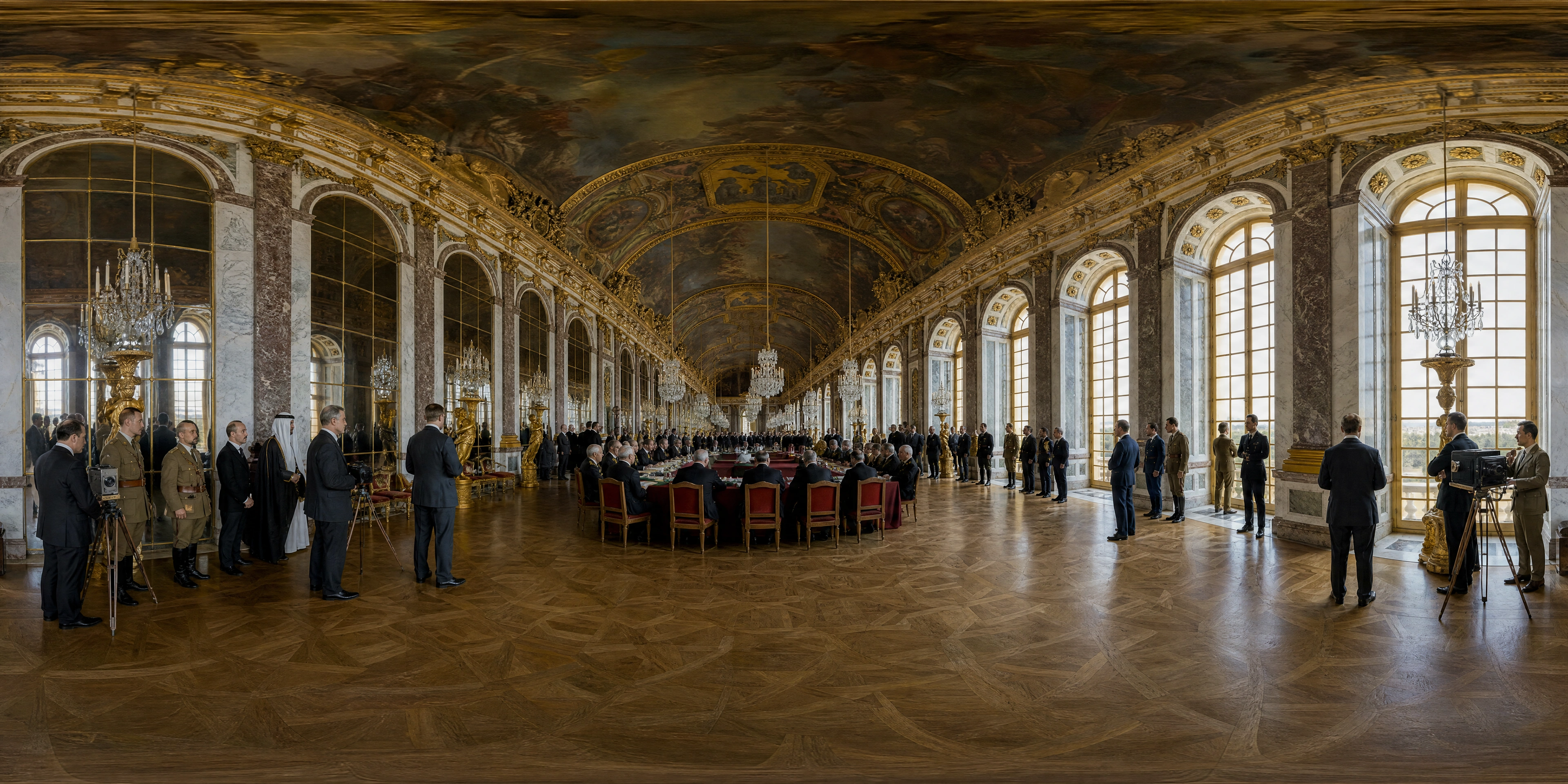
Hall of Mirrors, Palace of Versailles
On June 28, 1919, in the Hall of Mirrors at Versailles, exactly five years after the Sarajevo assassination, German delegates sign the Treaty of Versailles ending the First World War.
- Year
- 1919
- Where
- Versailles, Île-de-France · FR
- Era
- modern_early
- Coordinates
- 48.805, 2.120
The moment
A treaty signed in a hall of mirrors
The Treaty of Versailles was signed on 28 June 1919 in the Galerie des Glaces (the Hall of Mirrors) of the Palace of Versailles outside Paris.
The location was deliberate.
The Hall of Mirrors had been the room where, on 18 January 1871, the new German Empire had been proclaimed by Otto von Bismarck after the French defeat in the Franco-Prussian War. Forty-eight years later, in the same room, the new Weimar Republic was forced to sign the terms ending the First World War.
The French had chosen the venue for the symbolic closure. The signing took 50 minutes. The German delegation, Foreign Minister Hermann Müller and Transport Minister Johannes Bell, was not allowed to speak, only to sign.
The terms that ruined Germany
The treaty imposed punitive financial reparations on Germany, ultimately set at 132 billion gold marks (roughly 33 billion US dollars at 1919 exchange rates, the equivalent of perhaps 442 billion dollars today).
It also forbade Germany from maintaining an army larger than 100 000 men. Prohibited submarines, military aircraft, and conscription. Demilitarised the Rhineland. Transferred substantial territory to Belgium, France, Poland, Denmark, and the newly created Czechoslovakia.
Article 231, the "war guilt clause", required Germany to accept legal responsibility for causing the war. Factually disputable and political poison in Germany.
The economist John Maynard Keynes, who attended the negotiations as a British Treasury delegate, resigned in protest and published The Economic Consequences of the Peace in December 1919:
The peace is outrageous and impossible and can bring nothing but misfortune behind it.
His prediction that the treaty would destabilise Europe and lead to another war within twenty years proved correct.
The Fourteen Points that were not adopted
President Woodrow Wilson had arrived in Paris in January 1919 with his Fourteen Points: a programme of self-determination, open diplomacy, freedom of the seas, free trade, arms reduction, and a new League of Nations.
Most of the Fourteen Points were quietly abandoned during the six months of negotiation.
The British demanded reparations. The French demanded German military dismemberment. The Italians demanded territory. The Japanese demanded Pacific colonies. Wilson got his League of Nations (the first international organisation in modern history) but had to trade away most of his other points to do so.
He returned to the United States in poor health (he had a major stroke in September 1919) and could not convince the US Senate to ratify the treaty. The United States never joined the League of Nations Wilson created.
Five treaties, not one
The "Treaty of Versailles" is technically only one of five treaties signed at the Paris Peace Conference, each dealing with a different defeated power.
Versailles (Germany). Saint-Germain (Austria). Neuilly (Bulgaria). Trianon (Hungary). Sèvres (the Ottoman Empire).
Of the five, only the Versailles treaty involved the major Western powers signing in person. The others were signed in various Parisian suburbs to spread the symbolic weight.
Sèvres, which would have dismembered the Ottoman Empire into Greek, French, British and Italian zones, was rejected by the nascent Turkish Republic and replaced by the Treaty of Lausanne (1923): the first significant rejection of a victors' treaty in modern diplomatic history.
Further reading
Tagged
- france
- versailles
- treaty
- 1919
- ww1
- peace
- hall-of-mirrors
Published
See also

1944
Champs-Élysées, Paris
On the afternoon of 26 August 1944, the day after the German garrison surrendered, General de Gaulle rekindles the flame of the Unknown Soldier at the Arc de Triomphe and walks down the Champs-Élysées ahead of Leclerc and the Resistance leaders, through a crowd estimated at two million. The march seals his authority as head of liberated France.

1944
Omaha Beach, Normandy
At 6:30 a.m. on June 6, 1944, the first waves of American soldiers from the 1st and 29th Infantry Divisions wade ashore at Omaha Beach under heavy German machine-gun fire in the bloodiest landing of D-Day.

1939
Lower Wenceslas Square, Prague
On the morning of 15 March 1939, in a heavy fall of wet snow, German columns roll down Wenceslas Square as Hitler's troops occupy what remains of Czechoslovakia. Thousands of Praguers watch from the pavements, weeping, booing and singing the national anthem; that evening Hitler reaches Prague Castle, and the next day he proclaims the Protectorate of Bohemia and Moravia.