Villa Tugendhat, Brno
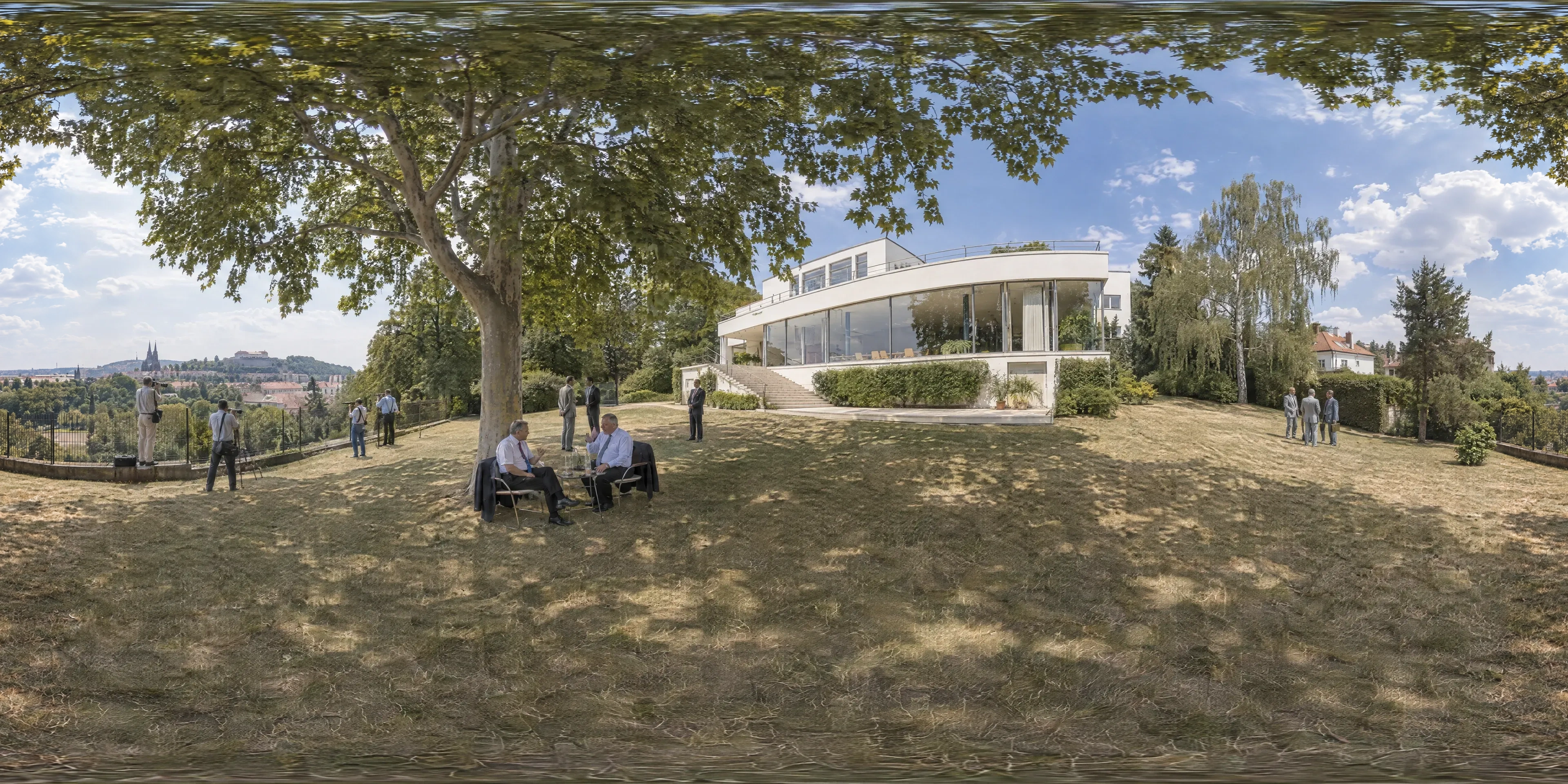
On the hot afternoon of 26 August 1992 the Czech and Slovak prime ministers, Václav Klaus and Vladimír Mečiar, talk for hours in shirtsleeves under a plane tree in the garden of Mies van der Rohe's Villa Tugendhat in Brno. Shortly before midnight they announce that Czechoslovakia will cease to exist on 1 January 1993.
- Year
- 1992
- Where
- Moravia · CZ
- Era
- Contemporary
- Coordinates
- 49.207, 16.616
The moment
Two prime ministers under a plane tree
On the hot afternoon of Wednesday 26 August 1992, a little after three, the Czech prime minister Václav Klaus and the Slovak prime minister Vladimír Mečiar sat down in the garden of Villa Tugendhat in Brno. They took off their jackets and talked for hours in the shade of a massive plane tree.
Journalists were kept out of the grounds. Photographers pressed against the garden fence with long lenses, and the pictures they took became the emblem of the split.
Shortly before midnight the two men announced the result: Czechoslovakia would cease to exist on 1 January 1993.
A house built for the Tugendhats
The villa is one of the great buildings of modern architecture, designed by Ludwig Mies van der Rohe with Lilly Reich and built in 1928 to 1930 for Fritz and Greta Tugendhat, a wealthy Jewish industrialist family.
To the garden it shows a long wall of plate glass on its main living floor, two panes of which could be lowered into the floor, with a flat-roofed upper storey and a broad terrace above. Inside stood a dividing wall of golden-brown onyx from the Atlas Mountains, and the house had early air conditioning.
The family fled in 1938, as Nazi persecution closed in. The Gestapo confiscated the villa in 1939, the Messerschmitt aircraft works later used it, and Soviet troops damaged it in 1945.
A divorce without a referendum
The meeting in the garden settled the future of two nations. The split was agreed by politicians, without a referendum in either republic, and it is still debated in both countries.
It is remembered as the velvet divorce, a peaceful separation. Slovakia shares the moment: the same agreement that created the Czech Republic created an independent Slovakia.
From the garden, the view the negotiators had over Brno takes in the red roofs of the city, the greenery of Lužánky park, the castle of Špilberk and the twin spires of the cathedral on Petrov.
Why 1 January is a Czech holiday
The independent Czech Republic was born on 1 January 1993, and the day is a state holiday. For many Czechs its founding image is still two men in shirtsleeves under a tree in Brno, photographed through a garden fence.
The villa itself has been restored and opened. It became a museum in 1994, a UNESCO World Heritage Site in 2001, and it went through a major restoration from 2010 to 2012.
In 1992 its finishes still reflected a restoration of the 1980s, and exactly where the tree stood and who else was in the garden that afternoon are not fully documented. The heat, the plane tree, the jackets and the midnight announcement are.
Sources
Further reading
Tagged
- czechia
- moravia
- brno
- villa-tugendhat
- dissolution-of-czechoslovakia
- velvet-divorce
- modernism
- 1992
Published
See also

2012
Olympic Stadium, London
At about 9.25 pm on 27 July 2012, in Danny Boyle's 'Isles of Wonder' ceremony, five glowing rings forged in a staged industrial revolution rise over the Olympic Stadium in Stratford and rain sparks. Watched by some 900 million people, it opens the Games many Britons remember as a high point of national pride.

2005
Frauenkirche, Dresden
On 30 October 2005 the rebuilt Frauenkirche is consecrated, sixty years after the air raids of February 1945 turned it into a heap of rubble that stood as a memorial against war throughout East German times. Some 60,000 people follow the service on screens on the Neumarkt, beneath a golden cross made by the son of a British bomber pilot.

1939
Lower Wenceslas Square, Prague
On the morning of 15 March 1939, in a heavy fall of wet snow, German columns roll down Wenceslas Square as Hitler's troops occupy what remains of Czechoslovakia. Thousands of Praguers watch from the pavements, weeping, booing and singing the national anthem; that evening Hitler reaches Prague Castle, and the next day he proclaims the Protectorate of Bohemia and Moravia.