Royal Palace of Visegrád
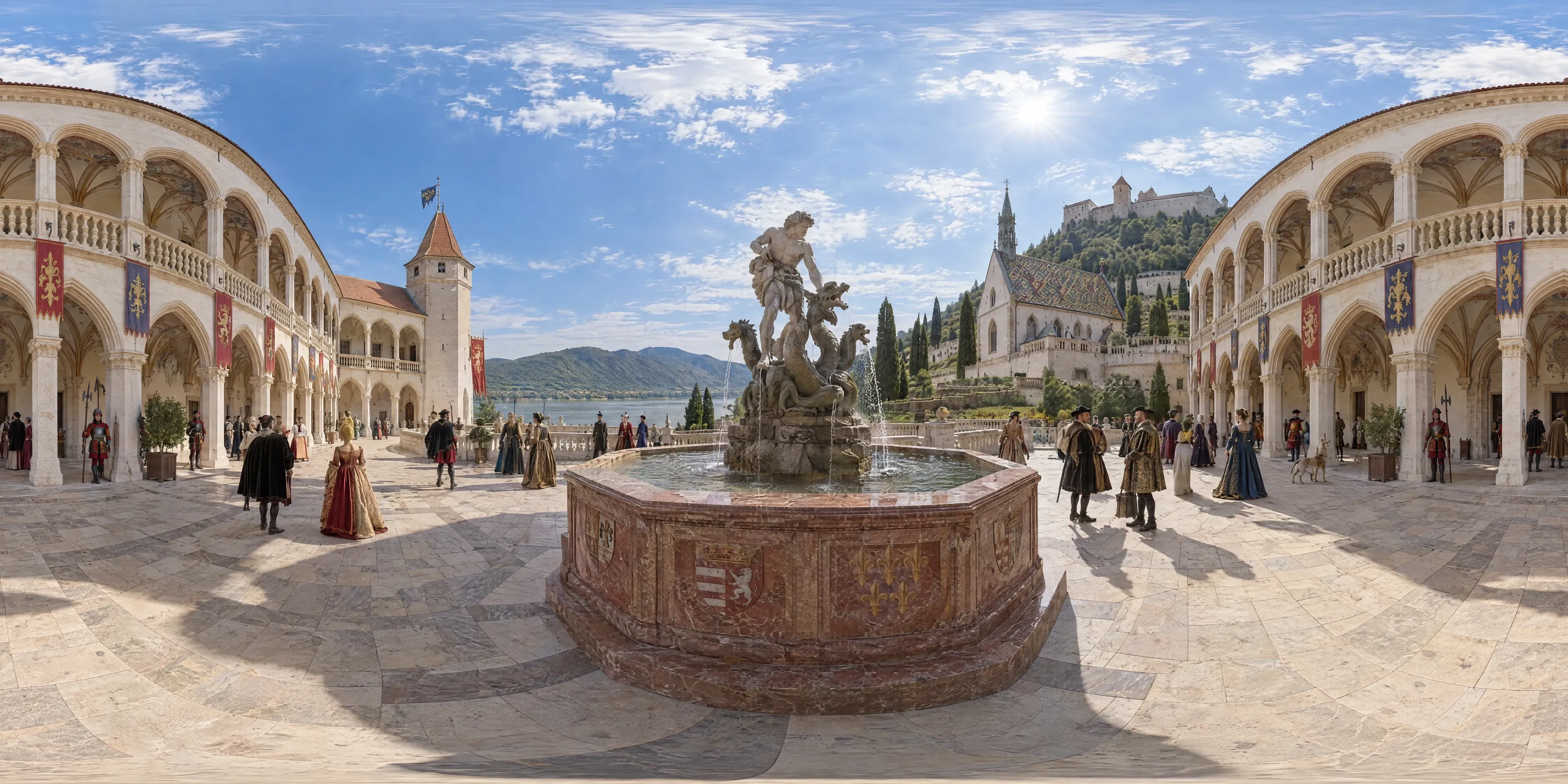
In 1484 King Matthias Corvinus finishes rebuilding the royal palace at Visegrád: its court of honour gains arcades with a Renaissance balustrade around a red-marble fountain of the infant Hercules fighting the Hydra, among the first works of the Italian Renaissance north of the Alps. On the ridge above, the citadel guards the Holy Crown.
- Year
- 1484
- Where
- Danube Bend · HU
- Era
- Renaissance
- Coordinates
- 47.792, 18.974
The moment
A royal seat since the 1320s
By 1484 the palace at Visegrád was already old. Charles I, the first Hungarian king of the Anjou line, moved the royal seat here in the 1320s, to the right bank of the Danube where the river bends between wooded hills.
In 1335 he hosted a congress of kings. John of Luxembourg, king of Bohemia, and Casimir III of Poland came to Visegrád, and the three made peace between their kingdoms and an alliance of Poland and Hungary against Habsburg Austria.
King Matthias Corvinus rebuilt the palace from the later 1470s, and by 1484 the work was done. The complex filled a square of 123 by 123 metres, with a Franciscan friary against its southern side.
Hercules in red marble
At the centre of the court of honour stood a new fountain. Its octagonal basin of red marble, carved with Matthias's coats of arms, was crowned by the infant Hercules wrestling the many-headed Hydra. It is dated to 1484 and attributed to Giovanni Dalmata, a sculptor from Trogir who had made his name in Rome.
Around the court ran a two-storey arcade, with late Gothic vaults on the ground floor and, above, an open gallery behind a balustrade of turned balusters in the new Italian manner. Fountain and gallery are among the earliest works of the Italian Renaissance north of the Alps.
The rest of the setting matched. The chapel roof glinted with coloured glazed tiles, and gardens climbed the hillside in terraces. On the ridge above stood the citadel, where the Holy Crown and the royal insignia were kept from the fourteenth century until 1526. Lower down, towards the river, rose the hexagonal Solomon Tower.
Buried until 1934
The palace did not survive the Ottoman wars. It was abandoned after the Ottoman conquest of 1544, the year half of the Solomon Tower collapsed, and by the eighteenth century the ruins lay completely buried under earth.
In 1934 János Schulek found them again, and excavation has continued ever since. Fragments of the Hercules fountain came to light in 1941, and more pieces turned up in the decades that followed.
Today's court is partly reconstruction. A working copy of the fountain, completed in 2000, stands in it, and the original fragments are kept at the palace.
Six centuries later, the Visegrád Group
For Hungarians, Visegrád belongs to King Matthias, remembered as "the Just" and still the country's best-loved ruler. His palace and its Hercules fountain are the showpiece of the Hungarian Renaissance and a fixture of school trips to the Danube Bend.
The congress of 1335 has a modern echo. In February 1991 the leaders of Hungary, Czechoslovakia and Poland met at Visegrád and set up a regular forum, the Visegrád Group, in the town where three kings had met six and a half centuries earlier.
Sources
Further reading
Tagged
- hungary
- visegrad
- matthias-corvinus
- renaissance
- palace
- danube-bend
- holy-crown
- everyday-life
Published
See also

1410
Old Town Square, Prague
On 9 October 1410 the Old Town councillors reward the clockmaker Mikuláš of Kadaň for the astronomical dial he has built on the town hall tower, the heart of today's Prague orloj. Below it the market square trades as usual in the year Wycliffe's books are burned in Prague and Jan Hus is excommunicated.

1539
Château de Chambord
On 18 December 1539 Francis I receives his old rival, Emperor Charles V, at Chambord, the vast hunting castle whose keep, bristling with chimneys, lanterns and dormers, has just been finished in the marshes of Sologne. The emperor, crossing France on his way to Ghent, is said to be dazzled; the visit shows off the French Renaissance at its most ambitious.

1500
Golden Roof, Innsbruck
In 1500 King Maximilian I, who often holds court in Innsbruck, completes a splendid oriel on the princely residence, roofed with 2,657 fire-gilded copper shingles. From its loggia, the Golden Roof, he and his court watch tournaments and performances in the square below.