Vítkov Hill, Prague
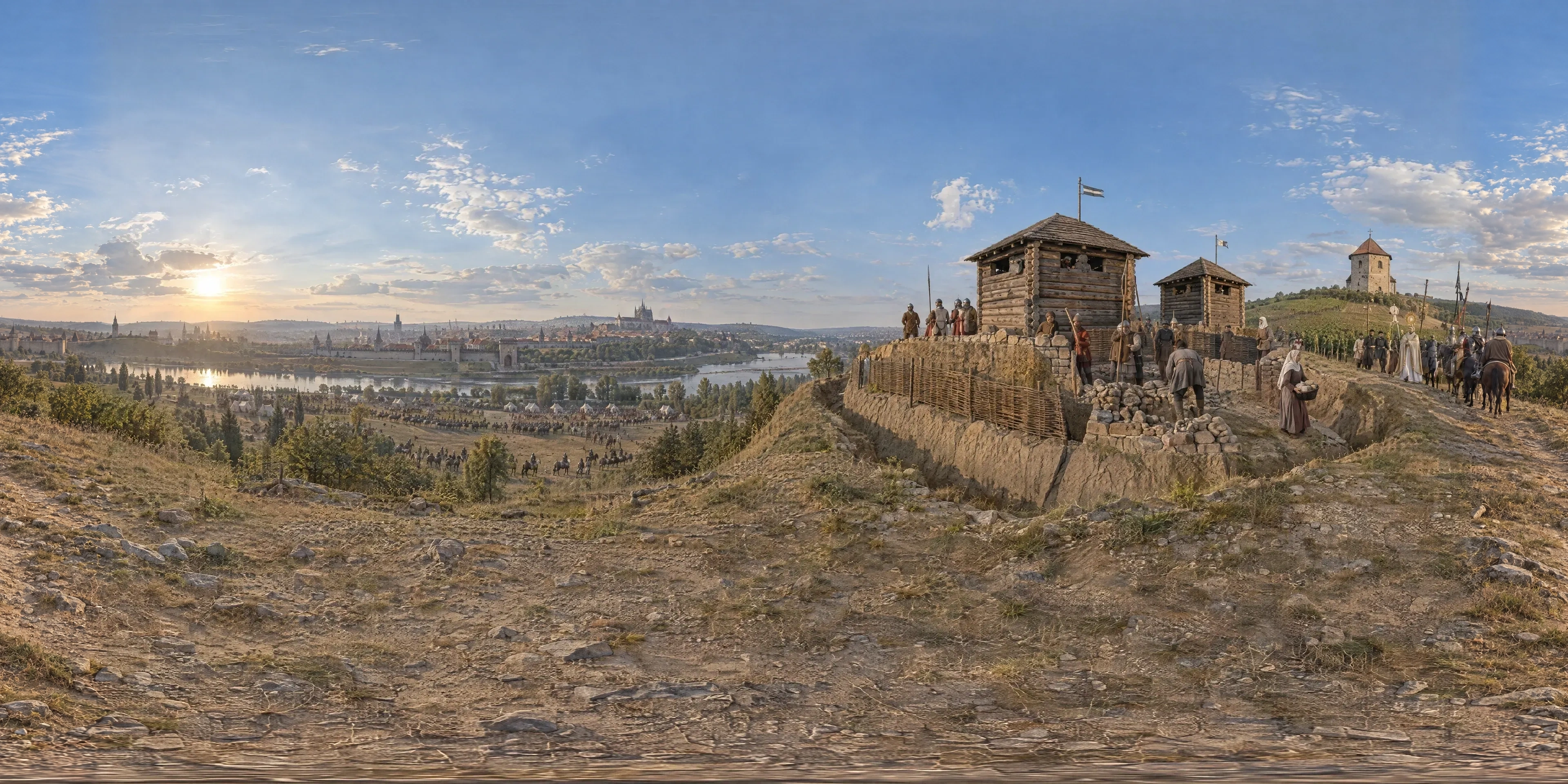
On the evening of 14 July 1420 a handful of Hussites under Jan Žižka hold two timber blockhouses on Vítkov against Meissen and Austrian knights of King Sigismund's crusade, until Prague gunners and flail-men led by a priest with the Eucharist storm up the slope and drive the attackers off the cliffs.
- Year
- 1420
- Where
- Bohemia · CZ
- Era
- Renaissance
- Coordinates
- 50.089, 14.449
The moment
Twenty-nine defenders on a ridge
In the summer of 1420 King Sigismund brought his crusade against the Hussites to the walls of Prague. His army camped on the Letná plain across the Vltava, and Sigismund watched from there.
East of the New Town walls, the Hussites under Jan Žižka held the narrow ridge of Vítkov. They had built two timber blockhouses behind three shallow ditches and a low wall of earth and stone.
By the traditional count, twenty-nine people held them: twenty-six men, two women and a girl.
An hour before sunset
On 14 July, about an hour before sunset, Meissen and Austrian horsemen advanced along the ridge from the east. Where it pinches into a neck only a few metres wide, the knights could not bring their numbers to bear.
The defenders held until help came. About fifty Prague gunners with handguns, and peasants with iron-shod flails, climbed the slope from the Mountain Gate behind a priest holding up the Eucharist in a monstrance, and struck the knights in the flank.
Caught between the sortie and the cliffs on the north side, the attackers broke. Some were driven over the rocks toward the Hospital Field, many drowned in the Vltava, and estimates of their dead run from 144 to 500.
The hour, the numbers and the priest are known from the chronicler Vavřinec of Březová and from a letter written on the losing side, by the margrave of Meissen.
A crown, then a retreat
The defeat did not end the war, but it ended the crusade. On 28 July 1420 Sigismund had himself crowned King of Bohemia in St Vitus Cathedral, in the castle his garrison still held.
Two days later his crusading army broke up. He had the crown; the Hussites kept Prague.
How a skirmish became a legend
By the standards of the wars that followed, Vítkov was a small fight. It made Jan Žižka, the one-eyed general, a national legend, and he still ranks in the top five of the Greatest Czech poll.
The name stuck to the place: the district on the hill's slopes is Žižkov. In the 1930s the National Memorial was built on the summit, destroying the original terrain, so the exact site of the blockhouses is lost. In front of it stands Bohumil Kafka's bronze Žižka on horseback, nine metres high and weighing 16.5 tonnes, cast by 1941 and unveiled on the battle's anniversary, 14 July 1950.
The memory has been claimed by everyone. Catholic and Protestant traditions read the Hussites very differently, and the communist regime idealised them. The facts on the ridge are simpler: a handful of defenders and a sortie from the city held a hill against mounted knights, and Prague did not fall.
Sources
Further reading
Tagged
- czechia
- prague
- bohemia
- hussites
- jan-zizka
- battle
- crusade
- medieval
Published
See also

1410
Old Town Square, Prague
On 9 October 1410 the Old Town councillors reward the clockmaker Mikuláš of Kadaň for the astronomical dial he has built on the town hall tower, the heart of today's Prague orloj. Below it the market square trades as usual in the year Wycliffe's books are burned in Prague and Jan Hus is excommunicated.

1357
Charles Bridge, Prague
In 1357 Emperor Charles IV lays the foundation stone of a new stone bridge on the Old Town bank near St Clement's, fifteen years after ice and floodwater wrecked the Judith Bridge. Tradition sets the moment at 5:31 on 9 July, a palindrome of odd numbers; the bridge will take 45 years to finish.

1410
Grunwald Battlefield
On the hot morning of 15 July 1410 the armies of King Władysław Jagiełło and Grand Duke Vytautas wait at the edge of the woods facing the Teutonic Order across the fields of Grunwald, until two heralds ride over with two naked swords from Grand Master Ulrich von Jungingen, a taunt to come out and fight. By evening the Order's army is broken and its Grand Master dead.