Celtic Oppidum of Závist
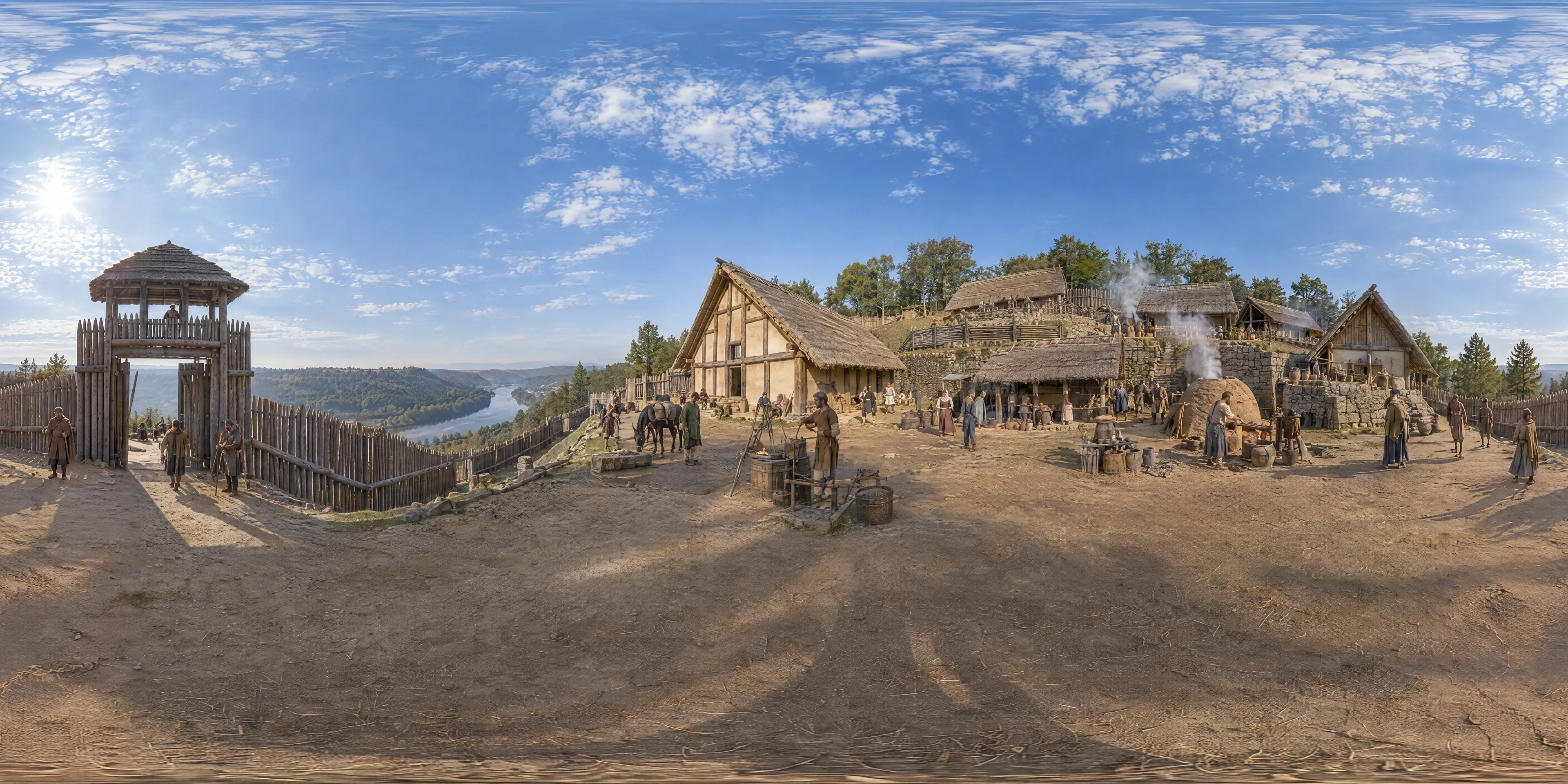
Around 100 BC the Celts of Závist, traditionally identified with the Boii who gave Bohemia its name, live in the largest Celtic oppidum in today's Czechia. Timber-laced stone ramparts ring a sacred acropolis and workshops that make blanks for coins, high above the Vltava.
- Year
- 1st century BC
- Where
- Bohemia · CZ
- Era
- Classical antiquity
- Coordinates
- 49.962, 14.408
The moment
The largest Celtic town in Czechia
Around 100 BC the largest Celtic oppidum in what is now the Czech Republic stood on Hradiště hill, 391 metres high, on the right bank of the Vltava opposite its confluence with the Berounka. Downstream, where Prague would one day rise, the river bend was still empty ground.
The oppidum of Závist was founded around the middle of the second century BC. Its ramparts ran for some nine kilometres and enclosed nearly 200 hectares, and about a thousand people lived inside, in terraces of houses, workshops and hearths stepping down from the summit.
A wall of stone, earth and timber
The defences were built in the Celtic manner. A front wall of dry-laid stone was tied into an earth bank with horizontal timbers and crowned by a wooden palisade, with a flat-bottomed ditch about six metres wide outside.
The main entrance, which archaeologists call gate D, was a pincer gate, its rampart ends turned inward to form a long defended passage. Its timber gate tower rose up to twelve metres above the deep Břežany valley.
At the top stood the acropolis. Its largest palisaded courtyard covered about 5,700 square metres and held four or five timber houses on regularly spaced posts. The summit had been sacred long before the oppidum: in the Late Hallstatt and Early La Tène periods it carried a sanctuary about 30 by 27 metres, built around a post structure of 18 by 9 metres.
Money was made on the hill
Závist was a working town. Excavation has found smithies, potters' kilns and the traces of coin-blank production: small cast pieces of metal, ready to be struck into coins.
Most of what is known comes from twenty-six years of digging, led by Libuše Jansová from 1963 and by Karla Motyková-Šneidrová from 1973, until the work ended in the summer of 1989. That year the site was declared a national cultural monument. The rampart, the gate, the courtyard and the terraces are excavated fact; the look of the houses and the pitch of their roofs are reconstruction.
The end was fire. After the middle of the first century BC the rampart burned, gate D was never rebuilt, and the hill emptied.
Why the country is called Bohemia
Roman writers called this land Boiohaemum. The earliest mention is in Tacitus's Germania, written at the end of the first century AD, and the name seems to join the tribe of the Boii to a Germanic word for "home". It survives in the English Bohemia and the German Böhmen.
That is why Czech pupils meet the Celts so early. The Czech name, Čechy, comes from the Slavs who settled here in the sixth or seventh century, but the name the rest of the world uses remembers the people of the oppida.
Whether those people were the Boii is less certain than the schoolbooks suggest. The seventeenth-century historian Bohuslav Balbín already linked Závist to the tribe, and the connection is still the textbook view, but some archaeologists dispute it. The Roman name, at least, is secure.
Sources
Further reading
Tagged
- czechia
- bohemia
- prague
- celts
- boii
- oppidum
- iron-age
- la-tene
Published
See also

1357
Charles Bridge, Prague
In 1357 Emperor Charles IV lays the foundation stone of a new stone bridge on the Old Town bank near St Clement's, fifteen years after ice and floodwater wrecked the Judith Bridge. Tradition sets the moment at 5:31 on 9 July, a palindrome of odd numbers; the bridge will take 45 years to finish.

960s
Malá Strana below Prague Castle
Around 965 the traveller Ibrahim ibn Yaqub finds Prague the richest trading place of the region: Rus and Slav merchants from Kraków and Muslim and Jewish traders from the east meet in the settlement below the Přemyslid castle, where saddles, bridles and shields are made and slaves, tin and furs are sold.

1945
Czech Radio Building, Vinohradská, Prague
On Saturday 5 May 1945 the Prague Uprising breaks out at the radio building on Vinohradská: at 12:15 the staff hoist the Czechoslovak and American flags, the station broadcasts desperate calls for help, and at six in the evening the SS inside surrender. That night about 100,000 Praguers raise some 1,600 barricades across the city.