Square of Work, Zlín
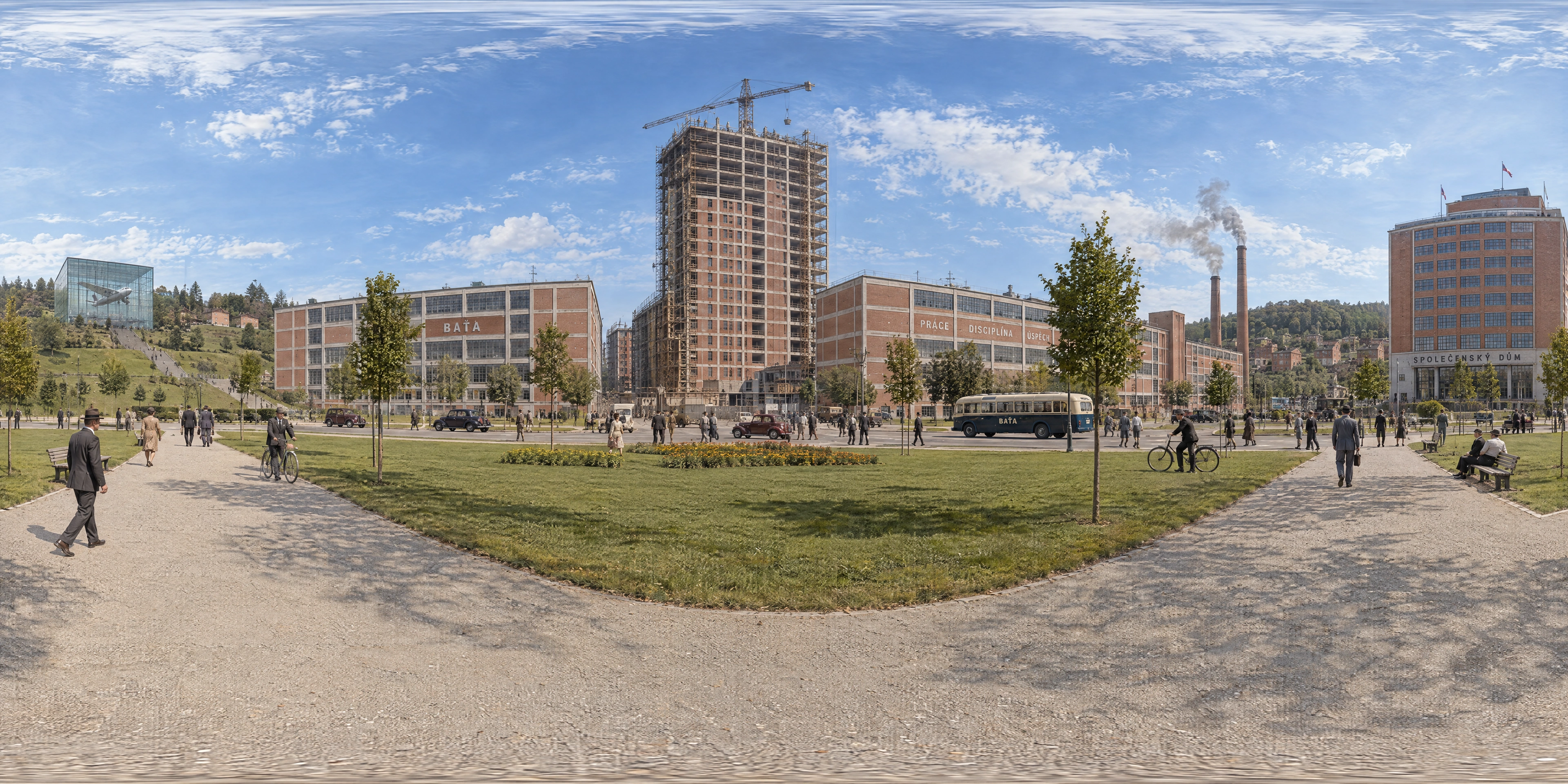
On 16 September 1937 the concrete frame of the Baťa company's new headquarters reaches its sixteenth floor above Zlín: at 77.5 m it is the second-tallest modern building in Europe. Around it stands the factory town the shoe empire built in brick, concrete and glass, the showcase of interwar Czechoslovakia.
- Year
- 1937
- Where
- Moravia · CZ
- Era
- modern_early
- Coordinates
- 49.222, 17.660
The moment
Sixteen floors in a year
Work on the new headquarters of the Baťa shoe company in Zlín began on 14 September 1936. By 16 September 1937 the bare reinforced-concrete frame had reached its sixteenth floor: 77.5 metres high, 80 metres long and 20 wide.
Building 21, as it is known, was designed by Vladimír Karfík. It was built on the company's standard grid of 6.15 metres, the same module used for the factory blocks around it.
Czech sources call it the second-tallest building in Europe when it was finished. Other reckonings place it third among Europe's pre-war skyscrapers, after the Telefónica building in Madrid and the Boerentoren in Antwerp.
An office that went up and down
The building was full of new ideas. Each floor had its own heating and air-conditioning controls, independent of the rest.
Its best-known feature was the director's office: a 6 by 6 metre room inside a lift, air-conditioned, with a telephone, a washbasin and its own alarm, able to move from floor to floor. By the time it was ready, during the Second World War, the director it was built for had left the country.
A town built by a shoe company
Zlín was the company's creation. Tomáš Baťa and his siblings founded the firm in 1894; Tomáš was elected mayor in 1923, and by then Baťa was the leading footwear maker in Czechoslovakia.
The town grew to a plan by František Lydie Gahura. Around the Square of Work stood rows of identical factory blocks of red brick set in concrete frames, with large steel windows.
On the hills rose streets of small red-brick workers' houses. Across the square stood the eleven-storey Community House hotel of 1932, and above it the glass memorial to Tomáš Baťa, completed in 1933, which held the Junkers aircraft in which he had died.
Why the skyscraper is a portrait of the First Republic
Tomáš Baťa is one of the most frequently named figures when Czechs are asked about great compatriots. His Zlín, modern, industrial and planned down to the grid, is the built image of the First Republic, the era Czechs rank second only to that of Charles IV.
The story did not end well for the firm at home. The company was nationalised in October 1945, and from 1949 to 1989 the Communists renamed the town Gottwaldov, after the communist president Klement Gottwald; it became Zlín again on 1 January 1990.
The paternalist Baťa system and the family's exile are still read differently across Czech politics. The skyscraper, restored in 2004, now houses the offices of the Zlín Region and the tax office, sixteen floors on a 6.15-metre grid.
Sources
Further reading
Tagged
- czechia
- moravia
- zlin
- bata
- functionalism
- first-republic
- industry
- everyday-life
Published
See also

1918
Wenceslas Square, Prague
Late in the morning of 28 October 1918, as news spreads that Austria-Hungary has accepted President Wilson's terms, crowds pour onto Wenceslas Square and the priest Isidor Zahradník proclaims an independent Czechoslovak state at the St Wenceslas monument. That evening the National Committee passes the new republic's first law.

1939
Lower Wenceslas Square, Prague
On the morning of 15 March 1939, in a heavy fall of wet snow, German columns roll down Wenceslas Square as Hitler's troops occupy what remains of Czechoslovakia. Thousands of Praguers watch from the pavements, weeping, booing and singing the national anthem; that evening Hitler reaches Prague Castle, and the next day he proclaims the Protectorate of Bohemia and Moravia.

1839
Gräfenberg Spa, Jeseník
In 1839 some 1,500 patients, among them a monarch, 22 princes and 149 counts and countesses, climb to Gräfenberg in the Jeseníky mountains of Austrian Silesia to take the cold-water cure of Vincenz Priessnitz, a self-taught farmer whose spa is the first hydrotherapy resort in the world; 120 doctors come to study his methods.