Žuráň Hill, Battlefield of Austerlitz
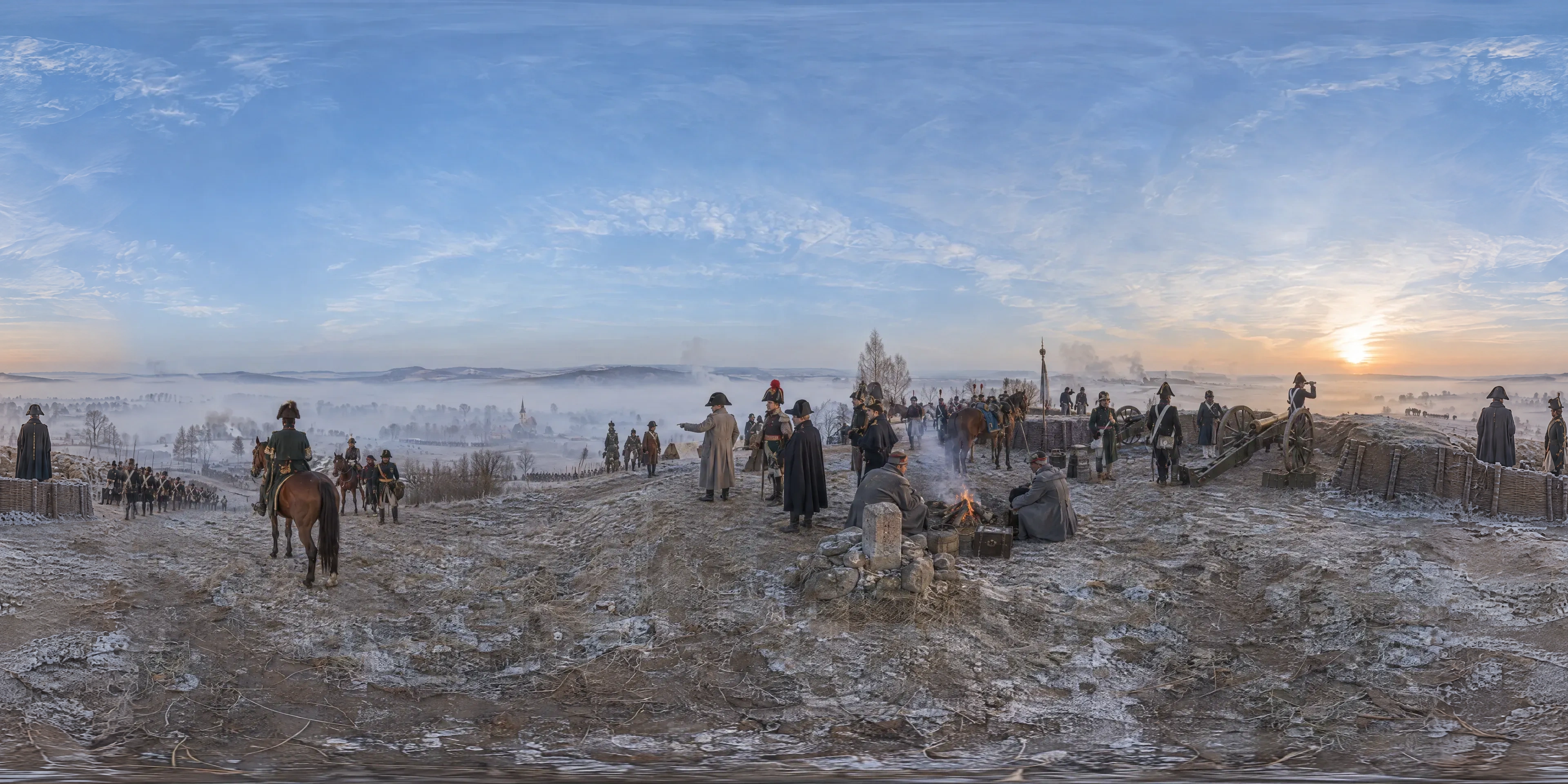
At half past seven on 2 December 1805 a red sun breaks through the fog over Slavkov (Austerlitz), and Napoleon on Žuráň hill sends Soult's divisions up the Pratzen Heights against the Russian and Austrian armies. By afternoon the Battle of the Three Emperors is his greatest victory, fought in the fields east of Brno.
- Year
- 1805
- Where
- Moravia · CZ
- Era
- Industrial
- Coordinates
- 49.180, 16.738
The moment
The fog lifted at the right moment
At half past seven on the morning of 2 December 1805, the sun rose red over Slavkov, the little Moravian town the French called Austerlitz. Thick white fog still filled the valley of the Goldbach below the long, bare ridge of the Pratzen Heights.
Out of that fog came the attack that decided the day. French columns climbed toward the heights as the mist burned off around them, and the "sun of Austerlitz" that tore it apart became a legend of its own.
The timings, the positions, the red sunrise and the fog are all recorded; only the exact spot where the staff stood on the hill is approximate.
A command post on an ancient mound
Napoleon watched from Žuráň, a low hill topped by an ancient burial mound beside the imperial road from Brno to Olomouc. Around him stood his marshals and staff, with the mounted chasseurs of the Guard.
To his left, French guns were dug into the slope of the fortified Santon hill. To his right, the villages toward Sokolnice and Telnice lay half drowned in mist.
Ahead, across the valley, Russian columns in dark green and Austrian troops in white coats were moving south along the ridge. Behind the emperor, open fields fell away west toward Brno.
One sharp blow
"One sharp blow and the war is over," Napoleon is reported to have said before he ordered the assault. Marshal Soult's IV Corps went up the Pratzen with the divisions of Saint-Hilaire and Vandamme, into the centre of the allied line.
It was called the Battle of the Three Emperors, because Napoleon, Tsar Alexander I and Emperor Francis II were all on the field. About 72,000 French with 157 guns faced some 85,000 allied troops, most of them Russian, with 318 guns.
By afternoon it was Napoleon's greatest victory. The French lost about 9,000 men; allied losses ran to between 27,000 and 36,000, including 12,000 to 20,000 taken prisoner.
The most famous battle on Czech soil
Austerlitz was fought in the rolling farmland east of Brno, and no battle on Czech soil is better known. It is taught in every Czech history course, and every winter it is re-enacted near Slavkov before thousands of spectators, by some 1,800 re-enactors from 20 countries.
Its consequences reached across Europe. The Treaty of Pressburg, signed in today's Bratislava on 26 December 1805, ended the War of the Third Coalition, and in 1806 Francis II dissolved the Holy Roman Empire.
The landscape now carries its memorials. A monument called the Cairn of Peace crowns the Pratzen, and Žuráň has its own memorial on the hilltop where the staff once stood.
Sources
Further reading
Tagged
- czechia
- moravia
- napoleon
- austerlitz
- battle
- napoleonic-wars
- slavkov
- 19th-century
Published
See also

1839
Gräfenberg Spa, Jeseník
In 1839 some 1,500 patients, among them a monarch, 22 princes and 149 counts and countesses, climb to Gräfenberg in the Jeseníky mountains of Austrian Silesia to take the cold-water cure of Vincenz Priessnitz, a self-taught farmer whose spa is the first hydrotherapy resort in the world; 120 doctors come to study his methods.

1869
Court Opera on the Ringstraße, Vienna
On the evening of 25 May 1869 Emperor Franz Joseph opens the new Court Opera, the first great public building on Vienna's Ringstraße, with Mozart's Don Giovanni sung in German. Neither of its architects lives to see the night: both died in 1868, after Viennese mockery of the 'sunken box'.

1897
Giant Ferris Wheel, Prater, Vienna
On 3 July 1897, a hot summer day, Vienna's Giant Ferris Wheel opens in the Prater, built by English engineers for the jubilee of Emperor Franz Joseph's 50 years on the throne. Its 30 cabins turn up to 64.75 m above the canals of the 'Venice in Vienna' pleasure park, making it one of the largest wheels in the world; a ride costs a gulden.